
The conversation about Chinese manufacturing has changed — but most of the articles written about it haven’t.
If you search “why buy Chinese OEM tools,” you’ll find two types of content: factory websites talking about their own quality, and sourcing guides written by people who’ve never been inside a production floor. Neither gives you a straight answer about what’s actually happening in the market.
Here’s the straight answer: European and Australian retailers — including some very well-known hardware chains — have been quietly shifting their private label power tools to Chinese OEM manufacturers for years. Not because it’s the only option. Because, when done right, it’s the best option.
I’ve been running export business from a cordless tool factory in Wuxi for fifteen years. I’ve seen this shift happen gradually, then quickly. This is what’s actually driving it.
The “Made in China Means Cheap” Assumption Is About 10 Years Outdated
Let me put some numbers on this first.
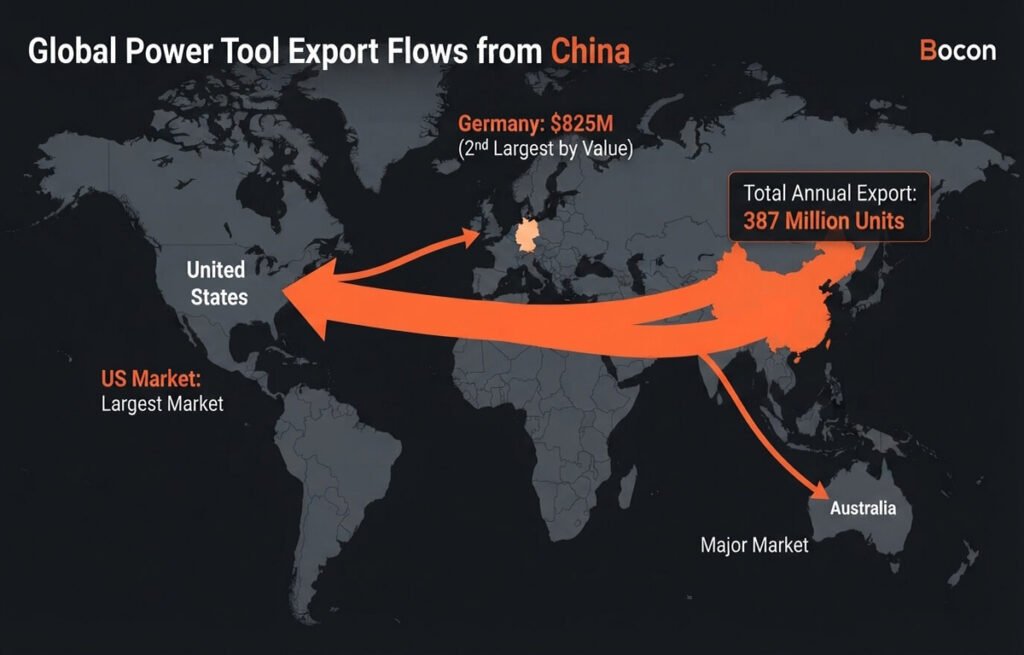
China produces approximately 543 million power tool units per year and exports around 387 million of them. Germany alone imports $825 million worth of Chinese power tools annually, growing at 6.5% per year in value terms over the past decade. That’s not a market being served by cheap tools. That’s a market being served by tools good enough that Germany — one of the most quality-conscious tool markets in the world — keeps ordering more of them.
The transformation in Chinese manufacturing quality isn’t something factories talk about themselves (obviously). But here’s what shows it:
The TTI story. Techtronic Industries — the Hong Kong-headquartered company that makes Milwaukee, Ryobi, and AEG — manufactures the vast majority of those products in China. Milwaukee is the benchmark professional cordless platform globally. Nobody calls Milwaukee “cheap Chinese tools.” They call it the gold standard for tradespeople. TTI makes it. In China.
The Ozito story. Bunnings’ private label brand Ozito — sold exclusively through Australia’s largest hardware chain — is manufactured in China. It holds a massive share of the Australian entry-to-mid-range cordless market. Bunnings built that brand intentionally on Chinese OEM manufacturing, and it’s worked.
The OBI/KANGTON story. KANGTON Industry, a Chinese OEM factory, supplies private label tools to major European hardware chains including OBI. When a German DIY giant trusts a Chinese factory with its branded product, that’s not a cost-cutting experiment — that’s a calculated strategic partnership.
The question stopped being “can Chinese OEM factories make acceptable tools?” a long time ago. The question is now “how do you identify the Chinese OEM factories that make genuinely good tools?”
What’s Actually Changed in Chinese Manufacturing (2015–2025)
If you last evaluated Chinese tool manufacturing 10 years ago, you’re working with outdated data.
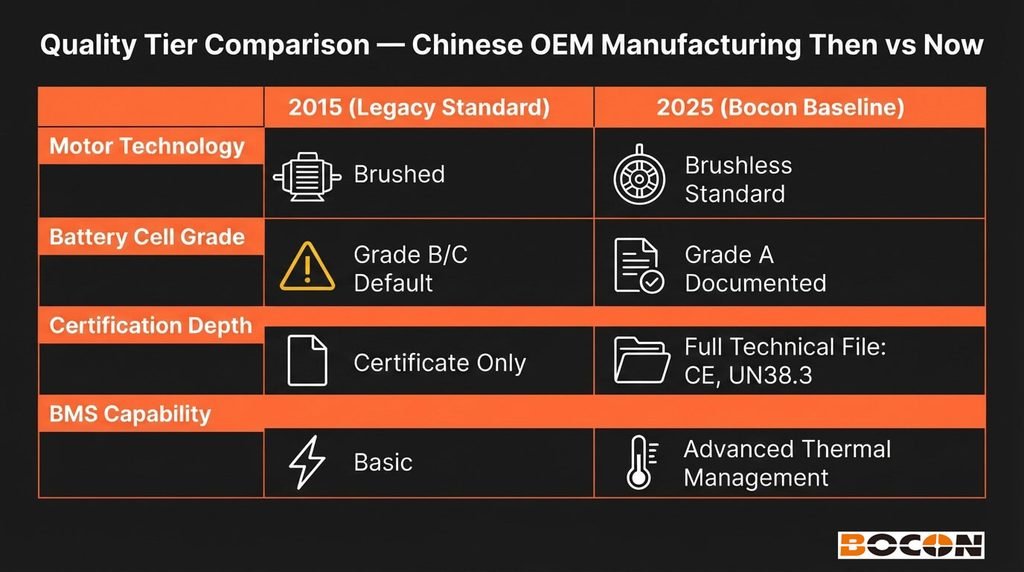
Brushless motor became the standard, not the premium
In 2014, brushless cordless tools from Chinese factories were expensive to produce and only offered by a handful of manufacturers. Most Chinese OEM factories were brushed-only.
That’s completely reversed. Today, any serious Chinese OEM factory targeting European or Australian export markets runs brushless across their product line. The motor technology that Milwaukee and DeWalt used to differentiate on is now table stakes for mid-tier Chinese OEM output.
Brushless motors matter beyond the spec sheet: they eliminate the main failure mode that gave Chinese tools a reputation for short lifespan. Brushed motors wear carbon contacts, generate dust contamination, and fail under sustained professional use. Brushless motors don’t have this failure mode. The lifespan gap between cheap brushed tools and quality brushless tools is a factor of 4–6x in operating hours.
When Chinese factories moved to brushless as standard, they eliminated the warranty driver that used to plague Chinese-sourced private label programs.
Battery chemistry and BMS capability caught up
The other major quality improvement is in battery packs — specifically, the adoption of Grade A lithium cells and sophisticated BMS (battery management system) firmware.
Five years ago, the default for budget Chinese OEM battery packs was Grade B or Grade C cells with minimal BMS protection. The packs worked fine for 50–100 cycles, then degraded rapidly. This was the source of the “battery died after a year” reviews that defined Chinese tool quality perception in online forums.
The manufacturers who took export markets seriously solved this by moving to Grade A cylindrical cells with documented cell-level testing, and by developing BMS firmware that provides genuine over-temperature, over-discharge, and overcharge protection. This matters especially for Australian conditions — tools used in 40°C summer heat need thermal management that cheap BMS designs don’t provide.
Certification infrastructure matured
Getting CE certification (for Europe) or RCM/SAA certification (for Australia) used to be a hurdle that many Chinese factories navigated by buying cheap certificates rather than doing the underlying engineering work. I’m not going to pretend that problem has completely disappeared — there are still factories selling paper compliance.
But the serious OEM factories have gone through the real process: EN 62841-1 testing, Machinery Directive technical files, UN38.3 battery certification, and increasingly the new EU Battery Regulation requirements. They’ve done this because their export clients require it, and they’ve done it enough times to build institutional competence.
The distinction to make: a factory that’s done ten CE certification projects has built up engineering knowledge about what actually needs to change in the design to pass. A factory doing its first certification is learning on your product.
Why European Retailers Specifically Are Making This Shift
The European market has structural dynamics that make Chinese OEM partnerships particularly attractive right now.
Margin pressure across the retail channel
European DIY hardware retail has been under sustained margin pressure for the better part of a decade. Bauhaus, Hornbach, OBI, Brico Dépôt — all of them are competing on price in a market where tool category gross margins have been squeezed by competition and cost inflation.
Private label is the response to this across every category in European retail. NIQ data from 2024 shows that Germany leads global private label adoption at 61% of consumers buying more private label than ever — significantly above the 50% global average. In a market where over half your customers actively prefer private label products, building a strong own-brand tool range isn’t optional. It’s a competitive necessity.
And for private label tools specifically, the economics only work if you can source from Chinese OEM factories. There is no alternative supply base that can produce at the required quality level, certification standard, and price point. European-manufactured private label tools at competitive retail prices aren’t a viable product category.
The professional channel is demanding brushless at entry price
The shift I’ve seen in European professional and trade channels over the past 3–4 years is the demand for brushless at price points that used to be brushed territory. A German electrician or a Dutch plumber now expects brushless in the €80–120 range. That expectation didn’t exist five years ago.
Satisfying that demand requires OEM partnerships with Chinese factories that can produce properly engineered brushless tools at production costs low enough to hit those retail price points. There’s no other way to make the math work.
Sustainability pressure is creating battery platform discipline
The EU Battery Regulation (2023/1542) and growing consumer awareness of sustainability are pushing European retailers toward platform-based battery systems rather than single-use tool-battery combinations. A private label tool range that works across a shared 20V or 18V battery platform reduces consumer cost (they need fewer batteries) and increases brand stickiness.
Building that kind of battery platform requires an OEM partner with genuine battery engineering capability — not just a factory that assembles cells into plastic cases. Chinese OEM factories with in-house BMS development, tested cell sourcing, and multi-tool platform coordination are the ones European retailers are moving toward.
Why Australian Retailers Have a Specific Pull Toward Chinese OEM
Australia’s situation has some unique factors.
The Bunnings effect sets market expectations
Bunnings Warehouse controls approximately 50% of the Australian hardware retail market. Their private label strategy — including Ozito — has accustomed Australian consumers to accepting Chinese-manufactured branded tools at accessible price points. The market expectation baseline in Australia is different from, say, Germany, where there’s more premium brand sensitivity.
This creates an opportunity for Australian retailers outside Bunnings to build competitive private label ranges at accessible price points, backed by Chinese OEM manufacturing. The consumer acceptance work has been done by Bunnings’ decade-long investment in Chinese-sourced private label tools.
Distance makes dedicated OEM relationships more valuable
Australia’s geographic distance from production creates a dynamic where supply chain reliability is more valuable, not less. An unexpected stockout in Sydney takes 6–8 weeks to resolve with a sea freight reorder from China — not 3–4 weeks like it might for a European buyer.
This premium on reliability pushes serious Australian buyers toward dedicated OEM partnerships with factories that carry their programs rather than spot-buying relationships. A Chinese OEM partner that knows your product, holds some finished goods buffer, and has your certification documentation in order is worth considerably more than a cheaper factory that treats you as one transaction among many.
Australian climate requirements demand engineering rigor
The Australian environment is genuinely demanding for power tools: extreme summer heat, dust, UV exposure, and high humidity in tropical regions. A battery pack that performs acceptably in a German autumn doesn’t necessarily survive being left in a ute tray in Queensland in January.
Australian buyers who’ve been through a warranty cycle with thermally inadequate battery packs understand this. They’re looking for Chinese OEM factories that have done the engineering work on thermal management — not just the factories that claim “high quality” in their catalog.
What Separates the Good Chinese OEM Factories from the Rest
This is the part where most articles get vague. I’ll be specific.
Component sourcing is documented, not claimed
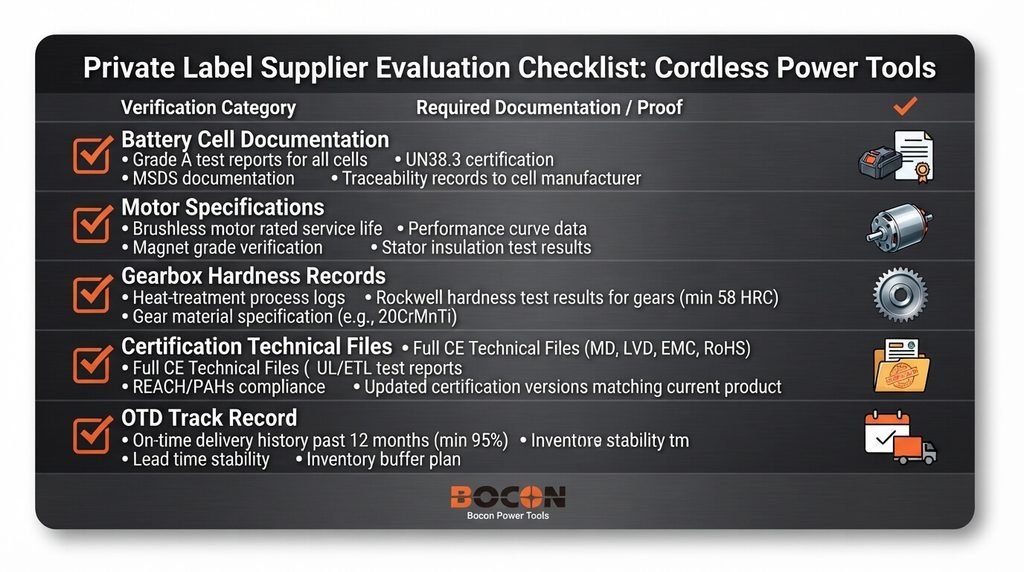
The key question isn’t whether a factory uses “Grade A cells.” It’s whether they can prove it. A credible Chinese OEM factory can produce cell-level certification documentation: the cell manufacturer’s test reports, batch records, and traceability back to the cell source.
Same logic applies to gearboxes. The planetary gears in a good cordless drill are heat-treated to 600–900 HV (Vickers Hardness) surface hardness. The gears in a cheap one are not treated, running at 150–200 HV. You cannot see this at inspection. You need the factory’s metallurgical records.
Certifications are full, not minimal
There’s a meaningful difference between a factory that has CE marking and a factory that has full CE technical files with test reports. The certificate is a declaration. The technical file is the evidence. When a European market authority audits a product, they’re asking for the technical file — not the certificate.
Same applies to UN38.3 (battery air transport safety certification). Some factories have UN38.3 on paper but have changed their cell chemistry since the certification was done, which invalidates it. The certification is only as good as the version of the product it was tested on.
Good factories can show you current, version-matched test reports. Not just certificates.
Production transparency is genuinely available
ISO 9001 certification is widely available among Chinese OEM factories at this point. It’s a baseline, not a differentiator.
What differentiates is whether a factory can show you actual production quality data: batch defect rates, yield metrics, corrective action records. A factory that tracks and shares this data has a quality system that functions. A factory that has the certificate but not the data has the form without the substance.
Engineering response time is fast and substantive
When you’re building a private label program, you’ll need engineering changes. A spec adjustment, a color change, a packaging modification. How quickly your OEM partner responds — and how technically sound their response is — determines whether your program runs on your timeline or their convenience.
The best Chinese OEM factories have dedicated engineering teams assigned to export programs. They respond to technical queries within 24–72 hours with substantive answers, not just “we can do it” confirmations.
The Questions to Ask Before You Commit
If you’re evaluating Chinese OEM factories for a private label tool program, these are the questions that separate the real partnerships from the ones that look good until your first container arrives:
On battery quality:
- Can you provide cell certification documentation at the cell level (not just the battery pack)?
- What are your BMS over-temperature cutoff parameters, and how were they validated?
- What was your battery warranty claim rate in the past 12 months?
On motor and drivetrain:
- Is this motor brushless or brushed, and what is the rated service life?
- What steel grade are the planetary gears manufactured from, and what heat treatment process?
- Can you provide hardness test records from your quality lab?
On certifications:
- Can I receive the full technical file and test reports — not just the certificate?
- Are your battery pack certifications current and matched to the cells you’re currently shipping?
- Which specific notified body or test laboratory issued these reports?
On operational reliability:
- What was your on-time delivery rate in the past 12 months?
- Which component categories do you have qualified backup suppliers for?
- What was your final inspection defect rate for the past four quarters?
A factory that answers all of these confidently, with documentation, is one worth taking seriously. A factory that gets defensive about any of them is showing you something important.
What This Means for Your Brand
The shift toward Chinese OEM partnerships isn’t a trend driven by cost-cutting. It’s driven by the realization that the best available manufacturing capability for cordless power tools at mid-to-professional quality levels now exists in China — not in Europe, not in the US, not in Japan.
The brands that are winning in private label power tools in Europe and Australia are the ones that identified the right Chinese OEM partners early, built the supplier relationships with enough engineering depth to actually specify what they want, and invested in the certification infrastructure to sell into their target markets properly.
The brands that are struggling are the ones that tried to source on price and ended up with a warranty problem they couldn’t recover from.
If you’re evaluating Chinese OEM partnerships for a cordless tool program — whether you’re entering the category for the first time or looking to upgrade from a problematic existing supplier — the framework is straightforward: verify the components, verify the certifications, and verify the reliability track record. Everything else follows from those three.
At Bocon, we’ve been running export programs for European and Australian buyers for fifteen years. We’re not the cheapest option in the market — we’re not trying to be. What we do offer is Grade A cell documentation, full CE and UN38.3 technical files, 100% brushless product line, and a 96%+ on-time delivery track record over the past two years.
If you want to talk specifics about your program, the conversation starts at www.oemcordlesstools.com.
Q: Are major Western tool brands actually manufactured in China?
A: Yes. Techtronic Industries (TTI), a Hong Kong manufacturer with major production in China, makes Milwaukee, Ryobi, and AEG. Bunnings’ Ozito is manufactured by Chinese OEM factories including KANGTON. KANGTON also supplies OBI in Europe. These are not edge cases — they represent the dominant production model for the global power tool industry.
Q: What percentage of global power tools are made in China?
A: China produces approximately 543 million power tool units annually and exports approximately 387 million of them. Germany alone imports $825 million in Chinese power tools per year. China’s share of global power tool production is estimated at 70–80%.
Q: Has Chinese power tool quality actually improved?
A: Yes, measurably so. The adoption of brushless motors (which eliminates the primary mechanical failure mode of brushed tools), Grade A lithium cell sourcing with documented BMS protection, and mature CE/UN38.3 certification capability among leading Chinese OEM factories represents a genuine quality improvement over the 2015 baseline. The private label programs of serious European and Australian retailers are the evidence.