
Every major product recall in the cordless power tool industry — every widely reported battery fire, every market surveillance authority intervention in Germany or Australia — starts with the same problem: a retailer sourced a product without understanding what was actually inside the battery pack.
The battery is not a commodity component. It’s a chemical system operating under continuous stress — charging, discharging, heating, cooling — and if it’s built with the wrong cells, the wrong protection circuit, or the wrong thermal management design, it will eventually fail. Usually in a way that’s expensive, dangerous, and damaging to your brand.
This guide is a comprehensive overview of what every European and Australian retailer needs to understand about power tool battery safety before placing an order with any OEM manufacturer. It’s written from the perspective of a factory that has been building battery-powered cordless tools for fifteen years — so we’ll tell you not just what the standards say, but what the standards don’t tell you, and where the real risks live.
If you’re a procurement manager, brand owner, or retail buyer evaluating cordless tool suppliers for the first time or switching partners, this is the document you should have read before your last order.
Why Battery Safety Is the Number One Risk in Cordless Tool Sourcing
Power tool batteries are the component category most associated with field failures, recalls, and regulatory action in the cordless tool industry. This isn’t our opinion — it’s documented across market surveillance data from the EU’s RAPEX system, Australia’s Product Safety Australia, and incident reports collected by fire services across Europe.
The reason is simple: a battery pack is a sealed chemical system that you can’t inspect from the outside. You can hold two battery packs that look identical, open them up, and find completely different cells, completely different protection circuits, and completely different safety margins. The outside tells you nothing.
This creates a sourcing risk that doesn’t exist with most other product categories. With a cordless drill body, you can check the chuck quality, test the chuck runout, and verify the motor’s torque output with basic equipment. With a battery pack, meaningful quality verification requires access to the cells, the BMS circuit, the welding quality, and the thermal management design — none of which are visible without destructive testing.
The retailers who get this wrong pay for it in three ways: the cost of managing a recall, the legal liability exposure if a battery causes property damage or injury, and the brand damage that follows a widely reported incident.
The retailers who get this right — and do the verification work before ordering — protect their margins, their reputation, and their customers.
Part 1: Understanding the Fundamentals — What Makes Lithium-Ion Batteries in Power Tools Different
Before getting into safety standards and sourcing verification, it helps to understand why lithium-ion batteries in power tools present specific safety challenges that don’t apply to consumer electronics like phones or laptops.
Why Power Tool Batteries Are Under More Stress Than Phone Batteries
A smartphone battery is stressed during calls, streaming, and app use — but the load is intermittent and generally within designed parameters. A power tool battery is asked to deliver high current continuously, often at elevated temperatures, often by users who don’t know what the tool’s limits are.
Power tool battery packs typically operate under what engineers call high discharge rate conditions — drawing 10A, 20A, or more from a single cell. A phone battery might draw 2A at peak. This difference in current draw means that power tool batteries generate significantly more internal heat, which accelerates every degradation mechanism in the cell.
The cells used in power tool packs are almost exclusively lithium-ion chemistry variants — typically lithium nickel manganese cobalt oxide (NMC) or lithium iron phosphate (LiFePO4). NMC offers higher energy density, which means longer runtime per charge. LiFePO4 offers better thermal stability and longer cycle life. Both are used in power tools, and the choice affects safety characteristics — LiFePO4 is inherently more stable at high temperatures, but has lower energy density.
What matters for retailers: you need to know which chemistry your supplier uses, and whether it’s appropriate for your target market’s use cases.
The Anatomy of a Power Tool Battery Pack
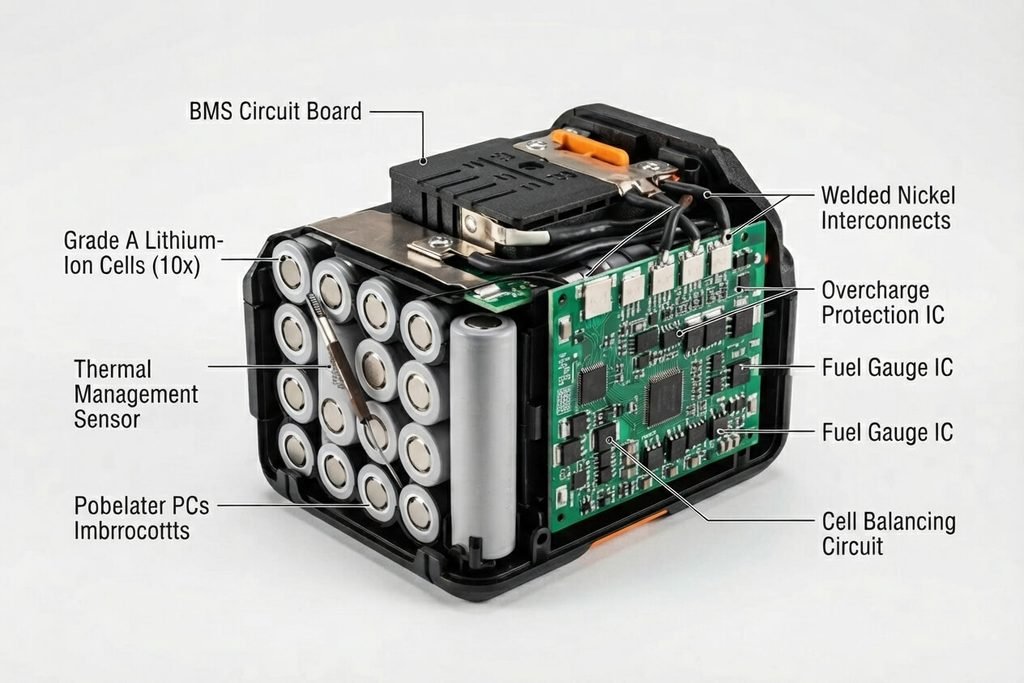
A complete battery pack consists of several subsystems, each of which has safety implications:
Battery cells: The individual cylindrical or prismatic cells that store energy. The grade, brand, and condition of these cells is the single most important variable in pack safety.
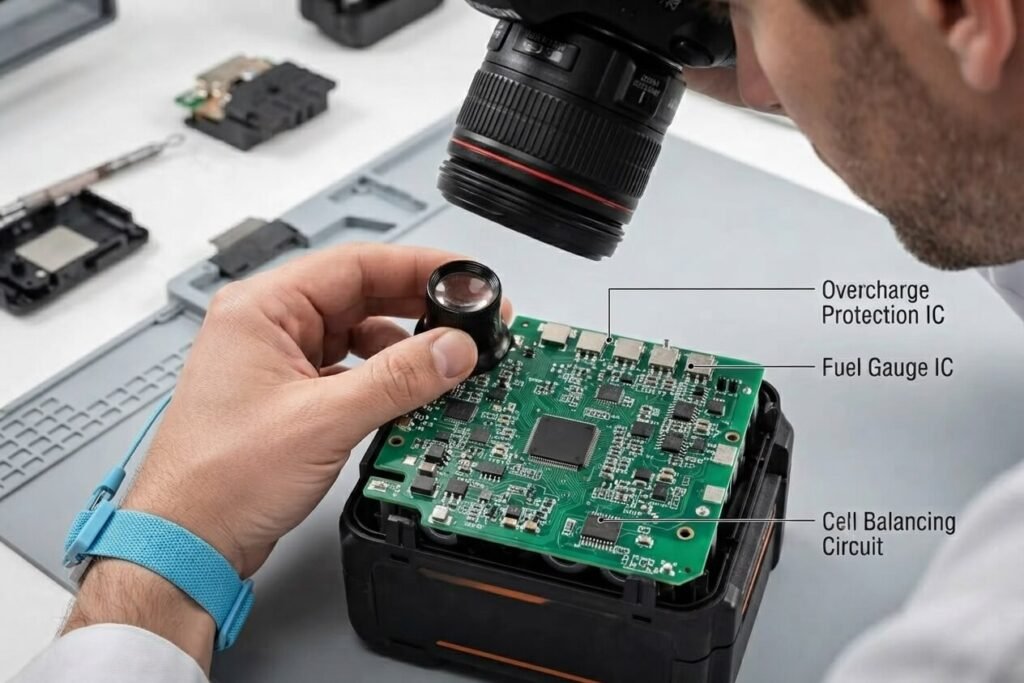
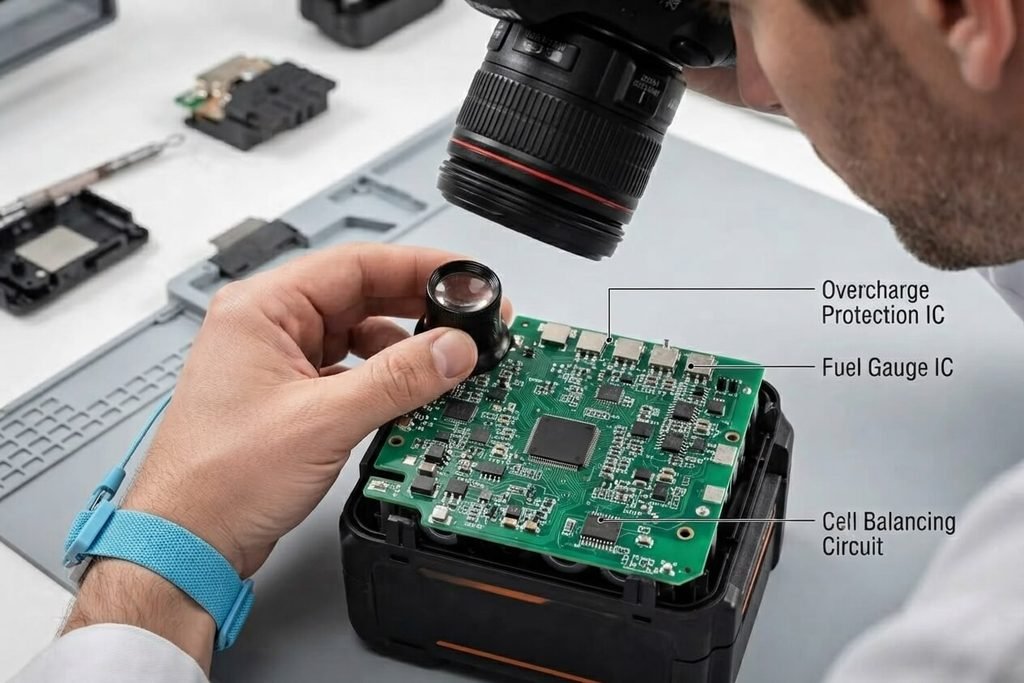
Battery Management System (BMS): The electronic circuit that monitors cell voltage, current, and temperature, and activates protection mechanisms when parameters exceed safe limits. The BMS is the brain of the battery pack — and the quality of its design determines whether the pack fails safely or catastrophically.
Thermal management system: Passive or active cooling that removes heat from the cells during high-current operation. This can be as simple as a metal heat sink plate or as sophisticated as a liquid-cooled jacket.
Housing and connector: The physical enclosure, which must protect cells from mechanical damage and provide safe electrical connections.
Each of these subsystems can be built correctly or incorrectly, and the safety implications compound. A high-quality cell with a poor BMS is still dangerous. A good BMS protecting low-grade cells is still a safety risk. The entire system has to be designed correctly.
Part 2: The Cell Grade Problem — Where Most Battery Safety Failures Start
Here’s a fact that most retail buyers don’t learn until after a problem: not all lithium-ion cells are created equal, even if they have the same form factor and labeled capacity.
The battery industry uses a grading system for cells that directly correlates with safety and performance. This system is widely understood within the industry and almost completely unknown outside it.
Cell Grades: What A, B, and C Actually Mean
Battery manufacturers grade their production output based on how closely cells meet specified performance parameters after formation and testing:
Grade A cells are first-quality cells that meet all specified parameters for capacity, internal resistance, voltage, and self-discharge rate. These are what reputable manufacturers use in their own products.
Grade B cells may have minor deviations from spec — slightly lower capacity, slightly higher internal resistance, or minor voltage inconsistency. These are sold at a discount and are commonly used in lower-cost products. The performance difference may be small; the safety margin difference is not.
Grade C cells are cells that have failed to meet Grade B specifications. These should not be used in consumer products. In some markets, they end up in budget battery packs anyway.
The practical safety implication: cells with higher internal resistance run hotter under load. Cells with inconsistent voltage within a pack create imbalance during discharge, which causes some cells to work harder than others, accelerating degradation. Cells that are manufactured with contamination or defects may pass initial testing but fail prematurely — sometimes catastrophically.
At Bocon, we source Grade A cells exclusively from certified suppliers. We verify incoming cell quality with incoming inspection that tests capacity, internal resistance, and voltage consistency across every batch. We do not use Grade B or C cells in any product, regardless of price pressure from buyers. We’ve turned down orders specifically because a buyer asked us to reduce cost by accepting lower-grade cells.
This is not a position every factory takes. It’s your job as a retailer to verify that your supplier does.
What to Ask Your Supplier
Ask directly: “What grade of cells do you use, and can you provide documentation of cell specifications from your supplier?”
A factory that uses Grade A cells will answer this question confidently and provide documentation. A factory that uses mixed grades or sources from the secondary market will be vague.
Ask for cell brand and model: “Which cell manufacturer do you source from?” Reputable suppliers use cells from established manufacturers like Samsung SDI, LG, Panasonic, or CATL. A factory that can’t name their cell supplier is sourcing from the spot market — which means cell grade and provenance are unknown.
Ask about incoming inspection: “What testing do you perform on incoming cells before they go into production?” A factory with a real quality system will have documented incoming inspection procedures.
Part 3: Battery Management System — The Protection Circuit That’s More Important Than the Cells
Here’s the most misunderstood component in the battery pack: the Battery Management System.
Most buyers know they need a BMS — the term appears on every battery spec sheet. What fewer buyers understand is that “having a BMS” is meaningless as a quality statement. The protection circuit inside the battery pack ranges from a basic single-chip solution that does the minimum required by regulation, to a sophisticated multi-chip system with active balancing, precise thermal monitoring, and communication protocols.
What a BMS Actually Does
The BMS in a power tool battery pack performs several critical protection functions:
Overcharge protection: Prevents any cell from exceeding its maximum voltage during charging. Charging a lithium cell above 4.2V per cell (for NMC chemistry) causes lithium plating on the anode — an irreversible degradation that increases fire risk.
Over-discharge protection: Prevents cells from being discharged below their minimum voltage. Deep discharge damages cells and can cause internal short circuits when the cell is subsequently charged.
Short circuit protection: Detects a short circuit condition and disconnects the pack within microseconds. This is the function that prevents a damaged or incorrectly assembled pack from delivering thousands of amps into a metal tool body.
Over-current protection: Limits discharge current to a level the cells can safely handle. Running cells beyond their rated current causes rapid heating.
Temperature protection: Monitors cell temperature during charge and discharge, and suspends operation if temperatures exceed safe limits. This is critical in hot environments or when the tool is used continuously at high load.
Cell balancing: In multi-cell packs, cells can drift out of balance during charge and discharge cycles. Active cell balancing — which redistributes charge between cells — maintains pack equilibrium and extends pack life. Passive balancing is simpler and cheaper but less effective.
The Design Gap: Bought Chips vs. Engineered Systems
Here’s where the BMS quality gap becomes significant.
The majority of Chinese factories use a standard BMS chip — typically from manufacturers like Texas Instruments, Richtek, or Chinese equivalents — that implements the basic protection functions. This is not inherently bad. These chips are proven, reliable, and pass regulatory tests. But they’re designed generically for the broadest possible market, not for a specific cell type, discharge profile, or thermal environment.
The factories with genuine engineering capability design and program their own BMS firmware — the software logic that runs on the chip. This allows them to calibrate protection thresholds precisely for their specific cell supplier, optimize the thermal management response for their pack design, and implement custom features like active cell balancing or state-of-charge estimation.
Why does this matter for retailers?
When a battery fails, the documentation of your BMS design becomes critical. If your documentation shows that your BMS was engineered specifically for your product — with tested thresholds, thermal modeling data, and validation records — that’s a fundamentally different legal and liability position than “we used a standard chip.”
In some European jurisdictions, if a battery causes a fire and your documentation shows you used a generic protection chip without adaptation, the question becomes: did you exercise due diligence in ensuring the protection was appropriate for your product? That’s a difficult question to answer well.
At Bocon, our engineering team develops our own BMS firmware. We can show you the firmware architecture, the testing records, and the thermal modeling data that went into our protection design. This isn’t something we hired a consultant to do — it’s a core engineering capability that we’ve built over fifteen years.
What to Ask Your Supplier
Ask this question exactly: “Do you design your own BMS algorithm, or do you integrate a third-party chip?”
The factories that design their own will answer this question clearly and can walk you through the technical rationale. The factories that use a standard chip will either be vague, dismissive, or confused by the specificity of the question.
If the answer is a standard chip, ask: “Has the chip been calibrated for the specific cell type and discharge profile of this product, or is it using factory-default parameters?”
Push for documentation. Ask to see the BMS specification sheet — not just the general product brochure, but the technical sheet that documents protection thresholds, response times, and operating parameters.
Part 4: The Certification Framework — What Standards Apply and What They Actually Verify
Battery safety certifications exist to provide independent verification that a product meets defined safety requirements. But understanding what each certification actually tests — and what it doesn’t test — is critical for making sourcing decisions.
UN38.3: The Transport Safety Standard
UN38.3 is the United Nations standard for the safe transport of lithium batteries. It is mandatory for shipping lithium batteries — including battery packs inside cordless tools — by air, sea, or road transport.
UN38.3 testing subjects batteries to a series of environmental tests that simulate transport conditions:
- Altitude test: Simulates air cargo pressure conditions
- Thermal test: Cycles the battery between extreme high and low temperatures
- Vibration test: Simulates vibration during transport
- Shock test: Simulates impact and drop conditions
- Short circuit test: Verifies the BMS responds correctly to an external short circuit
- Impact test: For cylindrical cells, simulates mechanical impact
- Forced discharge test: Tests cell behavior under forced discharge conditions
UN38.3 is tested on the battery cells and/or battery packs as they will be shipped. This is important: a battery pack that contains cells that have individually passed UN38.3 is not the same as a battery pack that has passed UN38.3 as a complete assembled unit. The pack-level test verifies that the assembled pack — including the BMS, the connections, and the housing — behaves correctly under transport stress.
The trap: Many factories have UN38.3 test reports for individual cells but not for the complete battery pack. If your product ships with battery packs included, you need the pack-level UN38.3 report.
Ask for: the complete UN38.3 test report for the battery pack as it will ship, including the test summary showing all eight test categories and their results.
CE Certification for Battery Packs
CE marking for cordless tool battery packs requires compliance with multiple EU directives and standards:
The Low Voltage Directive (LVD) 2014/35/EU applies to battery packs operating above 75V DC. For most power tool battery packs (typically 12V to 54V), this directive technically applies at the higher end of the range. However, compliance with its safety principles is considered best practice across the range.
The Electromagnetic Compatibility (EMC) Directive 2014/30/EU applies to battery packs as electrical equipment that can generate or be affected by electromagnetic interference.
The RoHS Directive 2011/65/EU restricts hazardous substances (lead, mercury, cadmium, etc.) in electrical equipment. This applies to battery packs and is a routine compliance requirement.
The EU Battery Regulation (2023/1542) — this is the new regulatory framework for batteries sold in the EU, which came into full effect in 2024-2025. It introduces requirements for battery labeling, state of health reporting, due diligence for raw material sourcing, and recycling targets. For retail buyers, this is the certification development to watch — requirements are expanding.
EN 62133 is the specific safety standard for portable sealed secondary cells and batteries. This is the technical standard that defines the test procedures for verifying safe operation of lithium-ion cells in portable applications. CE test reports for battery packs should reference EN 62133 testing.
What CE Does and Doesn’t Tell You
CE certification tells you that a product was tested against specified standards and passed. What it doesn’t tell you is:
- Whether the test sample was representative of the production units you’ll receive
- Whether the factory’s quality system ensures consistency between the sample tested and the production run
- Whether the test report documents the actual test data or just the pass/fail result
- Whether the factory holds a valid certificate or has had a certificate issued for a sample that’s no longer in production
This is why CE certificates alone are insufficient for sourcing decisions. You need the complete test reports, and you need to understand what they verify.
Part 5: The Retailer’s Verification Checklist — What to Actually Check Before Ordering
All of the above is background. Here’s the practical part: what you should actually verify before placing an order for cordless tools with battery packs.
Before Signing a Contract
Verify the cell source. Ask for the cell manufacturer’s name, model, and grade. Confirm that Grade A cells are specified in your purchase contract.
Verify UN38.3 for the complete pack. Request the full UN38.3 test report — not just a summary. Confirm that it covers the battery pack as assembled, not just the individual cells.
Verify CE compliance documentation. Request the full CE test reports for the battery pack, including the technical measurement data (not just the certificate). Verify that the reports reference EN 62133 and cover the specific product you’re ordering.
Verify BMS design documentation. Ask for the BMS specification sheet with protection thresholds and operating parameters. Ask whether the firmware is custom-designed or a standard chip implementation.
Verify the factory’s incoming inspection process for cells. Ask how they verify cell quality on incoming batches. Ask to see their incoming inspection records.
Verify supply chain for cells. Ask how many certified cell suppliers they maintain. A single cell supplier is a supply chain vulnerability.
Before Your First Shipment
Conduct or commission pre-shipment inspection. Hire a professional inspection company (SGS, Bureau Veritas, or equivalent) to perform dimensional, visual, and functional testing on a sample from your production batch.
Test the battery pack under real load conditions. Run the pack through multiple full charge/discharge cycles and document performance. Check temperature rise during high-current discharge.
Verify packaging and labeling compliance. Confirm that battery pack labels include all required markings (chemistry label, voltage, capacity, CE mark, WEEE symbol if applicable, EU Battery Regulation requirements).
Verify shipping documentation. Confirm that shipping documentation correctly identifies the battery chemistry and quantity, that UN38.3 documentation is complete, and that the shipper is certified for lithium battery transport.
Part 6: The Questions You Haven’t Been Asking — And Should
There are several battery safety topics that rarely appear in procurement checklists but cause problems for retailers regularly.
Question: Does the BMS firmware get updated after the product launches?
BMS firmware — like all software — can have bugs. More importantly, field experience often reveals edge cases that weren’t anticipated during initial testing. A factory that actively maintains and updates BMS firmware based on field data is operating at a different quality level than one that ships firmware and never touches it again.
Ask: “How do you handle BMS firmware updates after a product is in the field? Do you track BMS-related field failures and update firmware if issues are identified?”
Question: How is cell aging handled in the BMS design?
Cells degrade over time and with use. A properly designed BMS accounts for cell aging in its protection parameters — as cells lose capacity, the safe operating windows shift. A basic BMS uses static thresholds that don’t account for aging. This isn’t a problem during the first year, but it becomes one during the second and third year of the product’s life on a retailer’s shelf or in a customer’s garage.
Ask specifically about this if you’re selling products with multi-year warranties.
Question: What is the BMS response time for short circuit protection?
This sounds technical, but it’s simple to verify and critical for safety. In a short circuit condition, the BMS must disconnect the pack within microseconds. If the response time is too slow, the short circuit current causes immediate heating that overwhelms the BMS’s ability to respond. The UN38.3 short circuit test verifies this — but only if the test report includes the actual response time measurement.
Ask for the BMS short circuit response time from the specification sheet.
The Honest Assessment: Where the Real Battery Safety Risks Live
After fifteen years of building and shipping cordless tool battery packs, here’s the honest assessment of where the real risks are in this industry:
The largest risk is not getting a bad cell. It’s getting cells that are marginally acceptable — Grade B or re-certified cells that pass initial testing but degrade faster than specified. The failure might not show up for six months, by which time you’ve shipped thousands of units to retail shelves.
The second largest risk is not a bad BMS. It’s a BMS that was designed for a different cell type or a different discharge profile than the one actually in your product. The certification test passes because the parameters are within spec — but the margin of safety has been reduced.
The third largest risk is sample-production inconsistency. The battery pack that passed all testing during the sample phase is different from the pack that ships in your first container — either because the cells came from a different batch, the BMS firmware was modified between samples and production, or the welding quality on the production line is different.
Each of these risks is detectable with the right verification process. None of them are visible from a spec sheet or a CE certificate.
What Bocon Does Differently — And Why It Matters for Your Sourcing Decision
We’re writing this article as a resource for retailers who are evaluating OEM partners. We believe the market benefits from buyers who know what questions to ask — regardless of whether they end up working with us. But since you’ve read this far, here’s what we can tell you about how we handle battery safety at Bocon.
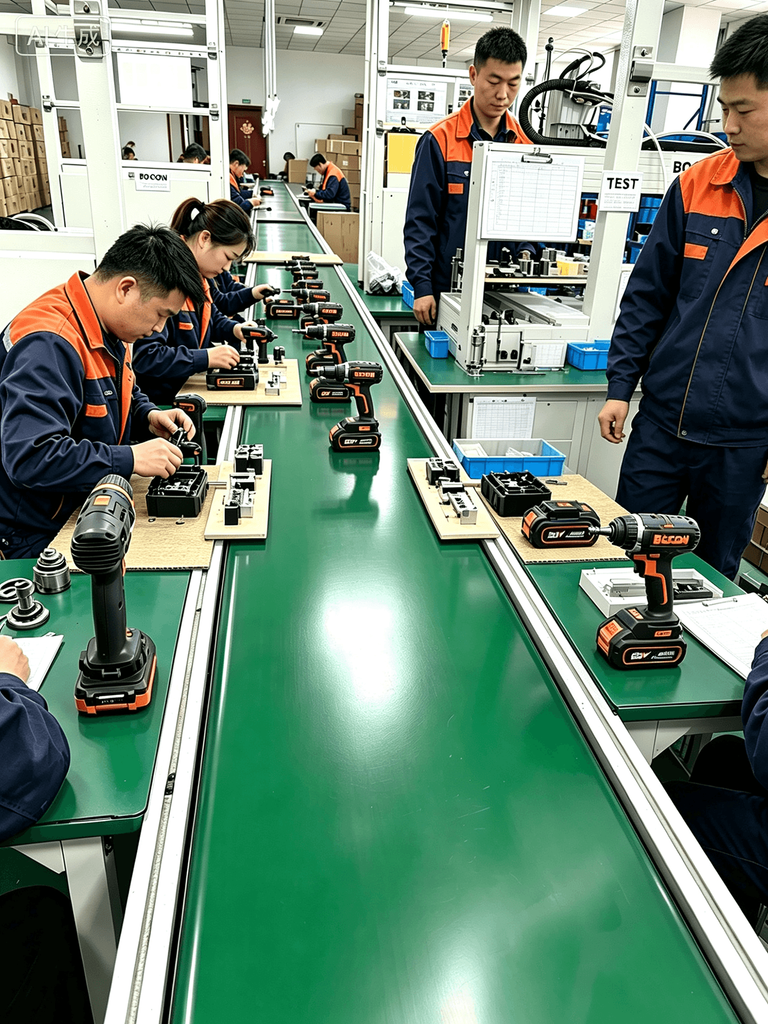
We use Grade A cells exclusively. We source from established cell manufacturers and maintain three certified cell suppliers for each major cell type we use. We verify incoming cells with capacity, internal resistance, and voltage testing on every batch.
Our BMS firmware is developed in-house. Our engineering team designs and maintains our BMS algorithms. We can provide full technical documentation — protection thresholds, thermal modeling data, firmware architecture — for every product we build.
We test at the pack level. Our UN38.3 testing covers the complete assembled battery pack, not just the individual cells. Our CE test reports include the full measurement data, not just the pass/fail result.
We track field failures by component. Our quality system monitors BMS-related field failures and updates firmware when patterns are identified. This is documented and shared with retail partners.
We maintain 35+ certified backup suppliers for core components. Cell supply chain resilience is built into our supplier management system, not improvised when a problem occurs.
If any of this is relevant to what you’re evaluating, reach out to us directly at www.oemcordlesstools.com or shawn@oemcordlesstools.com. We’re happy to walk you through the technical documentation before you commit to an order.
Summary: The Non-Negotiables for Battery Safety in OEM Cordless Tool Sourcing
Based on everything in this guide, here are the verification points that matter most:
Cell quality: Grade A cells from named manufacturers. Incoming inspection documentation. Multiple certified suppliers.
BMS design: Custom firmware or calibrated chip. Full specification documentation. Thermal modeling data. Active cell balancing if the product warrants it.
Certifications: UN38.3 test report for the complete pack (not just cells). CE test reports with full measurement data, not just certificates. EN 62133 reference in test reports.
Verification process: Pre-shipment inspection. Real-load testing before first shipment. Documentation review for sample-production consistency.
Supply chain: Cell supplier redundancy. BMS component supplier redundancy. Backup manufacturing capacity.
These are not expensive requirements. They’re standard practice for any factory that’s serious about battery safety. If a factory resists providing any of this documentation, that’s your answer.
This guide was written by the Bocon export and engineering team — cordless tool specialists with 15 years of experience shipping battery-powered tools to retailers across Europe and Australia. For technical questions about battery safety requirements for your specific market, contact us directly.