
I’ve been in the power tool business for a long time. Long enough to watch the industry swing from corded everything to brushless battery dominating every jobsite category. And in that time, I’ve had this same conversation hundreds of times — with distributors, brand owners, hardware chain buyers, and startup founders who’ve decided to launch their own tool line.
They come in using terms like OEM, ODM, and private label somewhat interchangeably. Sometimes they mean the same thing. More often, they don’t. And choosing the wrong manufacturing model doesn’t just cost money — it can cost you 18 months of your life.
So let me cut through the noise.
1. The Three Models, Without the Marketing Fluff
Before we go any further, it’s worth saying what these terms actually mean in practice — not the textbook definitions, but how real factories and real buyers use them.
1.1 What OEM (Original Equipment Manufacturer) Actually Means
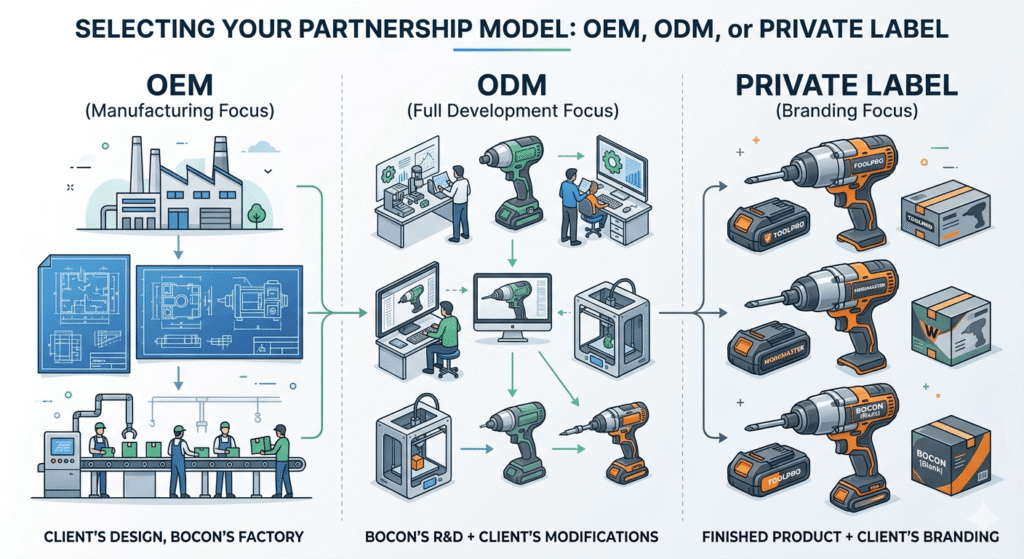
In the power tool world, OEM has a specific meaning that’s often different from how it’s used in, say, automotive parts. When a power tool company says “we do OEM,” what they typically mean is: you bring the design, we build it.
Your engineering team — or your R&D partner — provides complete specifications: motor parameters, gear ratios, housing geometry, torque curve, switch type, battery interface. The factory’s job is to manufacture to your exact blueprint. They are a production resource, not a design partner.
This is the model large brands like Panasonic or major industrial tool manufacturers use. They’ve done the R&D internally, they own the product intellectually, and they need a manufacturing partner with the production capacity, quality systems, and certifications to execute that vision at scale.
What it requires from you: A real engineering investment upfront. You’re not buying a product — you’re commissioning one. That means detailed technical specifications, tooling investment, and usually a minimum order commitment that justifies the factory’s setup costs.
What you get: Full product ownership. Nobody else is selling your design. The product is genuinely yours — from performance tuning to appearance to internal architecture.
1.2What ODM (Original Design Manufacturer) Actually Means
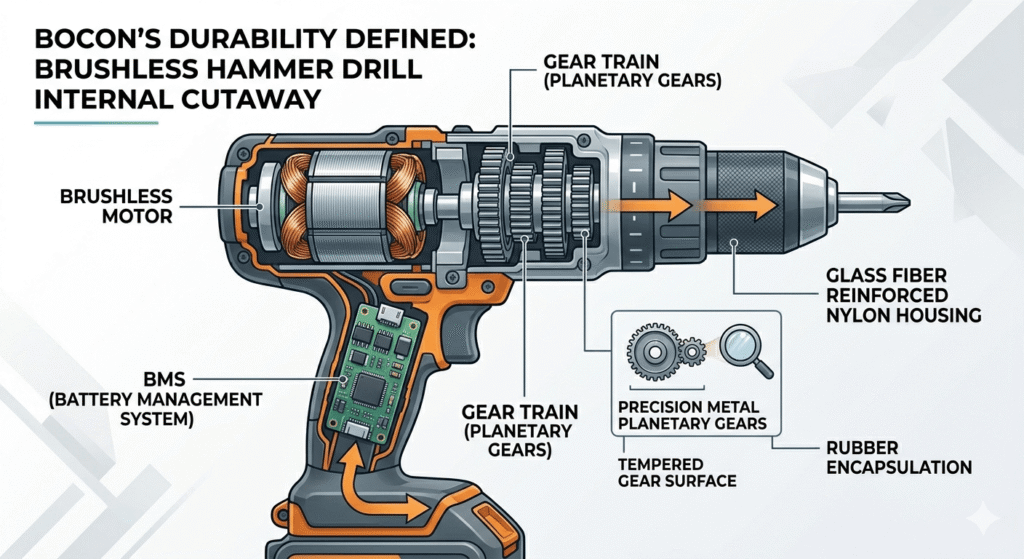
ODM is where the manufacturer’s own R&D team drives the design. The factory has already developed a product — let’s say a 20V brushless hammer drill with specific internal components, a particular motor, a tested gear train, and a validated BMS (Battery Management System). You’re licensing that design.
You might request modifications. Change the grip color. Swap the rubber overmold. Adjust the gear ratio for a different regional market. Add your own trigger switch feel. But the core product — the engineering that makes it work — belongs to the factory.
This is actually a much more nuanced model than people give it credit for. The key variable is the depth of the manufacturer’s R&D capability. There’s a massive difference between an ODM factory that reverse-engineered someone else’s product and a factory whose founder spent 15 years developing brushless motor control algorithms and built his own design studio before ever touching mass production.
When the engineering depth is real — when the factory genuinely understands why a particular brushless motor tuning reduces heat generation, or why a specific planetary gear geometry minimizes backlash under heavy torque — you’re not buying a commodity. You’re accessing proprietary engineering without paying for the R&D.
What it requires from you: A clear understanding of your target market’s performance expectations and a manufacturer you’ve genuinely vetted — not just price-checked.
What you get: A technically sound product, faster to market, with lower upfront investment. The tradeoff is that other brands may sell products built on the same platform.
1.3 What Private Label Actually Means
Private label is the most misunderstood of the three, mostly because people use it to describe very different things.
In the strict sense, private label means you’re taking an existing, finished product and putting your brand on it. The product design is completely fixed. The factory makes it in volume, you put your label on the box, and it goes to market.
In practice, however, “private label” in the power tool space usually involves at least some customization — packaging, color scheme, perhaps a branded battery platform. The degree of modification varies significantly by factory.
Some buyers treat private label as a stepping stone: launch a category with minimal investment, prove the market, then transition to ODM or OEM once you understand what your customers actually want. That’s a legitimate strategy, but it only works if you choose a factory capable of growing with you — one whose private label products are engineered well enough to hold up in market and whose team can eventually support a full ODM conversation.
What it requires from you: Mostly brand-building investment. The product development work is already done.
What you get: The fastest path to market. The risk is differentiation — if your competitor uses the same factory and the same base product, the only thing separating you is your brand story.
2. The Question Nobody Asks (But Should)
Most buyers focus on which model to choose. The smarter question is: what does the factory’s R&D infrastructure actually look like?
Here’s why this matters. A factory running ODM and OEM programs for industrial brands like those in the automotive assembly or professional construction sectors operates under an entirely different quality regime than a factory filling container orders for price-driven retail. The supplier audits are different. The material specifications are different. The tolerances are different.
When brands operating in professional or industrial environments run their supplier audits — and they run them seriously, covering quality management systems, social and ethical compliance, and environmental safety — they’re not checking a certificate. They’re evaluating whether the factory’s systems are built to sustain consistent output under real operational pressure.
That standard has a practical impact on every product the factory makes, including the ODM and private label tools. When a factory’s internal BMS uses active temperature protection, when the housing is glass-fiber reinforced nylon instead of standard ABS, when the planetary gear set is heat-treated alloy with controlled backlash — those aren’t marketing specifications. They’re engineering decisions made by people who understand failure modes.
A factory that holds ISO 9001, CE (MD + LVD + EMC), UN 38.3, and ETL certification isn’t just ticking compliance boxes. It’s signaling that the underlying quality infrastructure can support brands that can’t afford field failures.
3. The Practical Decision Framework
After all these years, here’s how I’d suggest thinking about this:
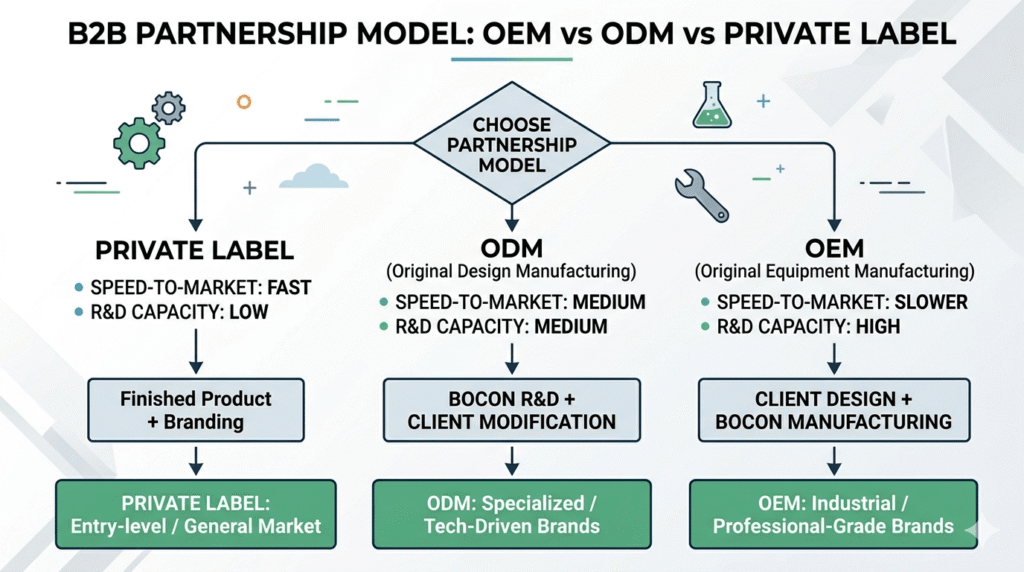
Choose OEM if: You have proprietary designs or engineering that represents a genuine competitive advantage. You’re protecting IP. Your target market is professional or industrial and performance differentiation is measurable. You have the technical resources to manage a design-to-production relationship.
Choose ODM if: You want to bring a well-engineered product to market without building an internal R&D team. You’re focused on a specific market segment and need a manufacturer who genuinely understands the engineering — not just the manufacturing. Speed to market matters, and you’re willing to invest in finding a factory whose R&D depth matches your product ambitions.
Choose Private Label if: You’re entering a new category and need to validate demand before committing to product development investment. Or you’re a retailer building a house brand where the margin math matters more than technical differentiation.
4. What Most Guides Get Wrong About Supply Chain Stability
One thing I rarely see discussed in these OEM/ODM explainers: manufacturing model choice has a second-order effect on supply chain resilience.
When you’re working with an ODM or OEM factory on mid-to-high-end product, the factory’s component sourcing strategy becomes your risk profile. A factory that maintains multiple qualified suppliers for every critical component — motor cores, battery cells, gear sets, switches — manages your exposure to disruption. A factory running lean on supplier relationships is one raw material shortage away from a production stoppage that affects your delivery schedule.
This isn’t an abstract concern. Anyone who sourced from single-supplier factories during recent global supply chain disruptions knows exactly what I’m talking about.
When evaluating a manufacturing partner, ask specifically how many qualified suppliers they maintain for each critical component category. The answer tells you a lot about how seriously they take operational continuity — and by extension, how seriously they’ll take yours.
5. A Note on Certifications and Market Access
For brands selling into North American or European markets, certification is not optional — and it’s not just an administrative burden. CE certification (covering the Machinery Directive, Low Voltage Directive, and EMC), ETL for North America, UN 38.3 for lithium battery transport compliance, and RoHS for environmental materials restrictions all carry real legal liability.
An ODM or private label relationship with a factory that doesn’t hold the relevant certifications for your target market isn’t a partnership — it’s a liability you’re absorbing. Verify the certifications apply to the specific product line, not just the factory in general.
6. The Bottom Line
OEM, ODM, and private label aren’t just procurement jargon. They represent fundamentally different risk and investment profiles — and the right choice depends on where you are in your brand development, what your technical capabilities are, and what your target market actually demands.
The one thing I’d push back on is the assumption that ODM means “off-the-shelf generic.” When you’re working with a manufacturer who has genuine engineering capability — where the founder has been in power tool R&D for fifteen years and the factory was built on proprietary design knowledge — ODM is access to serious intellectual investment at a fraction of what it would cost you to develop in-house.
The difference between a mediocre ODM product and an excellent one isn’t the business model. It’s the engineering behind it.