
I get asked this question more than almost any other. A brand owner is putting together their first cordless line, or expanding an existing one, and they want to know: brushless or brushed? Which one do we build around?
And the honest answer is: it depends on who you’re selling to, what price tier you’re competing in, and whether you’re trying to build a reputation or move volume. Those are not the same goal, and the motor technology choice follows directly from them.
Most of the content out there on this topic is written for consumers — should you buy a brushless drill for your weekend projects? That’s a fine question. But it’s not your question. You’re deciding what to put your brand name on. That’s a different conversation.
So let me give you the factory side of it.
What’s Actually Different Between the Two Motors
Before the strategy, the basics — because the technical differences drive everything else.
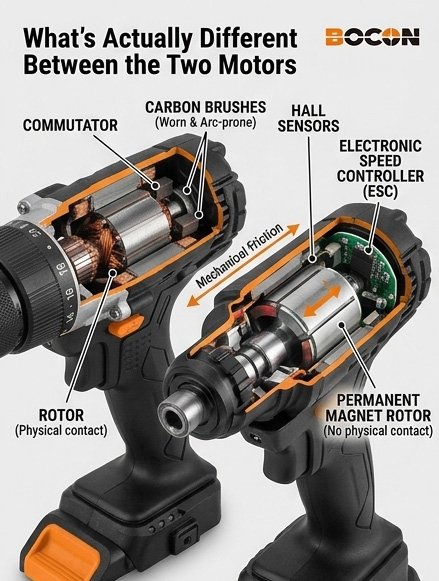
A brushed motor is a simple machine. Inside, a set of carbon brushes press against a rotating commutator ring to deliver current to the motor’s windings. Spin, contact, power. The simplicity is the point: fewer components, easier to manufacture, straightforward to repair. The problem is friction. Those brushes are always in contact with a spinning surface. They wear down. They generate heat. They impose a mechanical tax on every rotation, which means a portion of the energy from your battery is being converted to heat and noise instead of torque.
A brushless motor removes that friction entirely. Instead of carbon brushes, it uses a microcontroller and hall-effect sensors to electronically commutate the motor — delivering power to the right windings at the right moment, continuously adjusting based on load. There’s no physical contact between the rotor and the stator. The motor “knows” whether it’s driving a screw into soft pine or concrete, and it adjusts accordingly. That’s why brushless tools feel different when you pick them up — more responsive, more in control.
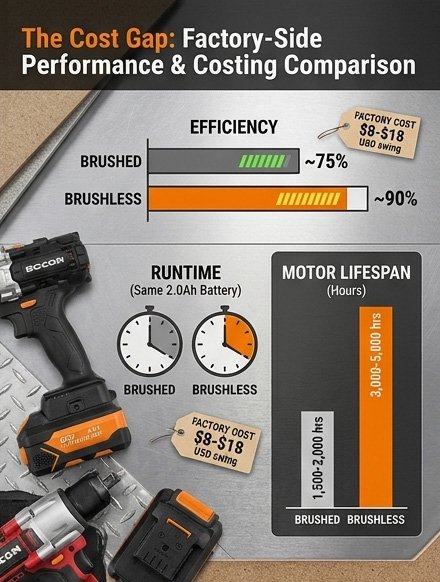
In terms of numbers: brushed motors typically operate at 70–80% efficiency. Brushless motors run at 85–95%. That gap closes into the battery — a brushless drill running the same battery as its brushed equivalent will run longer between charges, or deliver more torque at the same runtime. Over a tool’s lifetime, that difference compounds.
Lifespan is where the gap becomes most visible. Brushed motors typically need carbon brush replacement at around 500–800 hours of use, and total motor lifespan is roughly 1,500–2,000 hours under regular use. A well-built brushless motor, with proper thermal management and a decent controller, regularly reaches 3,000–5,000 hours. At Bocon, we’ve had brushless units come back from the field after four years of contractor use with the original motor still performing within spec.
The Cost Gap — And What It Actually Means for Pricing
Here’s where brand decisions get complicated.
A brushless motor assembly — the motor itself, plus the electronic speed controller (ESC) and the firmware that governs it — costs meaningfully more than a comparable brushed motor setup. In a cordless drill/driver at the 18V or 20V tier, the difference in your factory cost is typically in the range of $8–$18 USD per unit, depending on the controller quality and the motor spec. That sounds modest, but on a product with tight margins, that’s a 15–30% swing in component cost on the motor alone.
The relevant question isn’t whether brushless costs more — it does. The question is: can your target market absorb that cost, and does the additional capability justify the premium in their eyes?
For a brand targeting professional tradespeople, contractors, or serious DIYers in the US, EU, or Australia, the answer is almost always yes. These buyers are accustomed to paying $150–$280 for a drill/driver combo kit. The brushless motor is table stakes at this level — a brushed tool in this price tier will get laughed off the shelf.
For a brand targeting the entry-level consumer segment — think first-time homeowners, occasional DIYers, gift buyers — the calculation flips. A brushed drill at $49–$79 serves this market well. It has enough power for hanging pictures and assembling flat-pack furniture. The buyer will probably use it fewer than 50 hours over its lifetime. The extended lifespan of a brushless motor is completely wasted on this use pattern, and the $15 factory cost premium gets amplified into a $25–$35 retail price increase that your margin structure may not support.
This is why most established brands run both in their lineup. It’s not a failure to commit — it’s correct market segmentation.
How This Affects Your Product Line Strategy
Most guides will tell you “brushless is better” and leave you to figure out what to do with that. That’s not useful when you’re building a catalog.
The way we see it from the factory, there are three common approaches brand owners take:
Brushless-first, premium positioning. The brand commits entirely to brushless technology across all SKUs, typically in the $120+ retail tier. Everything in the catalog is brushless, the marketing leads with “professional-grade” messaging, and the higher price point is justified by the genuine performance difference. This works well when your retail channel partners — hardware chains, pro tool retailers, trade-specific distributors — are carrying the brand to a professional or serious prosumer customer. The risk is that you’re pricing yourself out of volume in mass retail and e-commerce environments where consumers are sorting by price.
Hybrid lineup, dual channel. This is the approach we most commonly see from brands that are scaling: brushed tools at the entry and mid-level (targeting DIY, home use, big-box retail), brushless at the pro tier (targeting tradespeople, specialty retail, online premium). Done right, this lets you capture multiple channel segments without brand dilution. The challenge is brand consistency — your $59 brushed drill and your $229 brushless combo kit need to feel like they come from the same family, which is a design and packaging problem as much as a product one.
Brushed only, value positioning. This remains a legitimate strategy for brands going into price-sensitive markets or distribution channels where cost is the primary driver. Think certain segments of Southeast Asia, Eastern Europe, or Latin America — or any channel where the buyer is comparing by price per tool in a display case. There’s nothing wrong with serving this market; it just requires being clear-eyed about where the ceiling is on brand equity, and building your margin structure around volume rather than premium pricing.
The Battery System Is Part of the Decision
Something brand owners consistently underestimate: the motor technology decision is also a battery platform decision.
Brushless motors typically require a higher-quality battery with a more sophisticated BMS (Battery Management System) to operate correctly. The ESC in a brushless tool is drawing variable current based on load, and it’s communicating with the battery’s BMS to manage thermal performance and prevent over-discharge. A low-quality cell pack — or a battery without a proper BMS — will limit your brushless tool’s performance and shorten the battery’s service life, even if the motor itself is excellent.
At Bocon, we run our own BMS protection algorithms developed in-house. This isn’t a marketing claim — it’s a functional necessity. When we tune a brushless tool’s firmware, the motor controller and BMS parameters are developed together. If you source a brushless tool from a factory that’s using off-the-shelf batteries from a separate supplier with no integration testing, the performance you see in samples may not hold up in production at scale.
This is one area where the brushed side is genuinely simpler. A brushed motor draws constant current from the battery. The demands on the BMS are less complex, and the battery performance is more predictable across a range of cell quality levels. For a brand just getting started, or one that’s still working out its battery platform, a brushed-first approach can reduce the number of variables you’re managing simultaneously.
What Field Failure Looks Like for Each Type
I want to be honest about failure modes, because this affects your after-sales structure.
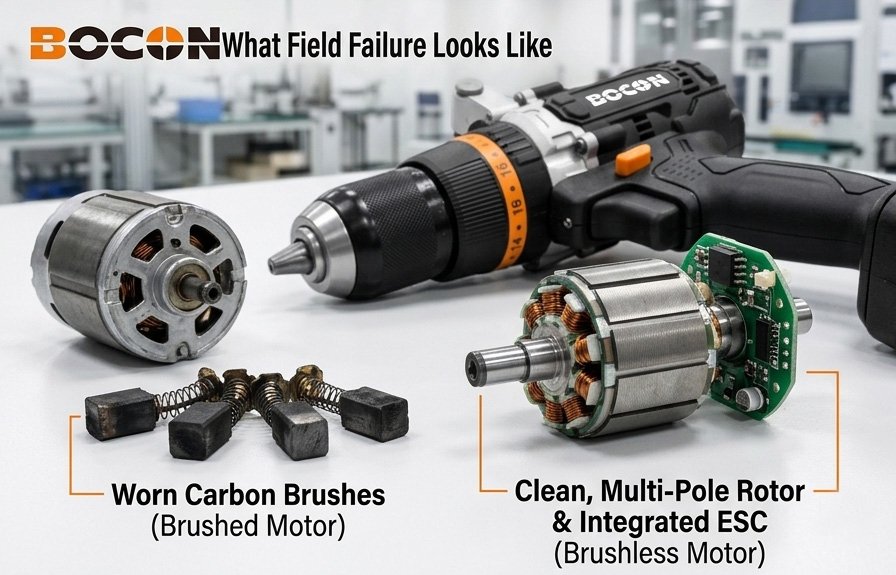
Brushed tools fail in predictable ways. The carbon brushes wear down, and the tool progressively loses power before eventually stopping. In most cases, brush replacement is a $5–$8 field repair. If your target market has any level of tool literacy, users can handle this themselves. The failure is gradual and anticipated — it rarely means a sudden dead tool in the middle of a job.
Brushless tools, when they fail, tend to fail more abruptly. Because the motor relies on an electronic controller, controller failures — when they happen — usually mean the tool stops working entirely. The root cause is typically thermal management (the controller getting too hot), moisture ingress, or firmware issues from the factory. A well-designed brushless system handles all of these gracefully. A poorly designed one doesn’t.
The implication for your brand: a brushless product line requires a higher level of quality control at the factory, better product testing before launch, and a clearer warranty support structure. The failure rate per unit should be lower than brushed — if it’s not, you have a factory problem. But when failures do occur, the diagnostic and repair path is more complex.
A Question I Get From Every Serious Brand Buyer
At some point in these conversations, the buyer always asks some version of: “Which one is the industry moving toward?”
Brushless. Unambiguously. The market data reflects it — the global brushless power tools segment is expanding faster than the overall cordless tools market, and the major brands (Milwaukee, DeWalt, Makita, Bosch) have been pushing their professional lines almost entirely brushless for the past several years. Manufacturing costs on brushless motors are coming down as production volumes scale. The controller technology is mature. The firmware is reliable.
That doesn’t mean brushed motors are disappearing from shelves next year — the entry-level consumer segment will carry brushed tools for a long time because the value proposition still makes sense for low-intensity use. But if you’re building a brand with any ambition above the pure budget tier, the long arc of this industry is brushless.
Where this matters practically: if you’re evaluating factory partners, prioritize one that has genuine brushless depth — not one that added brushless models to the catalog because buyers were asking. The difference shows up in how they talk about motor tuning, thermal management, and BMS integration. Factories with real brushless capability can answer those questions in detail. Factories that are reselling someone else’s design can’t.
Putting It Together: A Simple Framework
Before you decide, get clear on four things:
Your target retail price point. Below $80, brushed is often the better margin play. Above $120, brushless is increasingly expected. Between $80–$120, it depends on your channel.
Your customer’s use pattern. Daily use by tradespeople demands brushless longevity. Occasional DIY doesn’t.
Your channel. Pro tool distributors and specialty retailers expect brushless at mid-tier and above. Mass retail and general e-commerce are more forgiving at the lower end.
Your after-sales capacity. If you can’t support the warranty and service demands of a brushless line, don’t launch one until you can. A failed brushless drill under warranty is more complex to handle than a worn-out brushed one.
Get those four answers right, and the motor technology decision becomes obvious. The mistake most brand owners make is trying to answer the motor question before they’ve answered the market question.
One More Thing
If you’re at the point where you’re asking this question, you’re also probably asking questions about which factory can build it well. That’s the right sequence. The technology choice comes first, but it only matters if the manufacturing execution is solid.
A brushless drill built on mediocre components, loose tolerances, and an off-the-shelf controller isn’t more reliable than a well-built brushed drill. The motor type gives you potential. The factory’s engineering depth determines whether that potential is realized.
That’s the part of the decision that most brand comparison guides skip. And it’s the part that matters most.