
Let me tell you what I see on a regular basis: a buyer flies in, or hops on a video call, holds up a cordless drill, and says something like — “we need this certified for the US and Europe, how long will it take?”
And the answer I give depends almost entirely on one thing they haven’t thought about yet: the battery.
I’ve been handling export compliance at a brushless power tool factory for fifteen years. In that time, I’ve watched companies lose entire container shipments at customs. I’ve seen brand owners get blindsided by product recalls because a supplier handed them a test report covering the battery cell — but not the assembled pack. I’ve worked through every major certification body across three continents.
This guide is what I wish existed when I was starting out. Not a list of acronyms. An actual map of what you need, why you need it, and where the expensive mistakes happen.
Why Cordless Tools Are a Different Beast from Corded Ones
Most certification guides lump all power tools together. That’s a mistake, and it’s one that leads to the single most common compliance gap I see in export shipments: treating the battery as an afterthought.
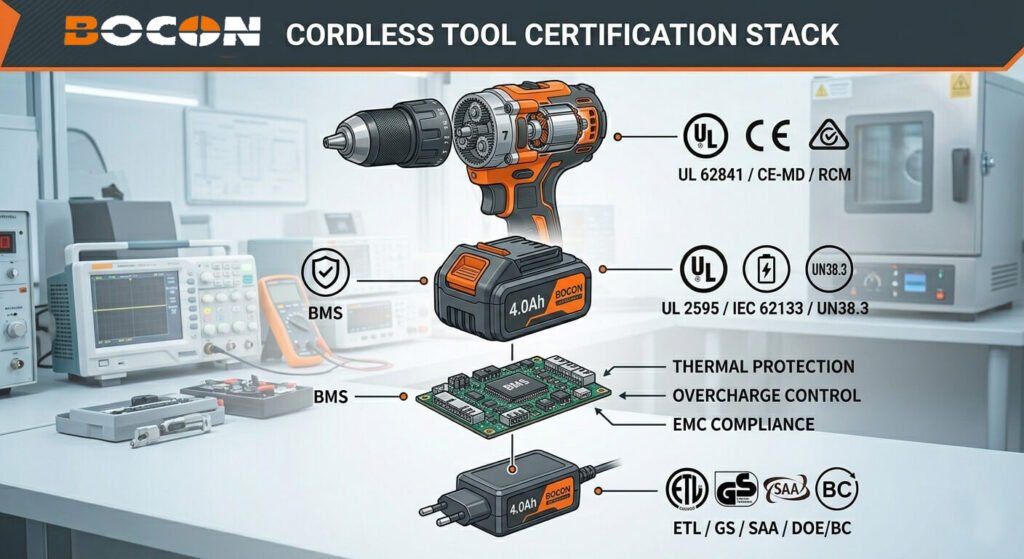
A cordless drill is not just a motor in a housing. It’s a lithium-ion battery system with a Battery Management System (BMS) board, a charger, and a tool body — and in the eyes of most regulators, each of those components has its own compliance requirements. Getting the tool body certified and assuming the battery comes along for the ride is how you end up with a product that clears factory audit but gets flagged at port.
The second complicating factor is voltage range. Most modern cordless tools run on 18V to 60V battery platforms. The EU’s Low Voltage Directive (LVD) kicks in at 50V AC or 75V DC. That boundary matters for how you structure your CE documentation. If your platform sits right at that edge, you need to know exactly which directive applies — and which testing standard goes with it.
The US Market: What You Actually Need
UL 62841 — The Core Safety Standard
The standard that governs cordless power tools in the United States is UL 62841, which is the American adoption of the international IEC 62841 series. This standard replaced the older UL 60745 series, and if you’re still working from documents referencing the old standard, you need to update your files.
UL 62841 breaks into two tiers: the general requirements in Part 1, and the tool-specific requirements in Part 2 (Part 2-1 covers drills and impact drills, Part 2-2 covers screwdrivers, and so on). Your product needs to demonstrate compliance with both the applicable Part 2 and Part 1.
In the US, there are two main routes to carrying a recognized safety mark:
UL Listed — tested and certified by UL (Underwriters Laboratories) directly. The UL Mark is widely recognized and required by many retailers, particularly for professional-grade tools entering big-box hardware stores or OSHA-regulated work environments.
ETL Listed — tested and certified by Intertek, which is another NRTL (Nationally Recognized Testing Laboratory). Functionally equivalent to UL for most commercial purposes, and often faster or more affordable depending on the lab’s queue.
Both marks tell buyers the product was independently tested to the applicable safety standard. Self-declaration is not an accepted route for the US market the way it is in the EU.
Timeline: Budget 10–16 weeks from sample submission to receiving your mark. Labs are frequently backlogged, and if your product fails initial testing — which happens — you’re looking at retesting cycles.
Cost ballpark: $3,000–$8,000 for UL or ETL certification on a standard cordless drill. Higher for multi-product families, lower if you’re sharing a platform across SKUs.
FCC Part 15 — For Electronics That Emit Radio Frequency
If your cordless tool incorporates any wireless communication — Bluetooth connectivity for a battery gauge app, wireless work light control, anything that transmits radio frequency — it must comply with FCC Part 15. This is administered by the Federal Communications Commission and covers unintentional emitters as well as intentional transmitters.
Even if your tool has no wireless features, the motor and control electronics can be incidental RF emitters. For most standard cordless tools, FCC Part 15 Class B compliance is satisfied through emissions testing during UL/ETL certification. But if you have any smart features or wireless integration, that needs to be explicitly tested and declared.
UN38.3 — The Battery Transport Requirement That Trips Everyone Up
This is the one most factories handle wrong, and it costs buyers the most.
UN38.3 is the United Nations test protocol for lithium batteries in transport. It’s not optional, it’s not covered by UL certification, and it applies to every shipment of lithium-ion battery packs — whether by air or sea.
Here’s where it gets complicated: there are two levels of UN38.3 compliance you need to understand.
Cell-level UN38.3: Covers the individual 18650 or 21700 cells inside your battery pack. Your battery cell supplier should have this documentation. Get it. Verify it.
Pack-level UN38.3: Covers the assembled battery pack — the specific combination of cells, BMS board, housing, and wiring that makes up your finished product. A cell-level UN38.3 report does NOT cover the assembled pack. The pack must be tested independently.
I have personally seen a shipment of 3,000 cordless drill kits held at a US port because the importer had cell-level documentation but had never commissioned a pack-level UN38.3 test. That’s a six-figure problem. Do the test.
One more thing: UN38.3 reports age. The standard is updated on a roughly two-to-three-year cycle. If your report references a superseded version, customs authorities in some markets will reject it. Check the issue date on your documents.
TSCA and REACH (Chemical Compliance)
Technically not a “power tool” certification, but it affects the materials used in your housing, packaging, and cable insulation. RoHS restricts ten hazardous substances in electrical and electronic equipment — lead, mercury, cadmium, hexavalent chromium, and several flame retardants and plasticizers. For the US market, REACH chemical compliance may also be relevant if your buyer is a large retailer with their own supply chain requirements.
Most reputable Chinese manufacturers test to these standards as a matter of course. But if you’re sourcing from a new factory, ask for the RoHS test reports and make sure they cover the finished product — not just the metal components.
The EU Market: CE Marking and the Documentation Behind It
Understanding CE: It’s a Declaration, Not a Certificate
This is the most misunderstood aspect of European compliance, and it creates a specific risk when sourcing from China.
CE marking is a self-declaration by the manufacturer that the product meets all applicable EU directives. There is no official third-party body that “issues” a CE certificate for most power tools — the manufacturer tests to the relevant standards, compiles the technical documentation, and issues the Declaration of Conformity (DoC) themselves.
What this means in practice: if a Chinese factory hands you a stamped document labeled “CE Certificate,” that document has no legal standing under EU law unless it’s an actual test report from an accredited laboratory or a properly formatted Declaration of Conformity. Many factories produce CE documents that look official but are meaningless.
What you need is:
- A test report from an accredited laboratory (CNAS-accredited for international recognition, or from a European notified body like TÜV, SGS, Intertek EU)
- A Declaration of Conformity in the correct EU format, signed by the legal manufacturer or their EU-authorized representative
- A Technical Construction File (TCF) that you maintain in your records — not something you send anywhere, but something regulators can request if there’s ever a market surveillance inquiry
The Three Directives That Apply to Cordless Power Tools
Most cordless power tools need to satisfy at least three EU directives simultaneously:
Low Voltage Directive (LVD) 2014/35/EU — covers electrical safety for equipment operating between 50–1000V AC or 75–1500V DC. This applies to your charger and, depending on voltage, may apply to the tool itself. The relevant harmonized standard is EN 62841 (the European equivalent of IEC 62841).
Electromagnetic Compatibility Directive (EMC) 2014/30/EU — covers both emissions (the tool interfering with other devices) and immunity (the tool being immune to interference from other devices). The harmonized standard is EN 55014-1 for emissions and EN 55014-2 for immunity. EMC testing is done in a shielded chamber and is typically the longest part of the EU testing process.
RoHS Directive 2011/65/EU (and its amendment 2015/863/EU) — restricts the ten hazardous substances mentioned earlier. Unlike CE, this is not self-declaration — you need test reports, typically using XRF screening plus wet chemistry confirmation for suspect materials. RoHS testing is relatively affordable (around $120–150 per material sample) but needs to be done on each material and component category.
The Machinery Regulation (EU) 2023/1230 also applies to power tools, replacing the old Machinery Directive 2006/42/EC. If you’ve been selling into the EU for a while and your documentation references the old directive, it’s time to update — the new regulation came into full effect in January 2027, but you should be building against the new requirements now.
WEEE and Battery Directive Compliance
WEEE (Waste Electrical and Electronic Equipment Directive) requires that your product be registered with a WEEE compliance scheme in each EU country where you sell. This is not a product test — it’s a registration obligation. Your EU importer or distributor typically handles this, but if you’re a factory selling direct-to-brand, you need to ensure someone is registered.
The EU Battery Regulation (2023/1542/EU) — which replaced the old Battery Directive — now requires battery labels with a QR code linking to an electronic product passport (for batteries above 2kWh), carbon footprint declarations for industrial and EV batteries, and recycled content minimum thresholds being phased in from 2026. For lithium battery packs in cordless tools, the labeling and marking requirements are the most immediately relevant part.
GS Mark — Not Required, But Worth Having for Germany and DACH
The GS Mark (Geprüfte Sicherheit — “tested safety”) is a voluntary German product safety certification administered by notified bodies like TÜV SÜD, TÜV Rheinland, or Dekra. It is not required by law, but in the German, Austrian, and Swiss retail market, it carries significant commercial weight. Many German distributors won’t take a product without GS.
If you’re planning serious distribution in the DACH region, add GS to your EU compliance package. It requires independent third-party testing — you cannot self-certify for GS — but the testing overlaps substantially with what you’ve already done for LVD and EMC, so the incremental cost is manageable.
The Australian Market: RCM, EESS, and Why You Need a Local Responsible Supplier
Australia has the smallest of the three markets but arguably the most precise documentation requirements — and the one that most exporters underestimate.
RCM — The Mark That Replaced C-Tick and A-Tick
The RCM (Regulatory Compliance Mark) is a combined marking that indicates compliance with both electrical safety (under the state/territory Electrical Equipment Safety System, EESS) and electromagnetic compatibility (under ACMA — the Australian Communications and Media Authority). It replaced the old C-Tick (EMC) and A-Tick (telecommunications) marks in 2016.
To affix the RCM to your product, the responsible supplier must have completed:
- Safety testing to AS/NZS 62841 (the Australian/New Zealand adoption of IEC 62841)
- EMC testing to AS/NZS CISPR 14-1 and AS/NZS CISPR 14-2
- Prepared and signed a Supplier’s Declaration of Conformity (SDoC)
EESS Registration — The Step Most Exporters Miss
For power tools classified as Level 3 electrical equipment under the EESS framework — which includes most consumer-grade cordless power tools and their battery chargers — you must register the product in the EESS database (eess.gov.au) before it can be legally supplied in Australia.
This is not a certification you apply for. It’s a database registration you complete yourself (or your Australian responsible supplier completes on your behalf). But it requires that you have a valid safety certificate from an accredited certification body first.
The critical catch: Registration in the EESS database must be done by an entity with an Australian Business Number (ABN). A Chinese factory cannot register directly. You need an Australian importer, distributor, or responsible supplier to be the registrant.
This means if you’re shipping into Australia and your buyer hasn’t set themselves up as a registered responsible supplier, the goods cannot legally be placed on the market — regardless of what certifications the product carries. I’ve seen this catch out distributors who assumed the factory’s compliance documentation was enough.
Applicable Testing Standards in Australia
| Requirement | Standard | Scope |
|---|---|---|
| Electrical safety — power tools | AS/NZS 62841-1 | General requirements |
| Electrical safety — battery chargers | AS/NZS 60335-2-29 | Battery charger safety |
| EMC emissions | AS/NZS CISPR 14-1 | Radio frequency emissions |
| EMC immunity | AS/NZS CISPR 14-2 | Radio frequency immunity |
| Battery transport | UN38.3 | Lithium pack transport |
Testing must be done by a laboratory accredited by NATA (National Association of Testing Authorities) or by an overseas laboratory accredited under the ILAC Mutual Recognition Arrangement (which covers most major international labs).
The Battery Layer: Certifications That Apply Across All Three Markets
Regardless of your target market, your lithium battery system needs its own compliance stack — separate from the tool body certifications.
| Certification | Market | What It Covers |
|---|---|---|
| UN38.3 | US / EU / AU | Lithium pack transport safety (mandatory for all shipments) |
| IEC 62133-2 | EU (harmonized standard) | Safety for portable lithium cells and batteries |
| UL 2595 / UL 62841 | US | Battery-powered appliances and power tools |
| IEC/UL 63370 | US / EU | Lithium-ion battery and charging system safety |
| EU Battery Regulation | EU | Labeling, QR code, carbon footprint (phased timeline) |
Two things worth underscoring:
First, the BMS inside your battery pack is an active electronic component, and its performance — overcharge protection, over-discharge protection, short-circuit cutoff, temperature monitoring — directly affects whether your pack passes safety testing. If you’re sourcing a finished battery pack from a supplier, ask specifically whether their BMS has been tested as part of the pack-level UN38.3 and IEC 62133 tests, not just whether the pack has those certifications in general.
Second, if your brand runs an interchangeable battery platform — meaning one battery works across multiple tool SKUs — each new tool model that uses that platform still requires its own tool-body compliance documentation. The battery certification doesn’t transfer to the new tool.
The Master Checklist: Organized by Market
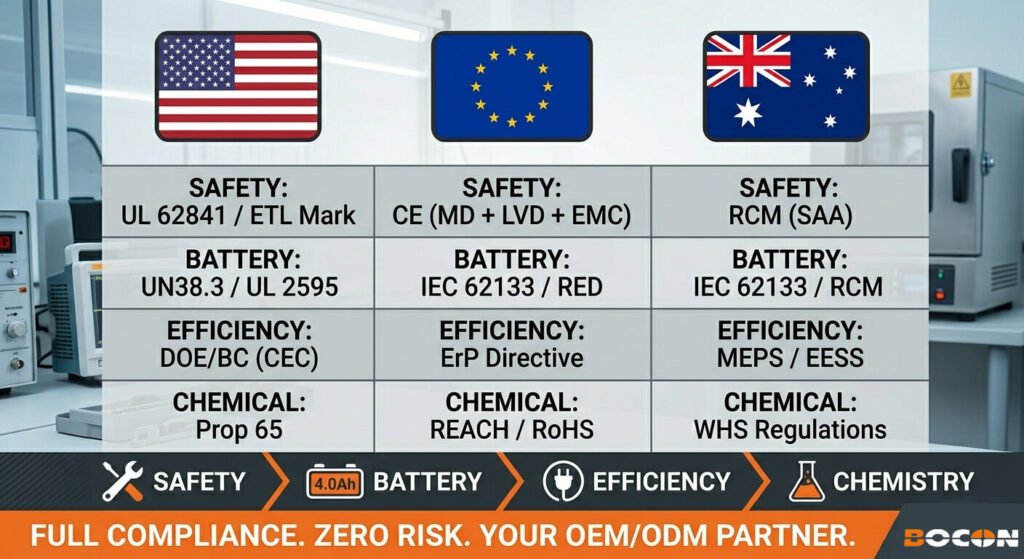
United States
- [ ] UL 62841 (UL or ETL Listed) — Part 1 (general) + Part 2 (tool-specific)
- [ ] FCC Part 15 — emissions testing (Part B for non-intentional emitters; additional if wireless features)
- [ ] UN38.3 — battery pack level (not just cell level)
- [ ] RoHS — material compliance test reports (if required by buyer or retailer)
- [ ] REACH/TSCA — chemical compliance (retailer-specific requirements vary)
- [ ] Battery cell supplier documentation — cell-level UN38.3, UL 1642 or IEC 62133
European Union
- [ ] CE Declaration of Conformity — signed, covering all applicable directives
- [ ] Technical Construction File — retained in-house, available on regulator request
- [ ] EN 62841 — electrical safety test report (LVD compliance)
- [ ] EN 55014-1 / EN 55014-2 — EMC emissions and immunity test reports
- [ ] RoHS Directive — test reports for all restricted substance categories
- [ ] WEEE registration — registered with scheme in target EU country/countries
- [ ] EU Battery Regulation labeling — QR code and mandatory markings on pack
- [ ] UN38.3 — pack-level transport documentation
- [ ] GS Mark (voluntary) — recommended for DACH distribution
Australia
- [ ] AS/NZS 62841-1 — electrical safety test report
- [ ] AS/NZS CISPR 14-1 / CISPR 14-2 — EMC test reports
- [ ] RCM mark — affixed only after SDoC is complete
- [ ] Supplier’s Declaration of Conformity (SDoC) — signed by Australian responsible supplier
- [ ] EESS Level 3 registration — registered in eess.gov.au by ABN-holding entity
- [ ] UN38.3 — pack-level
- [ ] AS/NZS 60335-2-29 — if charger is included in product kit
The Sequencing Problem: Why Getting the Order Wrong Is Expensive
Most exporters approach certification as something you do after the product is finalized — almost as a formality before shipment. That’s a mistake that costs real money, and I’ve seen it happen enough times to be direct about it.
The correct approach is to design against the standard. This means having your electrical engineering team reference UL 62841, EN 62841, and AS/NZS 62841 requirements during the development phase — not during pre-shipment testing. The requirements are largely harmonized, so a product designed correctly to IEC 62841 should pass in all three markets. But things like creepage distances, insulation materials, and grounding continuity need to be built in, not retrofitted.
The other sequencing issue is the pre-compliance test. Before submitting to UL or ETL for formal certification, have an internal engineer or a third-party lab run a pre-compliance check against the standard. This catches the most common failure modes — motor temperature rise, housing impact resistance, insulation resistance under humidity — before you’re on the clock at a certification lab. Retesting fees and schedule delays are expensive. Pre-compliance testing is not.
At Bocon, our standard practice is to run internal protocol testing before any formal submission, using the same test criteria that the accredited labs apply. This doesn’t eliminate failures, but it reduces first-submission pass rates from industry-average 60% to well above 80%. That’s a meaningful difference in time-to-market.
Red Flags When Evaluating Supplier Certifications
If you’re sourcing from a Chinese factory rather than developing your own product, here’s how to evaluate the certifications they present:
Ask for the actual test report, not just a certificate. A CE “certificate” issued by a Chinese agency with no EU authority is not valid CE documentation. You want the test report from an accredited lab (TÜV, SGS, Bureau Veritas, Intertek, etc.), and the Declaration of Conformity signed by the legal manufacturer.
Check whether the certification covers your specific product. Certification is product-specific. A UL mark for a 12V drill does not cover the 18V version. A CE declaration for a corded drill does not cover the cordless model. Ask for the scope statement on the test report.
Verify the battery pack is included. This is the most common coverage gap. Get explicit written confirmation that the UN38.3 report covers the pack-level assembly — with the BMS, in the specific configuration being shipped — not just the raw cells.
Check document dates. If the test report is more than three years old and references a superseded version of the standard, it may not be accepted. Markets are increasingly checking report dates, especially for UN38.3 battery documentation.
Ask about EU authorized representative. For selling into the EU, the product must have an EU Authorized Representative — a legal entity based in the EU who can be contacted by regulators. Many Chinese factories have this. Some don’t. If they don’t, and you’re the importer, you become the legal responsible party.
A Realistic Timeline and Cost Estimate
These figures are based on a standard 18V cordless drill/driver, tested independently for all three markets, starting from a finalized production sample.
| Market | Key Certifications | Typical Timeline | Rough Cost Range |
|---|---|---|---|
| US | UL/ETL + FCC + UN38.3 | 12–18 weeks | $5,000–$12,000 |
| EU | CE (LVD + EMC + RoHS) + WEEE | 8–14 weeks | $4,000–$10,000 |
| Australia | RCM (AS/NZS 62841 + CISPR) + EESS | 10–16 weeks | $3,500–$8,000 |
| All three (combined project) | Full multi-market compliance | 16–24 weeks | $12,000–$25,000 |
Note: GS Mark (voluntary) adds $2,000–$5,000 and 6–10 weeks. UN38.3 pack-level testing adds $800–$2,000 and 3–5 weeks on top of these estimates.
The spread within each range reflects whether this is a clean product with harmonized designs and good pre-compliance preparation, or a rushed one that goes into testing with unresolved engineering issues.
One cost-saving approach worth knowing: the CB scheme. IEC certifications issued under the IECEE CB scheme can be converted to national certifications in over 50 countries with reduced testing. If you get a CB test certificate for IEC 62841, it significantly reduces the incremental cost of adding additional national certifications later. It’s not a shortcut — you still need country-specific testing for parts of the standard that have national deviations — but it cuts a meaningful portion of the redundant work.
The Bottom Line
Exporting cordless power tools to the US, EU, and Australia is achievable for any factory with genuine engineering capability and a working quality system. The certification landscape looks complex from the outside, but once you understand the structure — tool body safety, EMC, chemical compliance, battery transport, and market-specific registrations — it becomes manageable.
The places where things go wrong are predictable: undertested battery packs, documentation that looks compliant but doesn’t cover the right product, and timelines that assume everything will pass first submission. None of these are hard problems to solve if you approach them before you’re under commercial pressure to ship.
If you’re at the stage of planning your compliance program for a new cordless product line — or auditing what a supplier has already provided — this checklist is a starting point. The details matter, and a compliance specialist who knows the specific market you’re entering is worth the cost before you start the testing process, not after you’ve already failed it.
References and Further Reading
- IEC 62841 Standard Series — IEC webstore
- UL 62841 Certification Services — UL Solutions
- CE Marking Requirements — European Commission
- Power Tool Regulations in the European Union — ComplianceGate
- RCM and Power Tools Compliance in Australia — Market Access AUS
- SAA Certification and RCM Requirements — Fanxstar
- EESS Registration Portal — eess.gov.au
- EU Battery Regulation 2023/1542/EU — EUR-Lex