
Every week, at least one buyer reaches out to us after a bad experience with their first power tool supplier. They usually have the same story: the factory looked good on paper, the sample was excellent, and the first container was a disaster.
When I ask what questions they asked before placing the order, the answer is almost always the same: they asked about price, MOQ, lead time, and certifications.
Those are fine questions. But they’re not the questions that actually separate a reliable OEM partner from one that will cost you more in the long run than you saved on the unit price.
I’ve been running export business from a cordless tool factory in Wuxi for fifteen years. This is what buyers should actually be asking — and what honest answers sound like.
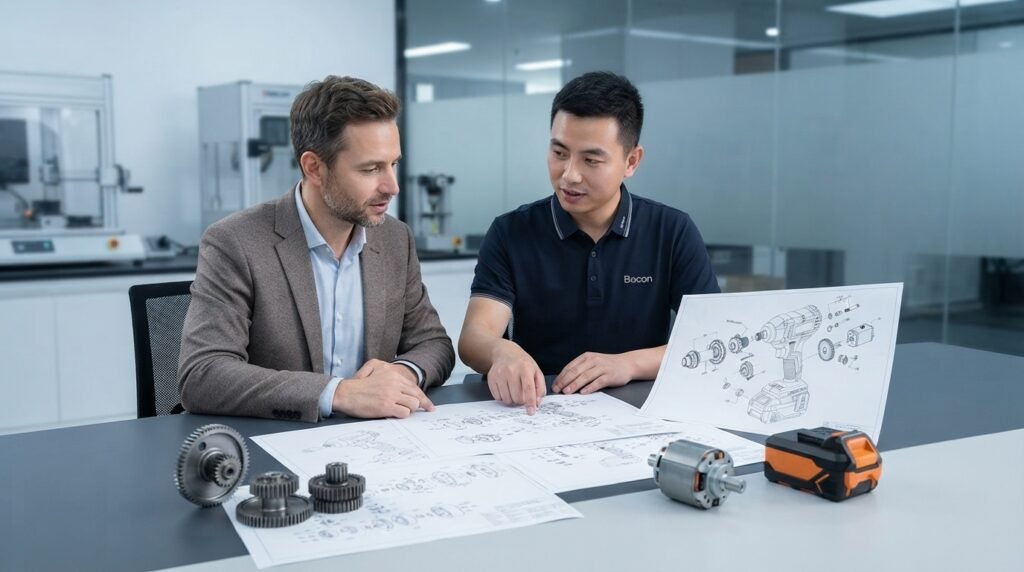
Q1: Can you show me your field failure data, not just your defect rate?
Why buyers ask this: A defect rate sounds like a quality metric. In practice, it’s almost always self-reported and optimistic.
Most factories will tell you their defect rate is under 1%. That number comes from their own quality report, which is written by the quality team that works for the same company that wants your order. It tells you what they found during their own inspection process — not what happened when the product was used in the field.
What you want is field failure data: what broke, where, after how many cycles, and what the factory did about it.
A factory that tracks field failure data is operating at a fundamentally different level than one that doesn’t. It means they have a system for collecting post-shipment data, an engineering team that reviews it, and a quality improvement process that acts on it.
What a good answer sounds like: “We track field failures by component across our entire client base. Here’s our breakdown for the past 12 months — you can see the gearbox, motor, battery, and BMS each account for a specific percentage of failures, and we can walk you through the corrective actions we took for each.”
What to watch out for: Vague answers like “our quality is very high” or “we rarely have problems.” A factory that’s proud of its quality will have numbers. A factory that’s hiding something will have marketing language.
Q2: Do you design your own BMS algorithm, or do you integrate a third-party chip?
Why buyers ask this: This question separates factories that understand battery safety from ones that are just assembling components.
Most buyers know they need BMS protection — battery management system, the circuit that prevents overcharge, over-discharge, short circuit, and thermal runaway. What most buyers don’t know is that there’s a significant gap between:
- A factory that buys a standard BMS chip from a supplier like Texas Instruments or RichTek and integrates it into the battery pack. This works. It passes basic regulatory tests. But the chip is designed generically for the broadest possible market, not for your specific cell chemistry, discharge profile, or thermal environment.
- A factory that designs and programs their own BMS algorithm. This requires genuine engineering talent — hardware designers, firmware programmers, and extensive field testing. It’s what the tier-one battery manufacturers do. It’s rare among Chinese OEM factories.
Why does this matter? Because when a battery fails in a way that creates a safety incident, the documentation of your BMS design becomes critical. If you can show that your BMS was engineered specifically for your product — not bought off a shelf — that’s a completely different legal and liability position than “we used a standard chip.”
At Bocon, our BMS algorithms are developed in-house by our engineering team. We can show you the firmware architecture, the thermal modeling data, and the test records. When I tell a European buyer that we handle BMS in-house, I can explain exactly what that means technically — not just hand them a certificate.
What to watch out for: “We have CE certification for the battery” is not the same as “our BMS is engineered correctly.” Push for technical detail. If a factory can’t explain their BMS architecture in plain language, they probably don’t understand it themselves.
Q3: What’s your actual production process — and which steps do you outsource?
Why buyers ask this: “We have our own factory” can mean anything from a fully integrated manufacturing facility to a trading company with a WeChat contact list.
I’ve seen factories that call themselves manufacturers but outsource motor winding, battery cell sourcing, gearbox production, and PCB assembly to separate suppliers. They’re essentially a final assembly operation — which isn’t necessarily bad, but you need to know what you’re actually buying.
When you outsource a production step, you lose visibility and control over that step’s quality. If the motor supplier has a bad month, the factory that outsources to them has to either accept lower quality or delay production. You become the casualty of someone else’s problem.
The factories worth working with are transparent about this. They’ll tell you which components they make in-house and which they source from qualified partners — and they’ll have quality agreements with those partners.
At Bocon, we manufacture motors, gearboxes, and BMS electronics in-house. We source battery cells from certified Grade A suppliers with whom we have long-term agreements. We don’t pretend otherwise.
What a good answer sounds like: “We machine our own gearboxes and wind our own motors. Battery cells come from three certified suppliers — here’s the qualification process for each. PCB assembly is done by a partner facility, but they’re ISO9001 certified and we do incoming inspection on every batch.”
What to watch out for: “We do everything ourselves” is almost certainly an overstatement. Even the best factories outsource some steps. The question is whether they’re honest about it and whether they have quality controls on what they outsource.
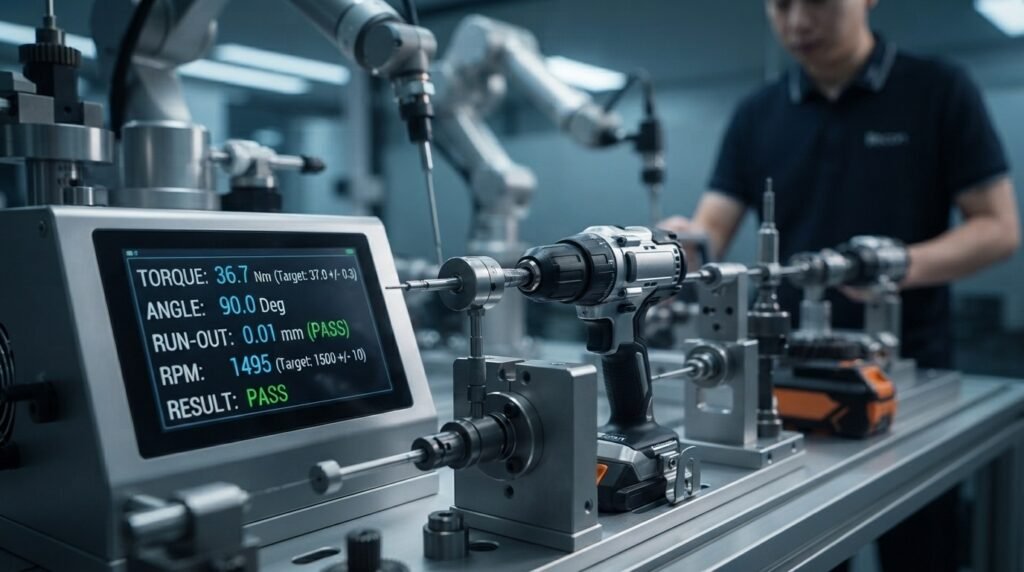
Q4: Can you give me the complete CE test report, not just the certificate?
Why buyers ask this: A CE certificate is a document that says a test was performed. A CE test report is the evidence of what was actually tested.
These are not the same thing.
I’ve seen factories show buyers a CE certificate that lists a test standard — “EN 62841-1:2015” — without the test report that shows what the actual results were. The certificate says the tool passed. The test report would show the specific measurements: torque output, no-load speed, temperature rise under load, noise levels, vibration. Without that report, you don’t know whether the tool passed because it met the standard or because the test was performed on a sample that was better than what went into production.
This matters especially for European market surveillance. When a national authority in Germany, France, or the Netherlands pulls a product and asks for documentation, the complete test report is what protects you.
What a good answer sounds like: “Here are our CE test reports, including the full measurement data for each standard. You can see the actual torque, temperature, and noise measurements — not just the pass/fail result. We can also provide the CB test report, which includes additional detail.”
What to watch out for: If a factory shows you a certificate but gets uncomfortable when you ask for the full report, that’s a serious warning sign. Legitimate test reports are not proprietary — they’re documentation of regulatory compliance, and every buyer has a right to see them.
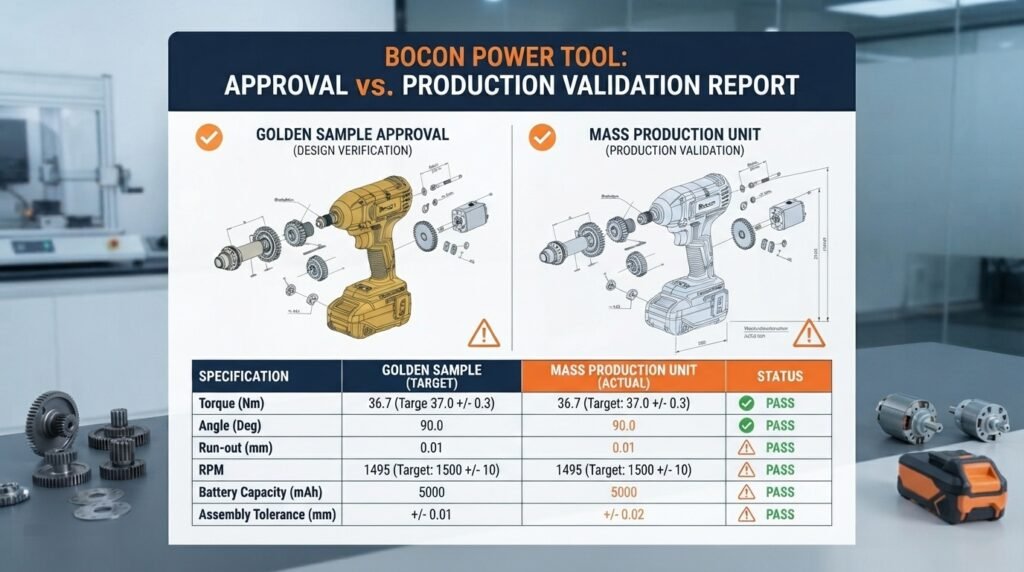
Q5: How do you ensure the product I receive matches the sample I approved?
Why buyers ask this: This is the single most common complaint I hear from buyers who came to us after a bad experience elsewhere.
The sample worked. The first container didn’t.
This happens because many Chinese factories run two different production standards: one for samples and one for bulk orders. Sample production gets individual attention — engineers tweaking parameters, QC staff inspecting every unit. Bulk production runs at speed, with different staff and different priorities.
The best factories don’t do this. They run the same process for every unit, because their quality system doesn’t allow for a split. At Bocon, the sample you approve is made on the same line, with the same components, by the same operators who will build your bulk order. The difference is that bulk production runs faster — but the specification doesn’t change.
What a good answer sounds like: “We don’t run separate production lines for samples and bulk orders. When you approve a sample, you’re approving the production standard — and that’s what every unit in your order is built to. We can show you our process control documentation that proves this.”
What to watch out for: Answers like “our quality is the same for everything” without process documentation to back it up. Push for specifics. How do they control component consistency between batches? What incoming inspection do they perform on raw materials? How do they handle a situation where a component supplier sends a batch that’s slightly out of spec?
Q6: What happens if a component supplier fails to deliver on time?
Why buyers ask this: In 2021, when lithium battery cell prices spiked and availability tightened globally, factories with a single battery supplier had to stop production or renegotiate prices with buyers. Factories with multiple certified suppliers absorbed the shock and continued delivery.
Supply chain resilience is not something you discover you need after a disruption. It’s something you plan for before you sign a contract.
What a good answer sounds like: “We maintain three or more certified suppliers for each core component — battery cells, motors, gears, electronics. If our primary cell supplier has a capacity issue, we have qualified alternatives ready. Here’s the supply chain map for the battery pack specifically.”
At Bocon, we maintain 35+ certified backup suppliers for core components. This isn’t a number we put on a website — it’s a deliberate strategy that we’ve invested in over years, because our European retail clients depend on us for continuity of supply.
What to watch out for: “We have long relationships with our suppliers” is not a supply chain strategy. Ask specifically: how many suppliers for battery cells? For motors? For electronic components? If the answer is “one,” that’s a vulnerability, not a relationship.
Q7: What’s included in your quoted price, and what isn’t?
Why buyers ask this: The initial unit price is almost never the full cost. Most buyers discover hidden costs after they’ve committed — tooling fees, packaging design costs, certification charges, shipping surcharges, minimum quantity premiums.
This isn’t necessarily dishonest — some costs are genuinely variable. But a factory that surprises you with unexpected charges after you’ve placed an order is a factory that didn’t communicate clearly at the start. That’s a relationship problem before the first container ships.
What a good answer sounds like: “Here’s our complete cost breakdown: unit price, packaging cost per unit, tooling investment (if applicable), certification fees, and estimated shipping to your port. We’ll also flag which costs are fixed and which could change based on commodity prices or exchange rates.”
Ask specifically about: packaging design and printing (tooling costs for custom boxes), logo application (is pad printing included or is it a separate setup fee?), sample costs (are they credited against your first order?), and inspection fees (is pre-shipment inspection included or charged separately?).
What to watch out for: A quoted price that’s significantly lower than competitors. There’s usually a reason — and the reason usually shows up as a hidden cost later, or as a quality compromise that you won’t see until the product reaches your customers.
Q8: What’s your lead time for tooling, samples, and first production order?
Why buyers ask this: Most buyers focus on production lead time and ignore tooling and sample timelines. But if you’re building a private label product — which means custom tooling, custom packaging, and custom branding — the real timeline starts much earlier.
I’ve seen buyers plan a product launch for Q3, only to discover after signing a contract that tooling takes 8 weeks, samples take 4 weeks to approve, and production scheduling adds another 6 weeks. By the time they factor in shipping from China to Europe, they’re looking at Q4 or later.
What a good answer sounds like: “Tooling for a new product typically takes 6-10 weeks, depending on complexity. Sample production takes 2-3 weeks after tooling is complete. First production order typically ships 5-7 weeks after sample approval. We’ll give you a detailed project timeline before you commit.”
Also ask: what happens if there’s a delay? Will the factory tell you proactively, or will you find out when the expected ship date passes with no update?
What to watch out for: Promises that seem too fast. If a factory tells you they can have tooling done in two weeks and samples ready in three, that’s a red flag — either they’re rushing a process that shouldn’t be rushed, or they’re lying about the timeline to close the deal.
Q9: Do you have experience with European retail compliance requirements beyond CE?
Why buyers ask this: CE is the minimum requirement for selling power tools in Europe. But European retailers — especially in Germany, France, and the Nordic countries — often have additional requirements above and beyond what CE demands.
These can include: REACH compliance documentation for materials used in battery packs and plastic housings, specific packaging labeling requirements for individual countries, WEEE registration and producer responsibility obligations, and documentation requirements for the EU Battery Regulation (2023/1542) which has specific requirements for rechargeable battery products sold in Europe.
A factory that’s serious about the European market will have experience with these requirements. A factory that’s focused primarily on the US market may not — and that experience gap can cost you time and money when you’re trying to get product onto European shelves.
What a good answer sounds like: “We’ve shipped to German, French, and UK retailers. We can provide REACH compliance documentation, EU Battery Regulation documentation, and country-specific packaging specifications. Here’s how we handle the documentation requirements for each.”
What to watch out for: “We have CE, so we’re good for Europe.” CE is the floor, not the ceiling. If a factory doesn’t understand the difference, they haven’t worked extensively with European retail markets.
Q10: Can I speak with your engineering team directly, not just your sales team?
Why buyers ask this: Sales teams are great at answering questions about price, lead time, and certifications. They’re less useful when you need to discuss torque specifications, battery platform compatibility, or a custom modification to an existing product.
The factories that are genuinely engineering-driven will connect you with their technical team — not just route your email to an engineer and call it done, but establish an ongoing technical dialogue. This matters most when you’re developing a new product, when you need to modify an existing tool for your specific market, or when something goes wrong and you need root cause analysis rather than a stock apology.
At Bocon, every buyer inquiry is reviewed by our engineering team. When we say we can build a custom tool, we can walk you through the engineering process — not just hand you a catalog number.
What a good answer sounds like: “Absolutely — here’s the direct contact for our lead engineer. For any technical questions, she’ll respond directly. For orders in progress, you’ll have a dedicated project manager who coordinates between you and the production team.”
What to watch out for: “I’ll check with our engineering team and get back to you” becomes a dead end when it happens for every technical question. A factory that can’t give you direct access to technical expertise is a factory where engineering and sales don’t communicate — which is a sign of a larger organizational problem.
Q11: What warranty and after-sales support do you provide?
Why buyers ask this: Most Chinese OEM factories offer a standard 12-month warranty. But the practical value of a warranty depends entirely on what it covers, how claims are processed, and whether the factory has the engineering capability to actually fix recurring problems.
A warranty from a factory that can’t diagnose why their products are failing is worth very little. A warranty from a factory that tracks field failures and implements engineering corrections is worth considerably more.
Ask specifically: what does the warranty cover (parts, labor, shipping)? How are claims processed? Who pays for shipping defective units back to China? Is there a threshold below which you absorb minor defects rather than processing a warranty claim? What’s the factory’s track record on warranty claim resolution time?
What a good answer sounds like: “We offer a 12-month warranty covering manufacturing defects. We track warranty claims by component and review them monthly with our engineering team — if we see a pattern, we investigate and correct it. For bulk orders, we’ll agree on a defect threshold and claim process that makes practical sense for both sides.”
What to watch out for: Unlimited warranties sound impressive but are meaningless if the factory doesn’t have the processes to back them up. A warranty is only as good as the factory’s ability to honor it.
Q12: Have you worked with European retailers before, and can I contact a reference?
Why buyers ask this: Experience with European retail markets isn’t just about certifications. It affects how the factory thinks about packaging (European shelf requirements, multilingual labeling), documentation (what customs and retail compliance officers expect to see), communication style (European business culture values directness and specificity), and problem resolution (European retailers have different expectations around response times and accountability).
A factory that’s shipped successfully to German or French retailers for several years has already made the mistakes that a new factory will make with your order. That experience has value.
What a good answer sounds like: “Here are three European retail clients we currently work with — I can provide contact information for two of them directly, and I’ll ask the third. You can speak with them about their experience with our quality consistency, communication, and response to issues.”
What to watch out for: A factory that claims European retail experience but can’t name a specific client or provide a reference. “We’ve worked with European companies” is not the same as “we have current European retail partners who can speak to their experience with us.”
The Question Most Buyers Forget to Ask Themselves
After fifteen years of export business, here’s what I’ve learned: the right questions to ask a factory depend on what you’re actually trying to build.
If you’re launching a mid-range private label line for a European hardware chain, you need a factory that understands European retail compliance, can handle the packaging and documentation requirements, and has the production consistency to keep your shelves stocked without quality variation between batches.
If you’re building a professional-grade cordless platform that competes with established brands, you need a factory with genuine engineering depth — not just assembly capability — and the BMS and motor design expertise to back up your performance claims.
If you’re testing a new product concept with a small first order, you need a factory that’s willing to work with a lower volume, provide genuine technical feedback on your design, and grow with you as the product gains traction.
None of these are wrong approaches. But they require different things from your OEM partner. Before you start asking factories questions, know what you’re actually trying to build — and find a factory whose experience matches your ambition.
If you’re at the beginning of that evaluation process and want to have a direct conversation with us, we’re at www.oemcordlesstools.com or shawn@oemcordlesstools.com. We don’t do high-pressure sales. We do honest conversations about what we can build and what we can’t.
Quick Checklist: 12 Questions to Ask Before Your First Order
- [ ] Can you show me your field failure data, not just your defect rate?
- [ ] Do you design your own BMS algorithm, or do you integrate a third-party chip?
- [ ] What’s your actual production process — and which steps do you outsource?
- [ ] Can I see the complete CE test report, not just the certificate?
- [ ] How do you ensure the product I receive matches the sample I approved?
- [ ] What happens if a component supplier fails to deliver on time?
- [ ] What’s included in your quoted price, and what isn’t?
- [ ] What’s your lead time for tooling, samples, and first production order?
- [ ] Do you have experience with European retail compliance requirements beyond CE?
- [ ] Can I speak with your engineering team directly, not just your sales team?
- [ ] What warranty and after-sales support do you provide?
- [ ] Have you worked with European retailers before, and can I contact a reference?
This article was written by the Bocon export team — cordless tool specialists who have made and shipped thousands of units to retailers across Europe and Australia. If you have technical questions about OEM cordless tool manufacturing, reach out to us directly.