
Most buyers start their search the wrong way. They find a ranked list of retail brands, compare torque numbers, and pick the one with the biggest spec sheet. Three months later, they’re dealing with premature battery failures, inconsistent torque delivery across units, and a supplier who stops responding.
I’ve spent 15 years on the factory side of this business — watching brands make those exact mistakes when sourcing cordless impact wrenches for their own private label or wholesale orders. This guide is written from that perspective. Not to sell you on any particular retail brand, but to help you understand what those spec sheets actually mean, which numbers are inflated, and what questions to ask before you commit to a supplier.
If you’re sourcing for a brand, stocking a retail shelf, or equipping a professional team, here’s what you actually need to know.
What Is a Cordless Impact Wrench — And Why Does It Matter for Your Sourcing Decision?
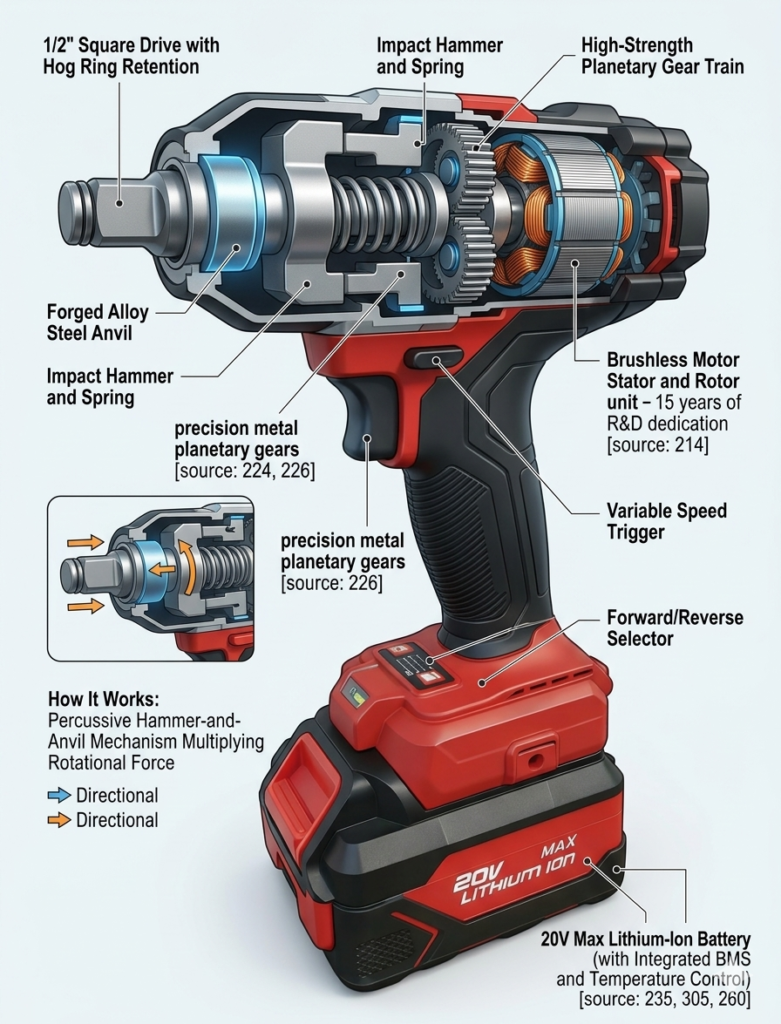
A cordless impact wrench is a power tool that delivers high rotational torque through a percussive (hammer) mechanism rather than continuous motor rotation. When the motor spins, a hammer strikes an anvil in rapid bursts — each strike multiplying the force applied to the fastener. This allows the tool to break free rusted or seized bolts that would stall a standard drill.
The critical point for buyers: the “impact” mechanism is where quality separates the real tools from the marketing exercises. A well-engineered impact mechanism delivers consistent torque with minimal vibration and heat buildup. A cheap one delivers inconsistent fastening, premature wear, and callbacks.
Most retail guides focus on what end users want. This guide focuses on what brand buyers and procurement managers need to evaluate when selecting a manufacturer or placing a private label order.
Torque — The Spec Everyone Quotes, Half of Them Inaccurately
What Torque Actually Means
Torque is the rotational force a tool can produce, measured in foot-pounds (ft-lbs) in North America or Newton-meters (Nm) in most other markets. For cordless impact wrenches, the relevant numbers are:
- Max torque: The peak force the tool can produce in laboratory conditions
- Breakaway torque: The force needed to loosen a stuck fastener — typically higher than max torque
- Fastening torque: The force used to tighten a bolt — typically lower than breakaway
Here’s what the spec sheets won’t tell you: “max torque” is often measured at the motor shaft, not at the socket. Power losses through the gear train and anvil mechanism mean the torque at the socket is consistently lower than the headline number. A tool claiming 1,500 ft-lbs of max torque might only deliver 900-1,000 ft-lbs at the socket.
At our factory, we test every production unit at the socket — not the motor. That’s the number that matters for your customers.
How Much Torque Do You Actually Need?
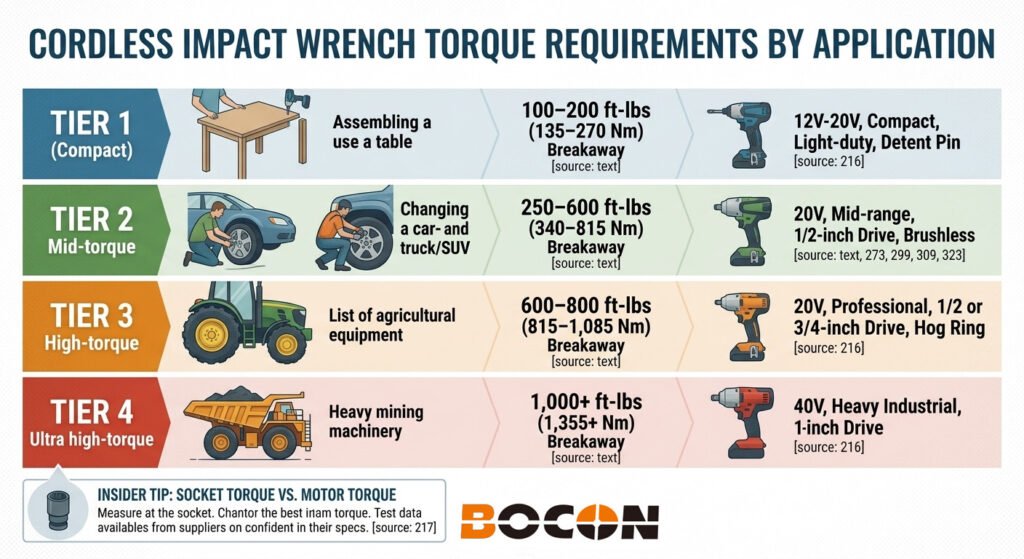
| Application | Breakaway Torque Required | Typical Tool Class |
|---|---|---|
| Flat-pack furniture assembly | 100–200 ft-lbs (135–270 Nm) | Compact / Light-duty |
| Tire changing (passenger vehicles) | 250–400 ft-lbs (340–540 Nm) | Mid-torque |
| Truck/SUV tire changing | 400–600 ft-lbs (540–815 Nm) | Mid-torque to High-torque |
| Agricultural equipment | 600–800 ft-lbs (815–1,085 Nm) | High-torque |
| Mining / heavy industrial | 1,000+ ft-lbs (1,355+ Nm) | Ultra high-torque |
For most retail buyers stocking a consumer or prosumer market, mid-torque (400–700 ft-lbs breakaway) covers 80% of end-user needs. Don’t overbuy unless your target market genuinely operates in the heavy industrial segment.
Insider tip: If a supplier quotes only “max motor torque” without specifying socket torque, ask for the actual test report. Suppliers confident in their specs will provide it. Those using inflated numbers will deflect.
Speed — RPM and Impacts Per Minute (IPM)
Speed in an impact wrench has two components:
1. RPM (revolutions per minute) — How fast the tool’s motor spins. Most cordless impact wrenches operate in the 0–2,500 RPM range, controlled by a variable speed trigger.
2. IPM (impacts per minute) — How many hammer strikes the tool delivers per minute. Range typically runs from 2,000 to 3,600 IPM.
Higher IPM means faster “striking rate,” which translates to quicker bolt loosening when the torque is sufficient. But IPM without adequate torque is meaningless — a 3,500 IPM tool that maxes out at 300 ft-lbs will bounce off a seized truck lug nut all day.
The spec sheets rarely tell you that torque and IPM often trade off against each other. A high-torque setting typically reduces IPM as the mechanism shifts to deliver stronger percussive force. The best tools maintain usable IPM across torque ranges — that’s a meaningful engineering difference.
What to ask your supplier: Does the tool maintain consistent IPM in high-torque mode, or does it drop significantly under load?
The Battery Platform Question — The Decision That Costs You Money Long-Term
This is the most underdiscussed topic in retail-focused impact wrench guides, and it matters enormously for brand buyers. Your battery platform choice isn’t just a product decision — it’s an ecosystem and cost-of-goods decision.
Voltage: 12V vs. 18V/20V vs. 40V
12V systems are compact and lightweight (typically under 2.5 lbs tool-only). They deliver 150–400 ft-lbs torque — useful for confined spaces and light-duty applications. For anything beyond flat-pack furniture and occasional tire changes, they fall short. If your target market includes professional mechanics or contractors, 12V is not a viable platform.
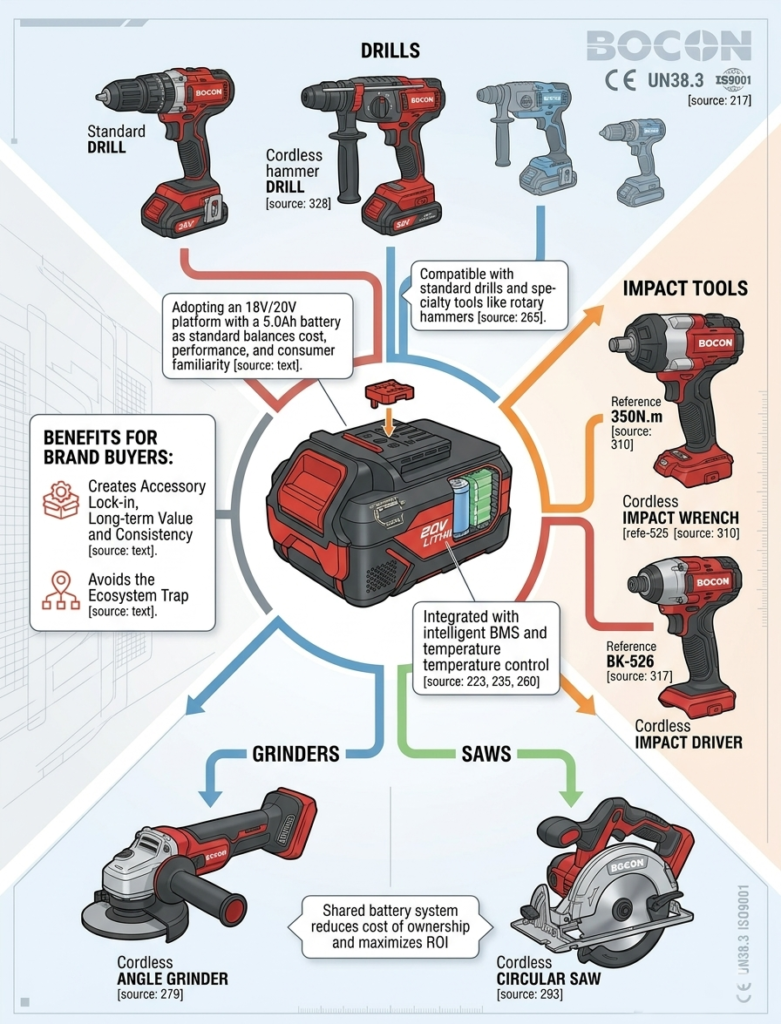
18V/20V systems (these are essentially equivalent — different manufacturers use different labeling conventions) are the standard for mid-to-professional cordless impact wrenches. They deliver 400–1,400 ft-lbs breakaway torque across the range and are supported by the widest ecosystem of tools, batteries, and chargers. This is where most private label and wholesale orders should focus.
40V systems target heavy industrial and professional users who need maximum power and runtime without the weight penalty of gas or pneumatic alternatives. They command a price premium and serve a smaller market segment.
Amp-Hours (Ah) — The Runtime Number
Battery capacity is measured in amp-hours (Ah). Higher Ah means longer runtime between charges.
For cordless impact wrenches under moderate use:
- 2.0–3.0 Ah: Light use, occasional jobs — charges deplete quickly under heavy load
- 4.0–5.0 Ah: The sweet spot for most users — 100–200 lug nut cycles per charge
- 6.0–8.0 Ah: Heavy professional use, all-day runtime
Important for brand buyers: Higher Ah batteries cost more to include in kits. Your BOM (bill of materials) cost scales directly with battery capacity. A 2-battery kit with 8.0Ah batteries costs significantly more than a 2-battery kit with 4.0Ah batteries — even if the tool itself is identical. Factor this into your landed cost calculation.
Brushed vs. Brushless Motors
Every reputable cordless impact wrench in 2026 uses a brushless motor. Brushed motors (with physical carbon brushes that wear down) are less efficient, generate more heat, and have shorter lifespans. If a supplier offers a brushed motor option to reduce cost, the torque and IPM specs will reflect the trade-off — and so will your warranty return rate.
The Ecosystem Trap
This is where brand buyers get caught. Most major tool brands (DeWalt, Milwaukee, Makita, Makita, Ryobi) have proprietary battery platforms. A DeWalt battery will not fit a Milwaukee tool.
For private label buyers: Your choice of which battery platform to adopt has long-term implications:
- A platform shared with major brands means end users can source batteries anywhere — convenient but erodes your accessory revenue
- A unique platform creates accessory lock-in but limits your battery ecosystem breadth
We typically recommend adopting a 18V/20V platform with a 5.0Ah battery as standard for mid-torque models — it balances cost, performance, and consumer familiarity.
Insider tip: Some budget suppliers cut costs by using lower-grade lithium-ion cells in their battery packs — the same voltage and Ah rating, but significantly shorter cycle life and higher self-discharge rate. Ask for the battery cell brand (Samsung, LG, Panasonic, Murata are the industry standards) and verify cycle life test data.
H2: Drive Size — The Detail That Determines What Jobs Your Tool Can Handle
The drive size (the square socket shank on the tool’s output) determines which socket sizes the tool can use:
- 1/4-inch hex: Used only with hex-shank bits — not a true impact wrench socket system; mainly for compact precision tools
- 3/8-inch drive: Handles smaller socket sizes; useful for light-duty mechanical work
- 1/2-inch drive: The standard for most automotive and general mechanical work; 70%+ of the market
- 3/4-inch drive: Heavy commercial and agricultural equipment
- 1-inch drive: Industrial applications — mining, heavy equipment, structural bolts
Most retail cordless impact wrenches are 1/2-inch drive. It’s the most versatile. If your target market is automotive, construction, or general mechanical, 1/2-inch is the answer.
Socket retention mechanism matters too: Most use a detent pin (spring-loaded pin that clicks into the socket hole) or a hog ring (circular clip that holds the socket). Hog ring mechanisms are generally more secure at high torque levels and are preferred in professional-grade tools.
Brushless Motors, Electronic Controls, and the Features That Separate Tiers
Variable Speed Trigger
A standard feature in any quality tool — allows the user to control output from low to full torque. Cheap tools sometimes have only two modes (on/off), which makes delicate work frustrating or dangerous.
Drive Modes
Mid-range and professional cordless impact wrenches increasingly offer multiple drive modes — typically 3–4 settings that adjust torque and IPM for different tasks:
- Mode 1: Precision / low torque
- Mode 2: Medium duty
- Mode 3: High torque
- Mode 4 (sometimes): Bolt breakaway mode (max reverse torque for stuck fasteners)
Electronic Overload Protection
This is critical for brand buyers — it protects the tool from damage when the user stalls the tool against an immovable fastener. Without overload protection, stalled motors overheat and burn out, generating warranty claims and reputation damage.
LED Work Light
Incremental but meaningful — if your end users work in wheel wells, undercarriages, or dim garages, the built-in LED light is a genuine utility feature, not a gimmick.
Cordless vs. Pneumatic — Why Cordless Is Winning in the Market
Most buying guides compare cordless to pneumatic tools, and the conclusion is consistent: cordless has won the convenience argument, and the performance gap has largely closed at mid-torque levels.
Pneumatic impact wrenches still deliver superior sustained high-torque performance for industrial applications (where a compressor is available), but cordless dominates at the retail, prosumer, and mobile professional levels.
For brand buyers sourcing cordless tools:
- Cordless units have fewer wearable parts than pneumatic (no air seals, o-rings, or oil maintenance)
- Cordless avoids the compressor dependency — a meaningful selling point for mobile mechanics, contractors, and rural users
- The battery cost is built into the product; no separate air system investment
The trade-off remains: sustained maximum torque under continuous use is still slightly better on pneumatic. If your market includes heavy industrial users with compressor access, consider a mixed product line.
7 Questions to Ask Your Supplier Before Placing an Order
After 15 years of receiving buyer inquiries, here are the questions that separate serious procurement professionals from first-time buyers:
1. What is the tested socket torque, not motor torque? (As discussed above — this exposes inflated spec sheets immediately.)
2. What battery cell brand is used in the packs, and what is the tested cycle life? A battery that loses 30% capacity after 200 cycles is a warranty nightmare. Quality cells maintain 80% capacity after 500 cycles.
3. What percentage of the tool’s components are manufactured in-house? A supplier who outsources motor assembly, gear casting, and electronic controls has less quality control than one who controls key processes internally. We cast our own planetary gears and assemble our own brushless motor units — that’s the kind of answer you want to hear.
4. What is the first-pass production yield rate? A factory with a 90%+ first-pass yield produces more consistent units. One running at 70% means 30% of units require rework — rework introduces variability.
5. What safety certifications do the tool and battery pack carry? For US market: UL or ETL listing on both the tool and the battery pack. For EU market: CE marking (though note — CE is self-declared, not independently verified; insist on IEC test reports). For Australia: SAA or RCM compliance. UN38.3 certification is mandatory for any lithium-ion battery that will be shipped by air or sea.
6. What happens when a unit fails under warranty? Some suppliers offer replacement only; others repair and return. The warranty process speed matters for your brand reputation — a slow warranty process generates bad reviews faster than the original defect.
7. Can you provide third-party test reports, not just your own spec sheets? Independent labs (SGS, TÜV, UL) provide verification that self-reported specs cannot.
The Real Cost Breakdown — What Affects Your Landed Cost
When sourcing cordless impact wrenches, the tool price is only part of the equation. Here’s what typically makes up your landed cost:
| Cost Component | Typical Share |
|---|---|
| Tool (FOB / EXW price) | 45–55% |
| Battery pack(s) | 20–30% |
| Charger | 5–10% |
| Packaging (gift box / retail packaging) | 5–10% |
| Certification and compliance testing | 3–8% |
| Shipping and logistics | 5–15% |
| Import duties (varies by destination) | Variable |
Battery selection has the largest variable impact on your BOM cost. A tool bundled with two 8.0Ah batteries costs substantially more than the same tool with two 4.0Ah batteries — even though the end user may not need the higher capacity.
Insider tip: Consider a tiered SKU structure — one kit at 4.0Ah for price-sensitive retail channels, one at 5.0Ah for the standard market, and an “extended kit” at 8.0Ah for professional users. Same tool, differentiated positioning, different price points.
Common Mistakes Brand Buyers Make
Mistake 1: Buying on peak torque, not socket torque. We addressed this. Socket torque is your real spec.
Mistake 2: Choosing a supplier based on the lowest unit price. The tool price is 45–55% of your landed cost. The remaining 45–55% (batteries, packaging, compliance, logistics) is where cheap suppliers make their money back — often at your expense.
Mistake 3: Ordering samples but not conducting production-line audit testing. A sample tool hand-assembled by the factory’s best technician doesn’t represent what comes off mass production. Request a pre-shipment inspection (PSI) or third-party lab test of production-line units.
Mistake 4: Skipping the UN38.3 certification conversation. If you’re importing lithium-ion battery products, UN38.3 testing is mandatory for transport. Some suppliers cut this corner — it can cause your shipment to be held or rejected at customs. Verify it before ordering.
Mistake 5: Underestimating the packaging cost impact. Custom retail packaging with your brand, UPC barcode, and compliance labels can add $2–5 per unit. Budget for it explicitly rather than discovering it after the order is placed.
What a Quality Cordless Impact Wrench Should Cost — Price Benchmarks
Based on current market pricing for mid-torque 18V/20V cordless impact wrenches (1/2-inch drive, brushless, 700–1,000 ft-lbs breakaway torque, with battery and charger):
| Tier | Target Market | Factory Price Range (FOB) | Retail Price Point |
|---|---|---|---|
| Economy | Price-sensitive DIY | $35–55 | $80–120 |
| Mid-range | Prosumer / serious DIY | $55–90 | $130–200 |
| Professional | Trade / mobile mechanic | $90–150 | $200–350 |
| Premium | Industrial / heavy-duty | $150+ | $350+ |
If a supplier quotes below the economy range for a tool with mid-torque specs, the quality or component consistency is being sacrificed somewhere. If a supplier quotes above the premium range, you’re paying for brand margin, not engineering.
What’s Coming Next — The Trends Shaping the Category
From our engineering floor, three trends are reshaping the cordless impact wrench category:
1. Higher voltage platforms moving down. 40V platforms that previously sat exclusively in heavy industrial are being miniaturized into the mid-torque form factor. Within two years, 40V mid-torque wrenches will be commercially viable for general automotive and contractor use.
2. Smart battery management integration. Bluetooth-connected battery packs that report charge level, cycle count, and health status to a mobile app. Early adoption by premium brands — becoming standard within three years.
3. Improved IPM at high torque. New gear and hammer mechanism designs are achieving 3,200+ IPM at 800+ ft-lbs torque — previously, you had to sacrifice speed for power. The trade-off is narrowing.
The cordless impact wrench market is mature enough that most suppliers can produce a tool that looks competitive on paper. The differentiation — for brand buyers and end users alike — lives in the details: actual socket torque (not motor torque), battery cell quality, production consistency, warranty support, and the honesty of the spec sheet.
If you’re sourcing for a brand or preparing to place a private label order, the most valuable thing you can do before choosing a supplier is ask for test data, not just specifications. A factory confident in its engineering will provide socket torque test reports, cycle life data, and production yield statistics. One relying on inflated numbers will find reasons not to.
We’ve spent 15 years refining our impact wrench line — from the planetary gear design to the BMS algorithm that manages thermal protection under sustained high-torque use. If you’d like to see how those specs translate into real-world performance data, or discuss what a private label order looks like for your market, reach out.