
Most sourcing guides give you a checklist of things to look for. Ask about MOQ. Check the certifications. Request a sample.
Good advice. Not enough.
The problem is that most factories know exactly how to answer generic questions. Ask a trading company “do you have ISO 9001?” and they’ll send you a beautiful certificate—possibly one from a different factory. Ask “what’s your lead time?” and they’ll quote you 30 days—even if production hasn’t started yet.
I’ve been on the other side of these conversations for over 15 years, first as a quality engineer and now in business development at Bocon, a cordless power tools factory in Wuxi, China. I’ve seen how these conversations go when buyers ask the right questions—and the wrong ones.
The questions below are the ones that actually separate factories that can build your brand from those that will damage it. For each one, I’m telling you exactly what a good answer looks like, and what answers should make you walk away.
Before You Even Ask: Know Who You’re Talking To
Before getting into the ten questions, do one thing first: verify you’re actually speaking with a manufacturer.
Search the company name on China’s National Enterprise Credit Information Publicity System (gsxt.samr.gov.cn). Legitimate factories are registered as manufacturing companies . If the company type shows as a trading company , you’re talking to a middleman—regardless of what their website says.
This matters because everything below—QC, certifications, customization depth—depends on the factory being who they claim to be.
Question 1: What Percentage of Your Components Do You Produce In-House?
Why this question cuts through the noise
A cordless power tool has five critical systems: motor, gearbox, battery pack, control board (PCBA), and housing. The more of these a factory produces in-house, the more control they have over quality, cost, and your delivery timeline.
Most factories don’t make everything internally—and that’s fine. What matters is what they make and what they buy.
What a good answer looks like
A real manufacturer will tell you precisely: “We produce our own motors, wind our own stator coils, and machine our gearboxes in-house. Battery packs use Samsung/LG cells assembled by our battery team. PCBA is purchased from our long-term partner, [name], with incoming QC on every batch.”
They’ll distinguish between critical components (motor, battery) and commodity parts (screws, wire, packaging material). They know the difference.
What a bad answer looks like
“We source everything from the best suppliers.” That’s not an answer—it’s a dodge. If a factory can’t tell you which components they produce and which they purchase, they’re probably a trading company or an assembler with no real manufacturing capability.
Follow-up: Ask to see the motor winding line on a video call. A factory with in-house motor production can walk you through it in 60 seconds.
Question 2: Which Battery Cells Do You Use, and Can You Show Me the Spec Sheet?
Why the battery answer reveals everything
The battery is 35–45% of your unit cost in a cordless tool. It’s also responsible for the majority of warranty claims, fire hazard reports, and Amazon listing removals. Getting the cell source wrong is the single most expensive sourcing mistake I’ve seen brands make.
And it’s exactly where low-cost factories cut corners without telling you.
What a good answer looks like
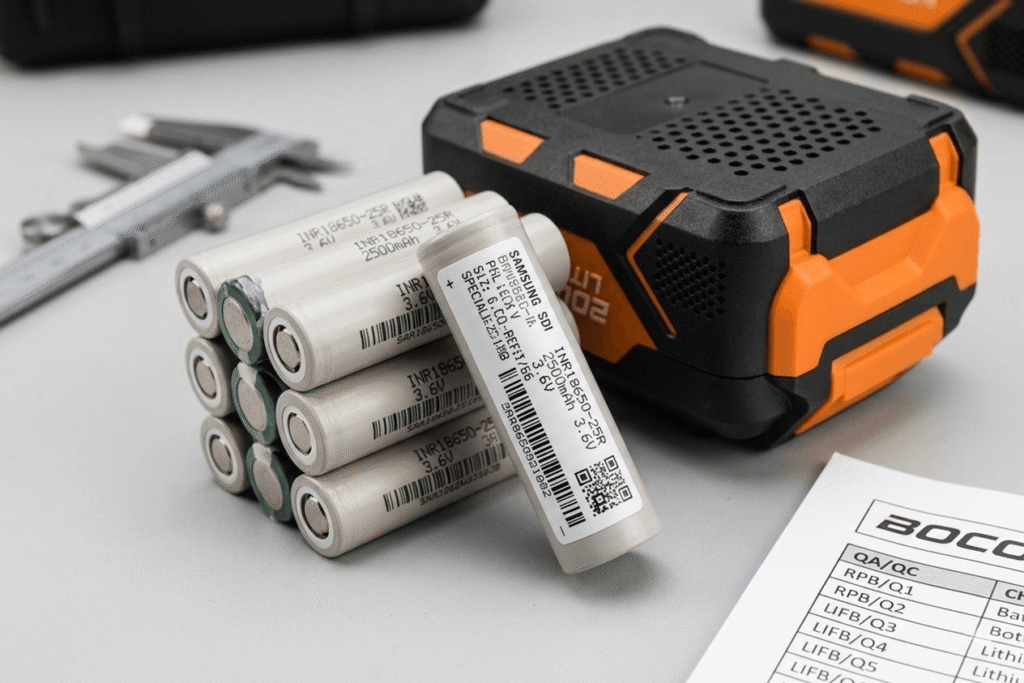
“We use Tier 1 cells—Samsung INR21700-50S, LG INR18650M26, or Panasonic NCR18650B depending on your voltage and amp-hour requirements. Here’s the specification sheet and our current supplier agreement.”
A legitimate factory knows their cell model numbers by memory. They can tell you the cycle life rating, the maximum discharge rate, and the operating temperature range—because these directly affect the tools’ performance and warranty claims.
What a bad answer looks like
“We use high-quality Chinese brand cells.” That means unbranded or second-tier cells with no traceable spec sheet—Lishen, BAK, or worse, generic cells with fake capacity ratings. Some of these cells are fine. Many are not. Without the spec sheet, you have no idea which you’re getting.
The trap to watch for: Some factories quote you a price based on Samsung cells, then switch to generic cells at production without telling you. Write the cell brand and model into your purchase contract. No exceptions.
Question 3: Walk Me Through Your Quality Control Process—From Raw Materials to Shipment
Why this reveals manufacturing maturity
Any factory can claim “strict quality control.” What you want is a description that’s specific enough to be verifiable. Vague answers mean there’s nothing to verify.
What a good answer looks like
A factory with a real QC system will describe it in stages:
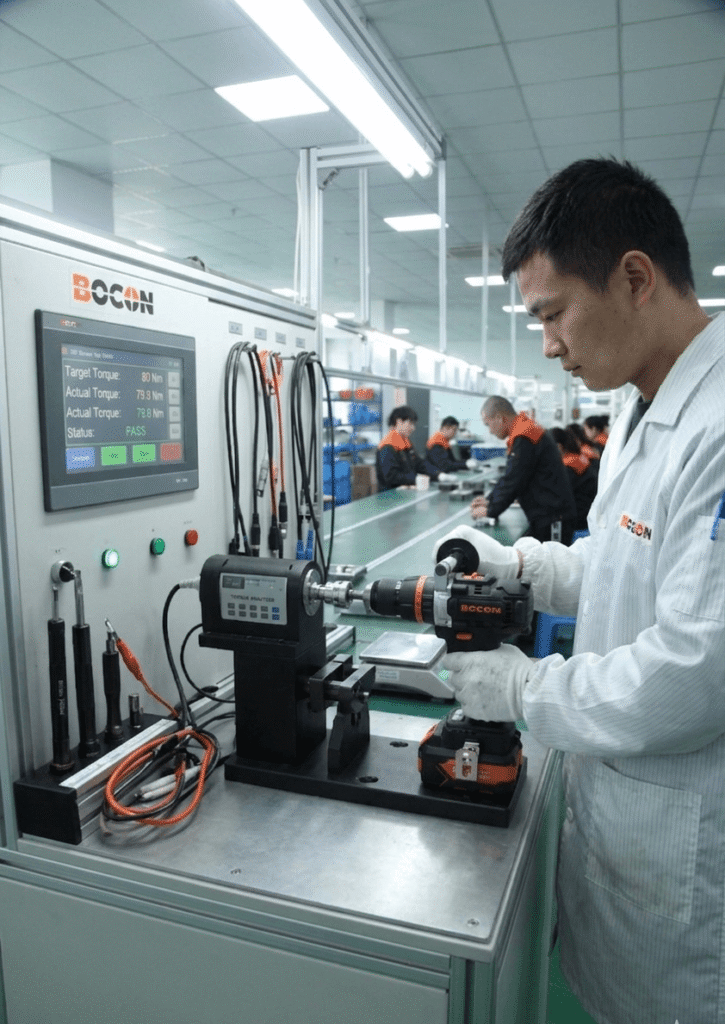
- Incoming inspection: Random sampling of components at receiving (torque testing on purchased motors, cell capacity verification on battery cells, dimensional checks on machined parts)
- In-process inspection: Inline torque tests after gearbox assembly, circuit continuity checks on PCBA before installation, housing fitment verification
- End-of-line testing: Full functional test on 100% of units—no-load RPM, loaded torque, battery charge/discharge cycle, drop simulation (sometimes)
- Pre-shipment inspection: AQL sampling against the golden sample before packing
They’ll likely mention the AQL level they work to (1.0–2.5 is standard) and whether they use an internal QC team or invite third-party inspectors.
What a bad answer looks like
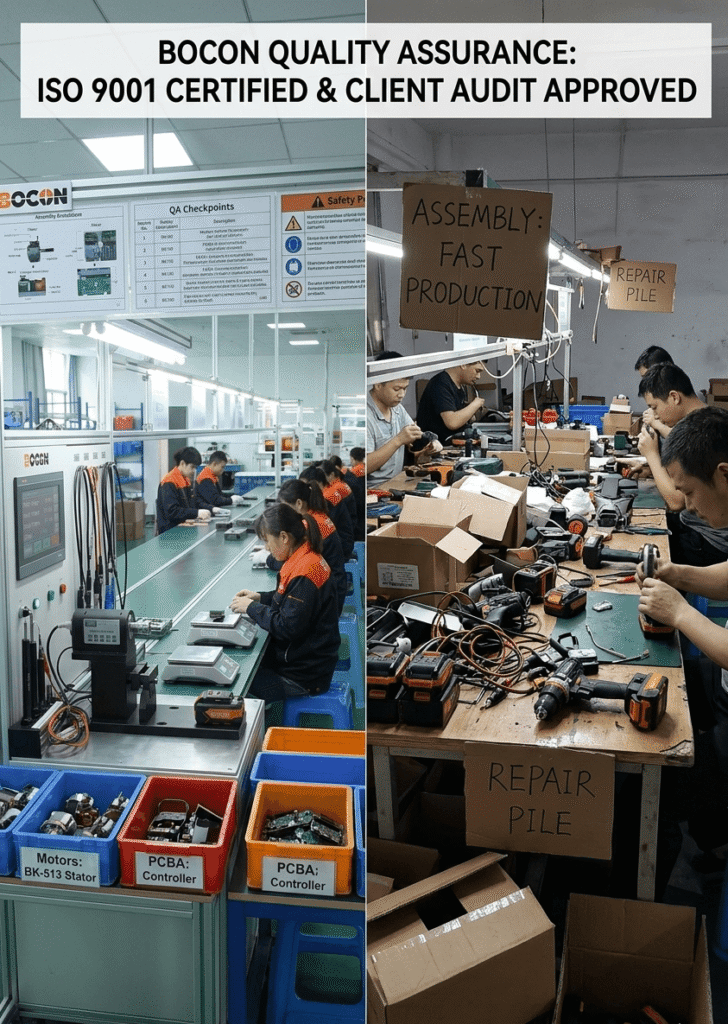
“Our workers check the quality during production.” No AQL. No mention of testing equipment. No golden sample reference. This tells you that their “QC” is whatever the assembly worker notices—not a system.
Important: Ask specifically whether they allow third-party pre-shipment inspections. Real factories say yes. Some factories say “we have our own QC, you don’t need it.” Walk away if they discourage third-party inspection. That’s not confidence—it’s a control tactic.
Question 4: What Certifications Do You Hold, and Do They Cover My Specific Product Configuration?
The certification trap no one warns you about
Most buyers ask “do you have CE?” and accept “yes” as the answer. That’s not enough—because CE certification is product-specific and configuration-specific.
Here’s what I mean: A factory might have CE for their standard 18V brushed drill. But if you want a brushless drill with a 4.0Ah battery instead of 2.0Ah, that’s technically a different product configuration—and their existing CE certificate doesn’t automatically cover yours.
What a good answer looks like
“We hold CE (LVD + EMC) and RoHS for our 18V brushless drill series, certified by TÜV Rheinland. Certificate number: [number]. The current certificate covers models with 2.0Ah and 4.0Ah battery packs in that series. If you modify the motor spec or housing, we’ll need to arrange a re-test, which typically takes 4–6 weeks.”
Notice: they cite the notified body (TÜV, SGS, Intertek—not a random Chinese lab), the specific directive, and they proactively flag the conditions under which re-testing is needed.
What a bad answer looks like
“We have all certifications.” That sentence means nothing. Ask to see the actual certificate, the issuing body name, the certificate number, and the exact product models it covers. If they stall, the certificate is probably fake or borrowed from another product.
For US buyers: Verify ETL or UL certificates on the issuing lab’s website. It takes two minutes. Real certificates are in their database.
Question 5: How Do You Handle the Transition from Sample to Mass Production?
This is where most brands get burned
A beautiful prototype sample and a production run of 1,000 units can be completely different products. I’ve watched it happen more times than I want to count—not always from malice, but because factories use hand-picked components for samples that aren’t the same components available in bulk at production volume.
What a good answer looks like
“We use a golden sample protocol. After you approve the sample, we seal and store three copies—one with you, one in our QC room, one for the third-party inspector. Every production unit is measured against those reference specs. We also lock the BOM after sample approval, so component substitutions require written sign-off from both parties.”
BOM-locking and golden sample triplication are the technical answers that prove a factory has a real process—not just intentions.
What a bad answer looks like
“Our production quality is the same as the sample.” No process description. No mention of BOM locking or golden samples. This means they’re relying on the same workers making the same decisions every time—without a reference point. That’s not quality control; that’s luck.
Minimum acceptable: A factory should at minimum keep one golden sample in their QC room, reference it during PSI, and have a written process for what happens when a production unit fails to match it.
Question 6: Do You Have In-House R&D and Tooling Capability?
Why this separates ODM factories from assemblers
If you’re building a private label brand, you’ll eventually want to differentiate—different housing color, a modified ergonomic grip, your brand’s signature LED pattern, or a custom battery indicator. Whether a factory can do that in-house tells you a lot about their actual depth.
What a good answer looks like
“We have an in-house R&D team of [X] engineers, including mechanical designers and electrical engineers. We own [X] mold sets and can modify or produce new molds in our tooling department. Average time from design to production-ready mold: 6–8 weeks for a full new housing, 2–3 weeks for a modification.”
They’ll know their mold lead times because they’ve done it. They’ll mention Solidworks or similar CAD software. They can show you renders of previous custom projects (even if client names are redacted).
What a bad answer looks like
“We can customize, just tell us what you want.” No mention of in-house tooling, no engineers cited, no timeline given. This factory will outsource your tooling to a third-party mold shop they have no control over—adding cost, lead time, and a point of failure outside your contract.
IP implication: If a factory owns their own tooling and mold assets, your custom design is more securely tied to your contract with them. If they outsource tooling, your mold might be stored at a third party with no legal obligation to you.
Question 7: What Is Your Supply Chain Backup for Critical Components?
The question no one asks until there’s a problem
COVID taught the industry a hard lesson about single-source supply chains. If your factory has only one battery cell supplier and that supplier stops production, your order is stuck—and you’re the one facing an out-of-stock situation with your retail buyers.
What a good answer looks like
“For motors, we have two qualified suppliers—our primary is [name], with [name] as backup. Battery cells: we run primarily Samsung and LG but can switch to EVE or CATL cells if required with 2–3 weeks for an incoming QC validation. We maintain 60–90 days of safety stock on motors and cells.”
Specific supplier names, specific backup options, specific safety stock levels. This is what supply chain resilience looks like in practice.
What a bad answer looks like
“We have relationships with many suppliers.” That’s not a backup plan. Without specific alternatives and transition timelines, “many suppliers” is marketing language for “we buy from whoever is cheapest this week.”
Why it matters for you: If you’re running a brand with committed retail shelf space or Amazon FBA inventory targets, a factory without backup supply options is a business continuity risk. One supplier disruption and your product goes out of stock.
Question 8: What Does Your Warranty Process Actually Look Like for My Customers?
Where most factories go silent
Every factory will tell you they offer a 1–2 year warranty. Very few will tell you what that warranty means operationally—who pays for shipping, what the RMA process looks like, how quickly defective units are replaced.
What a good answer looks like
“Our standard warranty is 24 months for the tool body and 12 months for the battery pack. For warranty claims, you maintain a small spare parts stock (we recommend 3–5% of order volume in replacement batteries and chargers). We supply replacement parts at cost with no handling fee. For verified factory-defect batches, we replace units FOB or issue credit notes. Typical resolution: 7–14 days for documentation, parts shipped within 3 weeks.”
Clear timelines, clear cost allocation, clear process. A factory that has done this before knows the specifics.
What a bad answer looks like
“We offer warranty and will handle problems.” This means: when a warranty claim arrives, you’ll discover that the factory expects you to ship defective units back to China at your cost, wait 60 days for assessment, and maybe receive a partial credit. That’s not a warranty—it’s a liability-transfer tactic.
Before signing: Ask for their warranty claims history as a percentage of shipments. A good factory will share this number (typically 0.3–1.5% for quality cordless tools). A factory that refuses to share has something to hide.
Question 9: Can You Provide References from Brands Currently Selling in My Target Market?
The reference question most buyers skip
Asking for references is obvious. Asking for references specifically from your target market is what filters out factories that are good for one market but wrong for yours.
Selling in Australia requires RCM certification and specific electrical standards. Selling in the EU requires CE from a recognized notified body. Selling in the US means tariff classification, UL or ETL, and increasingly, tariff engineering awareness under the current Section 301 regime.
What a good answer looks like
“We currently supply brands selling in Australia, Europe, and the US. I can share anonymized references for each market—they can speak to our compliance support, consistency, and responsiveness. With your permission, I can also introduce you directly to one or two if they’re willing.”
A factory that regularly exports to your target market knows the compliance requirements, has the right certifications in place, and has a logistics track record for that lane.
What a bad answer looks like
“We export worldwide.” That means nothing. Push for specifics: How many containers have shipped to Australia in the past 12 months? Which EU retailer requirements have they met? Can they name one brand (even if private, with permission) they supply in your market?
Why this matters: A factory that has never shipped to Australia might quote you a price that doesn’t account for RCM certification requirements—costing you $3,000–5,000 you didn’t budget for.
Question 10: What Has Gone Wrong with a Past Order, and How Did You Handle It?
The question that reveals character
This is the most important question on this list, and the one most buyers never ask.
Every factory has had a bad order. A motor supplier delivered a bad batch. A cell specs changed without notice. A container was delayed at customs and missed a product launch. What happened next is what you’re actually trying to find out.
What a good answer looks like
“About two years ago, we had a batch of motors from our secondary supplier that had a higher-than-spec no-load current draw. We caught it at incoming inspection on 40% of the batch. We held the order, notified the client, switched to our primary supplier, and remade the affected units. Total delay: 11 days. We absorbed the cost of the replacement units.”
Specific, without deflection. They own the problem. They describe the detection, the response, and the resolution—with timeline and cost accountability.
What a bad answer looks like
“We have very few problems.” Or: “Our quality is very stable.” These answers aren’t answers—they’re deflections. Every factory has had problems. A factory unwilling to share one means they’re either pretending or they have recurring problems they’re hoping you won’t find out about until it’s your order.
Why this question works: It’s not a trap. Most buyers never ask it. A factory that answers honestly, with detail and accountability, has demonstrated more trustworthiness in that one answer than a hundred polished sales presentations.
How to Use These Questions
Don’t send all ten as a questionnaire email. That’s too easy for a factory to prepare scripted answers.
Use them in a live video call, ideally during a virtual factory tour. Watch how long it takes the salesperson to get answers. Hesitation on Questions 2, 3, or 5 usually means they’re constructing an answer rather than recalling a process they live with every day.
The best factory conversations I’ve had—from the buyer side, when I was sourcing components for our own production—were with people who answered with more detail than I asked for, who corrected their own statements when they realized they weren’t being precise, and who referred me to their engineer for technical questions they weren’t certain about.
That’s what a factory with nothing to hide looks like.
A Note on the Evaluation Process
If you want a starting point for shortlisting factories, the Bocon inquiry process at www.oemcordlesstools.com is built around answering exactly these kinds of questions transparently. We’re not the right fit for every brand—but we’d rather you find that out in a 30-minute call than three months into production.