
When a cordless drill stops working, most people blame the motor. When a battery pack dies after six months instead of three years, almost everyone blames the cells.
Rarely does anyone blame the circuit board.
The Battery Management System — the small printed circuit board sitting inside every lithium-ion battery pack — is the component that determines whether your battery survives 500 charge cycles or 50. Whether your tool shuts down predictably when the cells are stressed, or whether it catches fire. Whether your brand accumulates warranty returns at 2% or 12%.
Yet in every factory I’ve visited over 15 years, BMS is the component most buyers never ask about. They check the cell brand. They verify the voltage and amp-hour rating. They ask for the datasheet. And then they skip the circuit board entirely.
This article is written to change that. Not because BMS is exotic or technically forbidding — it’s not — but because understanding it gives you an enormous advantage as a buyer. You can distinguish between a supplier who engineered their battery pack and one who assembled a parts list. You can predict warranty behavior before you place the order. And you can have a genuine conversation with your manufacturer about whether the BMS is right-sized for the application, or just the cheapest option that met the spec sheet.
What Is a Battery Management System (BMS)?
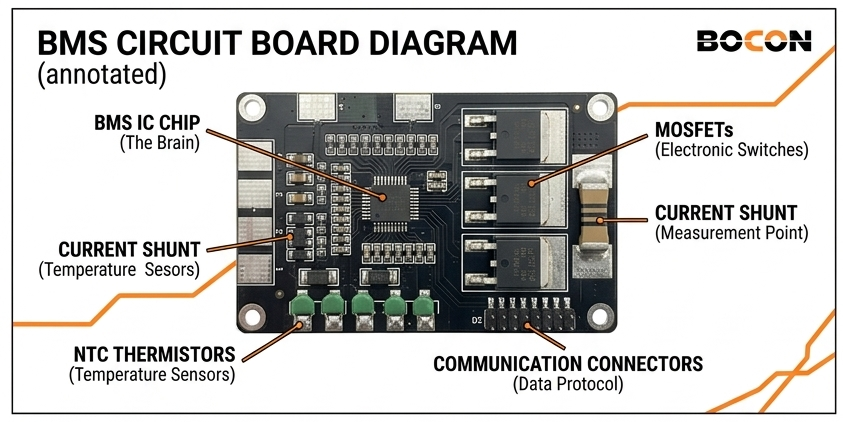
A Battery Management System is an electronic control circuit — a printed circuit board populated with specialized chips, MOSFETs (metal-oxide-semiconductor field-effect transistors), current shunts, and temperature sensors — that sits between the lithium-ion cells inside a battery pack and the tool or charger connected to it.
Think of it as the battery’s nervous system. It doesn’t store energy; it governs everything that happens to the energy stored inside the cells.
The BMS performs three core jobs:
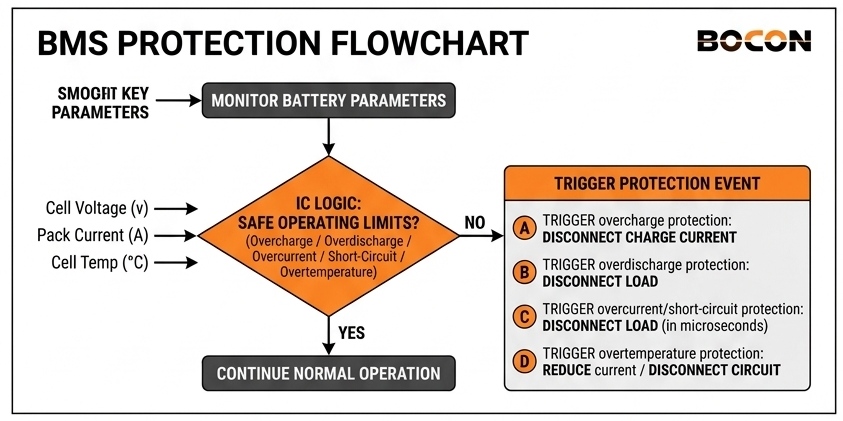
1. Protection — It continuously monitors cell voltage, pack current, and cell temperature. When any of these variables exceeds safe operating limits, the BMS disconnects the battery from the load or charger to prevent damage.
2. Optimization — It balances the charge across individual cells so they age at the same rate. It also manages charge and discharge rates to maximize the usable capacity of the pack.
3. Communication — In smart tools and branded platforms, the BMS communicates with the tool motor controller and charger via digital protocols, enabling features like state-of-charge display, tool-specific power limiting, and authentication of genuine battery packs.
Without a BMS, a lithium-ion battery pack operated outside its safe voltage or temperature range will degrade rapidly, overheat, or in extreme cases, enter thermal runaway. In a power tool — which routinely draws 20 to 50 amps during heavy use — the consequences of an unprotected battery are not theoretical.
The Hardware Layer — What a BMS Actually Contains
Most BMS boards in power tool applications contain these components:
BMS IC (The Brain)
The battery management IC (integrated circuit) is the core chip that runs the protection algorithms. This is where supplier quality diverges most dramatically.
High-tier IC manufacturers include Texas Instruments (TI), Infineon, Analog Devices (formerly Maxim), ROHM, and STMicroelectronics. These chips are produced under strict process controls, have well-characterized behavior, and are backed by comprehensive datasheets and application notes.
Budget-tier alternatives — including chips from less-characterized Asian semiconductor suppliers — may carry the same functional description on paper but exhibit different behavior under edge-case conditions: corner temperature limits, rapid current reversal, or cell voltage sag under high load.
For a brand buyer, asking “which BMS IC manufacturer do you use?” is a legitimate and revealing question. A confident supplier will answer directly.
MOSFETs (The Switches)
MOSFETs are the electronic switches that physically disconnect the battery when the BMS triggers a protection event. The critical spec is Rds(on) — the resistance each MOSFET adds to the current path. Lower Rds(on) means less heat generated during high-current discharge.
In power tool applications, where discharge currents routinely reach 25–40A continuous, MOSFET selection is not trivial. A BMS using MOSFETs with inadequate current rating or poor thermal design will overheat during sustained heavy use — exactly the conditions your end users encounter on a job site.
Current Shunt (The Measurement Point)
A current shunt is a precision resistor that allows the BMS to measure the actual current flowing through the pack. The BMS uses this data to calculate state of charge and to detect overcurrent conditions.
Low-quality shunts introduce measurement error, which means the BMS calculates state of charge inaccurately — giving end users false readings on their battery indicator.
NTC Thermistors (The Temperature Sensors)
NTC (negative temperature coefficient) thermistors are small temperature-sensing components placed near the cells and the MOSFETs. The BMS reads their resistance to determine cell temperature in real time.
A BMS with only one NTC sensor — or no sensor at all — cannot detect hot spots within the battery pack. A well-designed power tool BMS places sensors at multiple points: the hottest cell in the pack, the MOSFET array, and the PCB board itself.
Insider tip: If a supplier’s specification sheet says “temperature protection” but doesn’t specify the number of NTC sensors, ask for the board layout or a photo of the actual BMS. One sensor versus four sensors is not a minor difference — it’s the difference between detecting a localized hot spot and missing it until the pack is overheating.
The Six Core Functions Every Power Tool BMS Must Perform
1. Overcharge Protection
Lithium-ion cells are damaged when charged above approximately 4.25V per cell. A properly configured BMS cuts off the charge current when any cell reaches this threshold.
For a 5-cell (21V nominal) battery pack, this means the BMS monitors each of the five cell voltages independently and triggers protection if any single cell exceeds 4.25V — even if the pack-level voltage hasn’t reached its limit.
What goes wrong: Cheap BMS boards use a single pack-level voltage measurement instead of individual cell measurements. This means if one cell is weaker than the others, it can be significantly overcharged while the pack-level voltage is still within spec.
2. Overdischarge Protection
Lithium-ion cells are damaged when discharged below approximately 2.5–2.8V per cell. The BMS prevents deep discharge by cutting off the load when any cell reaches the threshold.
For power tools, overdischarge protection is particularly important because heavy current draw causes cell voltage to sag. A tool drawing 30A from a depleted pack may experience severe voltage sag, pushing individual cells below safe limits before the pack-level voltage triggers protection.
3. Overcurrent and Short-Circuit Protection
When the tool motor stalls — against a seized bolt, for instance — current draw can spike to 5–10x the normal operating current within milliseconds. Without rapid disconnection, this surge overheats the cells and MOSFETs.
A quality BMS for power tools responds in microseconds, not milliseconds. The difference matters: at 40A, even 10 milliseconds of a short-circuit current represents significant energy dumped into the circuit.
What goes wrong: Some budget BMS boards use a protection IC with a 20–50ms response time because it’s cheaper. In that window, a motor stall can generate enough heat to melt solder joints or damage cells.
4. Temperature Protection
Lithium-ion batteries operate safely between approximately 0°C and 45°C during charging, and between approximately -20°C and 60°C during discharging (the ranges vary by cell chemistry and manufacturer). Outside these ranges, efficiency drops and degradation accelerates.
A BMS with temperature protection monitors cell temperature via NTC sensors and takes protective action — reducing charge/discharge rate, or cutting off the circuit entirely — when temperatures exceed safe thresholds.
For power tool buyers: if your target market includes cold-climate users (outdoor contractors in winter, Nordic markets), temperature protection parameters are especially important. A BMS calibrated only for moderate climates may misbehave at -10°C.
5. Cell Balancing
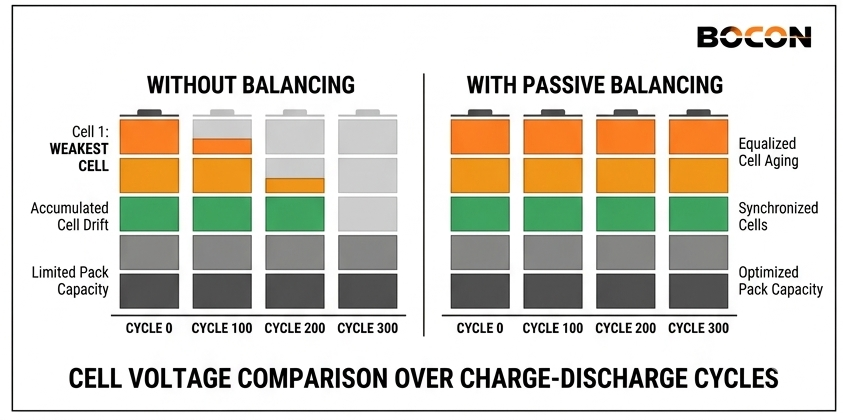
Lithium-ion cells in a multi-cell battery pack never age identically. Small manufacturing variations, differences in internal resistance, and uneven thermal conditions cause cells to drift apart in voltage over charge-discharge cycles.
Without balancing, a battery pack’s usable capacity is limited by its weakest cell. Once one cell reaches full charge while others are only at 80%, the pack must stop charging — even though it’s far from full.
Passive balancing is the most common method in power tool applications: the BMS discharges higher-voltage cells through resistors until all cells are equalized. It’s simple, reliable, and effective for the charge-drain profiles typical of power tools.
Active balancing — which transfers energy from higher-charge cells to lower-charge cells — is more efficient but more expensive, and is generally reserved for larger battery systems (electric vehicles, energy storage).
For a 5-cell or 10-cell power tool pack, passive balancing is entirely adequate if implemented correctly.
6. Communication and Authentication
Many major power tool brands use proprietary digital communication between the battery pack and the tool. The BMS must implement the correct protocol — and in some cases, the correct encryption or authentication challenge-response — to be recognized as a genuine battery.
For private label buyers sourcing compatible battery packs for branded tool platforms: this is where most compatibility problems arise. A BMS that implements the wrong protocol, or implements the right protocol with incorrect timing, will cause the tool to reject the battery even if every other spec is correct.
Why Power Tool BMS Is Different From BMS in Other Applications
Most BMS articles are written for electric vehicle engineers, energy storage system designers, or consumer electronics product managers. Power tool applications have distinct requirements that don’t always overlap with those other domains:
High Discharge Currents
An EV battery might sustain 100A discharge, but a power tool battery routinely delivers 25–50A from a compact 5–10 cell pack. This means the current density per cell — and per MOSFET — is significantly higher in a power tool application.
A BMS designed for an energy storage system, scaled down to fit a power tool pack, will fail. It won’t have adequate MOSFET current rating or thermal management for the continuous high-current pulses that power tools demand.
Vibration and Mechanical Stress
Power tools get dropped, bounced in tool chests, and used on job sites. The BMS board must be designed to withstand vibration and mechanical shock without solder joint fractures or component loosening.
At our factory, we pot (encapsulate) the BMS board in thermal-conductive epoxy for our higher-tier products specifically to address vibration resistance. This is not standard practice at every factory — ask your supplier whether they use board potting for vibration-prone applications.
Rapid Charge-Discharge Cycling
A power tool battery might go through a full charge-discharge cycle every day, or multiple times per day in heavy professional use. After 500 cycles, a BMS with poor passive balancing will have allowed cell drift to accumulate significantly — reducing pack capacity from 100% to 70% or less within 18 months.
A BMS with active balancing or well-tuned passive balancing will slow this degradation dramatically. This is one of the primary drivers of cycle life — and one of the least-discussed factors in battery pack specification.
Compact Form Factor
Power tool batteries are designed to be compact and lightweight. The BMS must fit a small physical envelope without compromising thermal management. This constrains component selection and forces engineering trade-offs that don’t exist in larger battery systems.
BMS Quality — Why the IC Chip Manufacturer Matters
Here’s the distinction most buyers never learn until they’ve received a warranty return batch: not all BMS IC chips are equivalent, even when they carry identical functional descriptions.
A Texas Instruments BQ series IC and a generic Chinese “BQ-compatible” IC may both be described as “3–5 series lithium-ion battery protection IC with overcharge, overdischarge, overcurrent, and short-circuit protection.” In the same way, a Milwaukee M18 battery and a $15 Amazon battery may carry the same voltage and capacity on the label.
The difference shows up in:
- Corner-case behavior: How does the IC respond at -10°C? At 45°C? When cell voltage sags rapidly under high current? Premium ICs are characterized across the full operating envelope; budget ICs may not be.
- Accuracy of voltage measurement: A 10mV difference in overcharge detection threshold doesn’t sound significant, but across hundreds of cycles, consistent slight overcharging accelerates cell degradation.
- Response time for overcurrent protection: Microseconds vs. milliseconds — the former stops a stall condition before damage; the latter may not.
- Quiescent current: The current the BMS draws when the tool is off. High quiescent current slowly discharges the pack during storage. Premium BMS ICs draw microamps; budget ICs can draw milliamps, causing noticeable self-discharge over weeks of storage.
Insider tip: Ask your supplier for the bill of materials (BOM) for the BMS — specifically the BMS IC part number and manufacturer. If they provide it without hesitation, that’s a good sign. If they resist or provide a generic description (“protection IC, manufacturer confidential”), that’s a yellow flag worth investigating.
What Brand Buyers and Procurement Managers Should Know About BMS
When you’re evaluating a supplier for cordless power tool battery packs, BMS is a legitimate and necessary topic of due diligence. Here’s a framework:
Question 1: Can you provide the BMS circuit schematic?
A supplier confident in their engineering will share the circuit design. A supplier using a reference design from a chip manufacturer without modification may also share it — with attribution. A supplier who refuses is either protecting a competitor’s design (acceptable) or hiding something they don’t want you to see (not acceptable).
Question 2: What BMS IC manufacturer do you use?
As discussed above — TI, Infineon, ROHM, ST, Analog Devices are industry-standard. Chip manufacturers in the “unverifiable” category should prompt additional questions.
Question 3: How many NTC temperature sensors does the BMS have?
Minimum for a well-designed 5–10 cell power tool pack: one per cell group, plus one at the MOSFET array. A board with a single NTC is a cost-reduced design that may miss localized overheating.
Question 4: What is the BMS quiescent current?
For a battery pack that sits on a shelf or in a toolbox between uses, quiescent current determines self-discharge rate. Target: under 50μA per cell IC. Above 500μA, you’ll notice significant capacity loss after 4–6 weeks of storage.
Question 5: Do you perform BMS firmware aging tests?
BMS firmware — the software running on the IC — should be validated across temperature ranges, cell age conditions, and load profiles. Ask whether the supplier runs accelerated aging tests on the BMS firmware, or simply uses the default settings from the IC manufacturer.
Question 6: What is the BMS thermal management design?
How does the board dissipate heat from the MOSFETs during high-current operation? Is there a thermal pad? A heatsink? Is the board potted? For heavy-duty power tool applications, thermal management is not optional.
Question 7: Has the BMS been validated with the cell chemistry you’re specifying?
A BMS configured for NMC (nickel-manganese-cobalt) lithium-ion cells has different voltage thresholds than one configured for LFP (lithium iron phosphate). Verify that the BMS configuration matches the cells you’re ordering.
Common BMS Problems — How They Show Up and How to Detect Them
Based on warranty return patterns we’ve seen from brands sourcing elsewhere:
Problem: Battery shuts down under moderate load Likely cause: BMS triggering overcurrent protection due to excessive voltage sag. The cells may be fine, but the BMS is calibrated too conservatively — or the MOSFET Rds(on) is too high, causing heat buildup. What to check: Request the BMS current limit spec and compare it against the tool’s actual current draw under your target load.
Problem: Battery shows 80% charge but dies in minutes Likely cause: Cell imbalance. One or more cells have drifted significantly from the pack average, and the BMS is cutting off discharge when the weak cell reaches its limit — even though the overall pack voltage looks healthy. What to check: Ask the supplier whether they perform cell balancing verification during pack formation and aging. Request cycle test data showing cell voltage variance across 100+ cycles.
Problem: Battery drains significantly during storage Likely cause: Excessive BMS quiescent current. The protection IC is drawing too much current when the pack is idle. What to check: Ask for storage discharge test data — capacity loss after 30 days at full charge, no load.
Problem: Battery not recognized by branded tool platform Likely cause: BMS communication protocol mismatch. The digital handshake between the battery BMS and the tool’s motor controller is not correctly implemented. What to check: If you’re sourcing compatible packs for a branded platform, verify protocol compatibility explicitly in the purchase order, not just the spec sheet.
The Relationship Between BMS Quality and Your Brand’s Warranty Profile
Here’s the business case for caring about BMS: the battery pack is the component most likely to generate warranty returns in a cordless power tool product line. Not the motor. Not the gearbox. The battery.
Lithium-ion cells age. They degrade with use, with temperature exposure, and with deep cycling. A well-designed BMS moderates this degradation — by enforcing safe operating limits, by balancing cells consistently, and by preventing the conditions (overcharge, deep discharge, overtemperature) that accelerate aging.
A cheap BMS accelerates it.
When you’re calculating warranty reserve requirements or evaluating supplier quality, the BMS is the single component that most directly determines your return rate trajectory. A 5% first-year return rate on batteries can destroy the margin on an entire product line.
At our factory, our BMS firmware is developed in-house, not licensed from a reference design. We run cell balancing verification on every production pack, and we calibrate BMS voltage thresholds to ±20mV — not the ±50mV you’ll find in many budget designs. This is engineering overhead. It’s also why our battery packs consistently outlast the competition on cycle life tests.
BMS in the Context of Overall Battery Pack Quality
BMS is important — but it’s one layer in a system. The battery pack quality ultimately depends on the interaction of four components:
| Component | What It Does | Key Quality Indicator |
|---|---|---|
| Cells | Energy storage | Cell brand, cycle life rating, temperature range |
| BMS | Protection and management | IC manufacturer, quiescent current, NTC count |
| Mechanical pack design | Physical protection, thermal path | PCB potting, vibration rating, IP rating |
| Assembly quality | Intercell connections, solder joints | X-ray inspection of spot welds, ICT testing |
A premium BMS cannot compensate for low-quality cells. But a low-quality BMS will undermine even premium cells, accelerating degradation and generating warranty returns.
The Battery Management System is the most underappreciated component in the cordless power tool supply chain — by buyers, and occasionally by manufacturers who are themselves learning.
Understanding what the BMS does, how it does it, and what separates a quality implementation from a cost-reduced one puts you in a significantly better position as a buyer. You can read a specification sheet and know what’s missing. You can ask questions that reveal engineering depth. And you can avoid the warranty return patterns that erode brand trust and margin.
When you’re evaluating a supplier for your next battery pack order — whether for a private label launch, an existing product line refresh, or a new tool platform — make the BMS a line item in your technical review. Not as an afterthought. As a requirement.
We’ve been designing and manufacturing BMS-protected lithium-ion battery packs for power tools since we built our first production line in 2017. If you’d like to see how our engineering approach translates into cycle life data and warranty performance, let’s talk.