
We invited a veteran buyer friend to share his insights on OEM, and we have summarized his views below:
I’ve been sourcing cordless power tools from China for fifteen years. I’ve visited more factories than I can count, approved more samples than I’d like to admit, and navigated a fair number of shipments that didn’t go as planned. I’ve built brand lines from scratch and helped others save programs that were heading off the rails.
So when someone asks me what OEM power tools manufacturing actually is — not the Wikipedia version, but what it means when real money is on the table — I have a very specific answer.
This guide is that answer. It’s not a factory pitch. It’s a buyer’s-side breakdown of how the process works, where it tends to go wrong, and what separates a sourcing program that scales from one that stalls after the first order.
What OEM Actually Means (And What It Doesn’t)
OEM stands for Original Equipment Manufacturer. In the power tools context, it means you’re commissioning a factory to produce tools that will carry your brand name. The factory manufactures; you brand and sell.
That’s the simple version. The real version is more nuanced.
In practice, “OEM” in the cordless power tools space covers a wide spectrum of arrangements. At one end, you’re selecting from a factory’s existing designs, applying your logo to the housing, and customizing the color and packaging. At the other end, you’re bringing detailed engineering specifications for a new product, the factory is building to your blueprint, and you own the tooling and the design IP. Most first-time brand programs land somewhere in the middle.
The term that often gets confused with OEM is ODM — Original Design Manufacturer. The distinction matters:
- OEM: You own the design, the factory manufactures it. You control the IP.
- ODM: The factory owns the base design. You license it, typically with some customization (color, branding, accessories, packaging).
For a buyer launching a first cordless line on a defined budget, ODM is often the faster, more cost-effective entry point. You’re not paying for product development — you’re paying for manufacturing and brand adaptation. For a buyer building a long-term brand with proprietary product architecture, OEM with full design control is the right structure, and you’ll need a factory partner with genuine engineering depth to support it.
Neither is inherently better. The right model depends on your timeline, your IP strategy, and how much of your brand differentiation you want to live in the product itself versus in marketing and positioning.
Why China — And Why It’s Not a Simple Answer
China manufactures roughly 70-80% of the world’s cordless power tools. That’s not hype; it’s the reality of how the global supply chain for this category is structured. The concentration of component suppliers, motor manufacturers, battery producers, and assembly factories in specific regions — particularly in Jiangsu, Zhejiang, and Guangdong provinces — creates a manufacturing ecosystem that doesn’t exist at scale anywhere else.
The honest qualifier: that concentration also means there’s an enormous range of quality within a single postal code. A factory making tools for Panasonic and a factory selling unbranded drills on Alibaba for $12 can be operating five kilometers apart. They’re not playing the same game.
As a buyer, the question is never “should I source from China?” — the answer to that is yes, unless you have a very specific reason not to. The question is: “How do I find the right factory within that ecosystem?” And the answer to that requires more precision than most sourcing guides provide.
The Factory Landscape: What You’re Actually Choosing Between
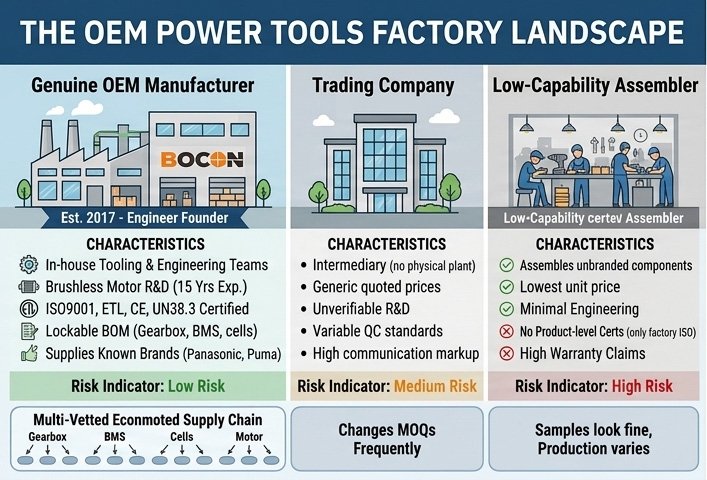
When you start reaching out to Chinese power tools factories, you’ll encounter roughly three types of operations — and knowing which you’re talking to changes everything.
Genuine manufacturers with OEM depth. These factories actually manufacture the products they sell. They have in-house tooling rooms, engineering teams that can discuss motor specifications and BMS parameters, proper quality management systems, and the certifications to back up their compliance claims. Their pricing is not the lowest on any given inquiry, and they’ll ask you detailed questions about your intended market and certification requirements. This is what you want.
Trading companies presenting as factories. These are intermediaries sourcing from actual factories and marking up the price. Not inherently bad — some experienced traders add real value in communication and coordination — but you need to know what you’re working with. If a “factory” can’t show you a plant video with equipment running, can’t answer specific questions about their brushless motor controller firmware, and changes their quoted MOQ depending on the week, you’re probably talking to a trader.
Low-capability assembly operations. These factories are real manufacturers in a technical sense — they do assemble products — but they’re assembling from bought-in sub-assemblies with minimal engineering capability, thin quality control, and often unverifiable certifications. They compete on price. Their samples often look fine; it’s what happens at volume and over time that reveals the gap.
The category you choose determines your risk profile more than almost any other decision you’ll make in this process.
The Real Cost Structure (Nobody Tells You This Upfront)
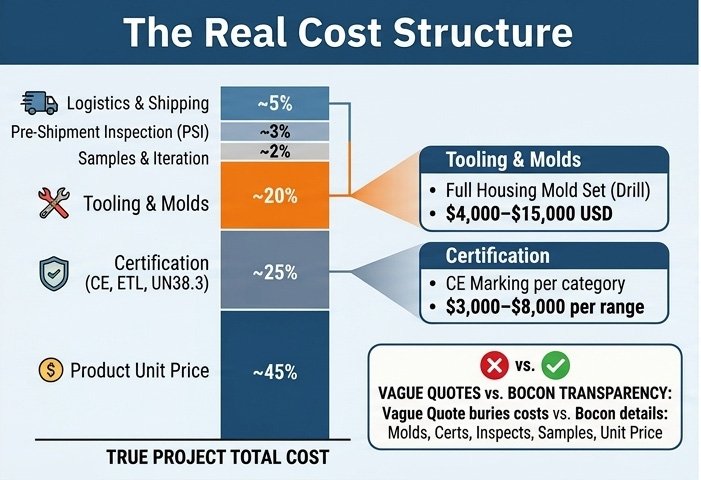
One of the most consistent ways buyers get surprised is in the price conversation. A factory quotes you a unit price that looks workable, and then the total project cost ends up being 30-40% higher than planned. Here’s where the gaps usually are.
Tooling and mold costs. If you’re doing any product customization beyond color and logo — housing shape, grip design, battery platform change — you’re paying for molds. A full housing mold set for a cordless drill can run $4,000–$15,000 USD depending on complexity and material. This is a one-time cost, but it needs to be in your budget before you start, not discovered after your first sample request.
Certification costs. If you’re selling into the US, EU, or Australia, you need legitimate certifications. CE marking for a cordless tool family typically runs $3,000–$8,000 per product category through an accredited EU lab. UL listing in the US is in a similar range. UN38.3 for the battery pack is additional. These costs get quoted separately from unit price, and some factories quote them and some don’t — which makes price comparisons meaningless unless you’re comparing apples to apples.
Sample costs and iteration. Expect to pay for samples. A professional factory will charge $150–$400 per sample unit, sometimes more for complex tools. A factory offering free samples at the start of a relationship is either recovering that cost in your unit price or planning to make it up somewhere else. Budget for 2-3 rounds of samples before locking specs for mass production.
Tooling amortization in unit price. Some factories bury tooling costs inside the unit price to make it look like there’s no upfront investment. The math still has to work out somewhere; this approach just makes it harder to see.
Payment structure. The standard payment structure for a first order from a verified factory is 30% deposit upfront, 70% before shipment. Variations exist — T/T, L/C, and various hybrid structures — but if a factory is asking for 50% or more upfront on a first significant order, that’s a yellow flag. If they’re accepting 0% upfront, ask why.
The Sample Problem (And Why It’s More Serious Than People Admit)
Here’s something that doesn’t get discussed enough in sourcing guides: the sample you receive and the product that ships in your first production run are not automatically the same thing.
This isn’t necessarily malicious. It’s a function of how Chinese manufacturing works at the component sourcing level. When a factory makes a sample, they often pull parts from their best available inventory — the motor from a top-tier supplier, the cells from a fresh batch, the housing from a careful production run. When production volume kicks in and cost pressure hits, substitutions happen. A slightly cheaper motor winding. A cell supplier that’s 10% less expensive but has tighter tolerances. A housing material that’s within spec but at the bottom of the acceptable range.
Each individual substitution might be defensible. The aggregate effect on product quality can be significant.
How you protect against this: lock the Bill of Materials (BOM) in writing before production approval. List approved suppliers for key components — especially the motor, battery cells, and controller. Build in a pre-shipment inspection (PSI) that specifically tests against the approved sample’s performance specs, not just the product’s physical appearance. And establish in your contract that component substitutions require your written approval.
This is the difference between buyers who have consistent product quality across orders and buyers who are constantly troubleshooting warranty claims.
Certifications: What “We Have CE” Actually Means
Certification claims are the area where the most buyer confusion lives. A factory says they have CE certification. You ask for documentation. They send a certificate. You feel reassured.
Here’s the problem: there are three very different things that certificate might represent.
A legitimate Declaration of Conformity with a test report from an accredited EU notified body. This is what you actually need for legal sale in the EU. The test report references the specific product model, was conducted by a real lab, and the documentation is traceable.
A test report from a Chinese testing lab that is not an EU notified body. This is common. Chinese labs can conduct the same tests, and the results may be perfectly valid as a pre-compliance screen. But a report from a Chinese lab does not constitute CE marking for EU market purposes.
A “CE certificate” issued by a Chinese certification body with no legal standing under EU regulation. These documents exist. They look official. They mean nothing.
Before accepting certification documentation, verify: (1) the name of the testing lab and confirm it’s an EU-accredited notified body or NRTL (for US) for the product category, (2) that the model number on the report matches the exact product you’re buying, and (3) that battery pack certifications are listed separately and include UN38.3 for transport.
A factory that pushes back when you ask these questions, or can’t produce the underlying test reports, is a factory that can’t actually certify the product. Walk away.
What a Good Factory Partner Actually Looks Like
After fifteen years of this, the factories I’ve kept working with long-term share a specific set of characteristics that have nothing to do with price.
They ask harder questions than you do at the start. A factory that immediately quotes without asking about your target market, certification requirements, and distribution channel is a factory that’s quoting something generic and hoping you don’t notice. A factory that asks “which market are you targeting?” and “what is your expected annual volume?” before providing a quote is trying to understand your project. That difference in orientation tells you a lot.
Their certifications are product-specific. Broad ISO 9001 certification covers the quality management system. It says nothing about whether a specific product has been tested to the applicable safety standard. Factories with genuine compliance programs have product-level certifications that you can verify.
They can talk about failure modes. Ask a factory what the most common warranty issue is with their brushless drills. A good factory can tell you specifically — overheating in the controller under sustained high-load conditions, battery capacity degradation in cold climates, whatever is relevant to their product. A factory that says “we have no warranty issues” either hasn’t shipped enough product to know or isn’t being honest with you.
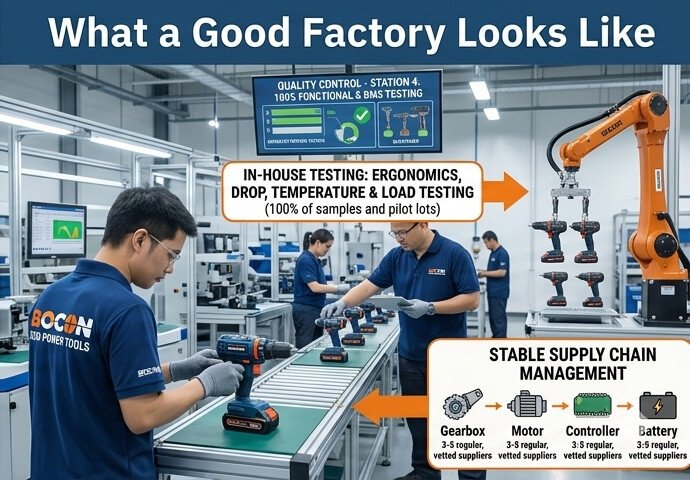
They have a paper trail on components. Ask who supplies their battery cells and what the BMS specification is. Ask for incoming inspection records on motors. A factory that manages its supply chain will have answers to these questions. A factory that assembles whatever arrives in the morning will not.
One factory worth knowing in this space is Bocon, a brushless cordless tools OEM/ODM manufacturer based in Wuxi, Jiangsu. They’re one of the operations I’d point a brand owner toward when they’re looking for a factory that has genuinely invested in engineering capability — in-house BMS algorithm development, product-specific certifications including ETL, CE, and UN38.3, and a supply chain with multiple vetted suppliers per component category. Their founder has 15 years of R&D background, which shows up in how their engineering team actually engages with customization requests.
When to Start Small and When to Commit
A common mistake I see from first-time brand builders: either they go in too big (large first order, full product line, significant tooling investment) before they’ve proven the factory relationship, or they go in too small (trial order so minimal the factory puts them at the bottom of the priority queue).
The right entry strategy for most B2B buyers entering a new factory relationship:
Initial qualification phase (before any production order): Request samples. Conduct a factory audit — in person if budget allows, video call with factory floor walkthrough if not. Verify certifications. Have a technical discussion about your specific product requirements. This phase should cost you time and a sample fee, but not large sums of money.
Pilot production order: 500–1,500 units depending on your category and market. Enough to test the factory’s process under real production conditions. Commission a pre-shipment inspection from a third-party quality firm. This order is as much about evaluating the factory as it is about getting inventory.
Full production commitment: Once you’ve received the pilot order, confirmed quality against spec, and worked through any issues on the first shipment, you have the information you need to decide whether to commit to this factory for volume production.
Factories often push for larger commitments upfront, particularly on tooling. Some of that pressure is legitimate — they’re making an investment too. But a factory that won’t work with you through a modest pilot order before demanding full tooling payment and a volume commitment is optimizing for their interests, not the partnership. That’s relevant information.
The Timeline You Should Actually Plan For
This is where optimism creates most first-order failures. Standard timelines for a new OEM cordless tool from inquiry to delivered first shipment:
- Factory identification and qualification: 4–8 weeks
- Product specification and sample development: 6–12 weeks (longer if significant customization is involved)
- Sample revision and approval: 2–4 weeks per round, typically 2 rounds
- Certification testing (if new): 8–16 weeks for CE or UL, depending on lab queue
- Production (once specs are locked and certifications are in progress): 4–8 weeks for standard cordless tool categories
- Shipping: 3–5 weeks sea freight from China to major markets
Add it up and a genuinely new OEM cordless tool program — starting from scratch, done properly — takes 6–12 months from first factory contact to product on shelf. Buyers who plan for 3–4 months consistently find themselves either cutting corners they’ll regret or missing their target season.
If you’re sourcing an existing design from a factory’s standard line with minimal customization, you can compress this significantly. But the certification timeline is essentially fixed — you can’t rush a lab, and you can’t skip the process.
Before You Send That First Inquiry
A few practical points that apply to every OEM power tools project, regardless of where you are in the process:
Decide your target market certification requirements before you approach factories. This affects which factories can support you and how they’ll structure pricing. Walking into negotiations without this decided gives the factory too much control over the conversation.
Have at least a rough specification for your product before asking for quotes. You don’t need a full engineering document — but you should know the voltage platform (18V, 20V, 40V), the product type, the approximate performance targets, and the markets you’re selling into. Factories that receive vague inquiries give vague quotes.
Ask for client references and follow up on them. A factory’s previous B2B clients are the best source of information about what actually happens after the order is placed. Most factories can provide references; most buyers don’t call them.
Don’t select on price alone. This gets said everywhere and ignored constantly. The difference in manufacturing quality between the cheapest and the most appropriate factory for your program is not marginal. If a quote is 30% below every other quote you’ve received, something is different about what you’re actually buying — and you need to find out what it is before you commit.
OEM power tools manufacturing, done right, is one of the most effective ways to build a hardware brand with genuine margin and staying power. Done wrong, it’s expensive, slow, and damaging to the brand you’re trying to build.
The difference is almost entirely in the factory selection and the quality of specification and contract work you do upfront. The factories that will make you look good are out there. They’re just not always the easiest to find — or the cheapest to work with. That’s not a coincidence.
Looking for a verified OEM manufacturer for brushless cordless tools? Bocon manufactures brushless cordless power tools for brand owners and distributors across North America, Europe, and Australia. You can review their capabilities and reach out at www.oemcordlesstools.com.