
A buyer once sent us a sample order for a 40V cordless circular saw. Everything looked fine on the spec sheet — voltage, capacity, BMS, torque output. Then we asked the question that stopped the conversation: “Do you have the UN38.3 test report for the battery pack?”
Dead silence on the other end of the call.
They had the cell-level certifications. They had the BMS protection specs. They had a CE certificate. But the UN38.3 report — the document that proves the battery pack can survive the physical conditions of international transport — they didn’t have that.
That buyer was six weeks from a scheduled ship date. The circular saw line almost didn’t make it.
UN38.3 is not a marketing badge. It’s not optional. And it doesn’t automatically travel with your product just because the cells inside carry one. In this article, I’ll explain what UN38.3 actually tests, what changed in 2026, why the cell-vs-pack distinction matters more than most buyers realize, and what questions you should be asking your supplier before you commit to a purchase order.
What Is UN38.3?
UN38.3 is a section in the UN Manual of Tests and Criteria that defines the safety testing requirements for lithium batteries intended for transport by air, sea, or land. It originated because lithium batteries — when improperly designed, manufactured, or packaged — pose real hazards during transport: fire, explosion, venting of toxic gas.
The regulation applies to:
- Lithium-ion batteries (UN3480)
- Lithium-metal batteries (UN3090)
- Batteries packed with equipment
- Batteries installed in equipment
If your product contains a lithium battery and it’s crossing an international border, UN38.3 testing is not a nice-to-have. It’s the document your freight forwarder will ask for before accepting the shipment.
The critical thing most buyers miss: UN38.3 is a transport safety standard, not a product safety standard. Passing UN38.3 does not mean your battery is safe for every possible use. It means it was tested and survived the specific physical stresses of being shipped. For actual use-case safety, you need separate standards like IEC 62133-2 (portable products) or IEC 62619 (industrial battery systems).
The Eight Tests: What UN38.3 Actually Requires
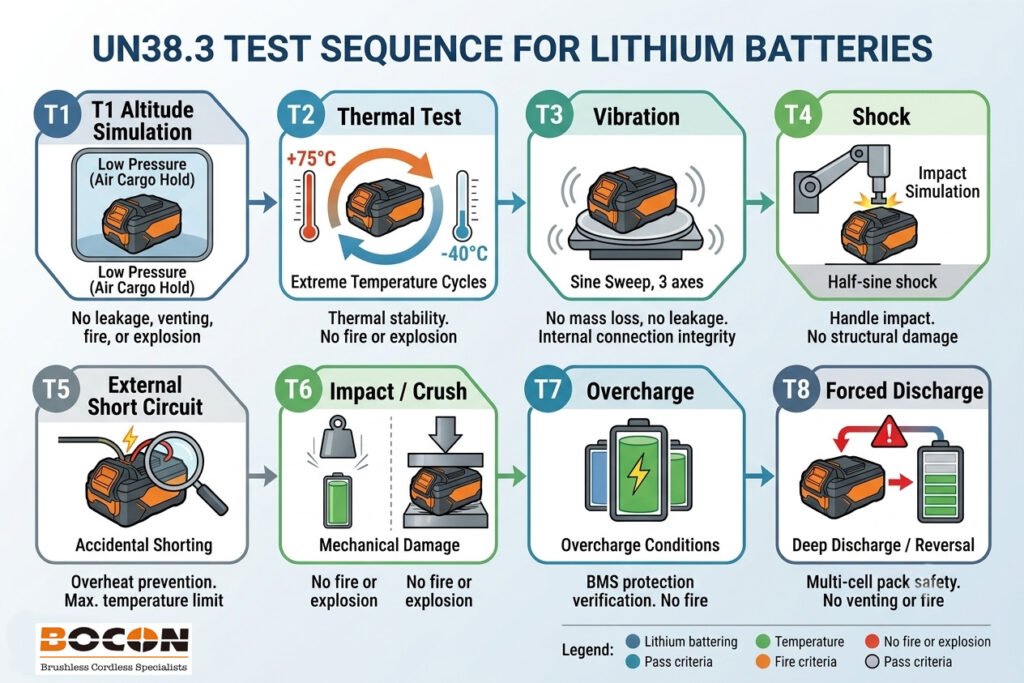
UN38.3 testing consists of eight sequential or related tests (T1 through T8) that subject the battery to the physical stresses it might encounter during transport. Each test has specific pass/fail criteria.
T1 — Altitude Simulation
The battery is placed in a low-pressure chamber at 11.6 kPa (simulating air cargo hold conditions at altitude) for a minimum of 6 hours.
What it checks: Can the battery casing hold pressure without leaking, venting, or rupturing when the cabin loses pressure?
Pass criteria: No leakage, no venting, no fire, no explosion, no mass loss exceeding specified limits.
T2 — Thermal Test
The battery is cycled 10 times between high and low temperatures: from +75°C to -40°C, with at least 6 hours at each extreme.
What it checks: Can the battery maintain thermal stability when exposed to the temperature extremes of a cargo hold in summer heat or winter cold?
Pass criteria: No fire, no explosion, no venting, no leakage, no electrical shorts.
T3 — Vibration Test
The battery is vibrated using a sine sweep from 7 Hz to 200 Hz over a 3-hour period, applied across three axes.
What it checks: Can the battery’s internal connections, welds, and components withstand sustained vibration during truck, ship, or air transport?
Pass criteria: No fire, no explosion, no venting, no leakage, no electrical performance degradation beyond specified limits.
T4 — Shock Test
The battery receives 18 half-sine wave shock pulses at 150 gn peak acceleration — three positive and three negative in each of three axes.
What it checks: Can the battery survive the sudden impacts of handling and loading?
Pass criteria: No fire, no explosion, no venting, no leakage, no significant capacity loss.
T5 — External Short Circuit
The battery’s terminals are connected through a short circuit at 55°C (±2°C), and the battery is observed for fire, explosion, or rupture.
What it checks: What happens if the battery is accidentally shorted during packing or handling?
Pass criteria: No fire, no explosion, no casing rupture. The battery temperature must not exceed a defined limit.
T6 — Impact / Crush
For lithium-ion batteries: an impact test where a 9.1 kg rod is dropped onto the battery from a specified height. For lithium-metal batteries: a crush test applies sustained pressure.
What it checks: Can the battery survive mechanical damage — a heavy object falling on it, or being crushed during improper handling?
Pass criteria: No fire, no explosion for both types.
T7 — Overcharge Test
The battery is charged at a rate above its rated charge current for a defined period.
What it checks: Does the battery’s overcharge protection hold under sustained overcharge conditions?
Pass criteria: No fire, no explosion.
T8 — Forced Discharge Test
The battery is connected in series with an external power source and subjected to forced over-discharge beyond its rated capacity.
What it checks: What happens when a battery is discharged too far — including reverse charging situations in multi-cell packs?
Pass criteria: No fire, no explosion, no voltage reversal beyond specified limits.
The Eight Tests at a Glance
| Test | Name | Key Stress Simulated | Duration / Intensity |
|---|---|---|---|
| T1 | Altitude Simulation | Low pressure (air cargo hold) | 11.6 kPa, 6+ hours |
| T2 | Thermal Test | Extreme temperature cycles | +75°C to -40°C, 10 cycles |
| T3 | Vibration | Transport vibration | 7–200 Hz sine sweep, 3 hours |
| T4 | Shock | Handling impact | 150 gn half-sine, 18 shocks |
| T5 | External Short Circuit | Accidental shorting | 55°C, short circuit applied |
| T6 | Impact / Crush | Mechanical damage | 9.1 kg rod drop / sustained crush |
| T7 | Overcharge | Overcharge conditions | Charge at elevated rate |
| T8 | Forced Discharge | Deep discharge / reversal | Forced over-discharge via series connection |
Why Most Buyers Get UN38.3 Wrong: The Cell vs. Pack Problem
This is the issue that causes the most delays, shipment holds, and costly redesigns in battery-powered product programs — and most buyers don’t learn about it until they’re already in trouble.
When a supplier says they have “UN38.3 certification,” the critical follow-up question is: UN38.3 for what?
Cell-Level vs. Pack-Level Testing
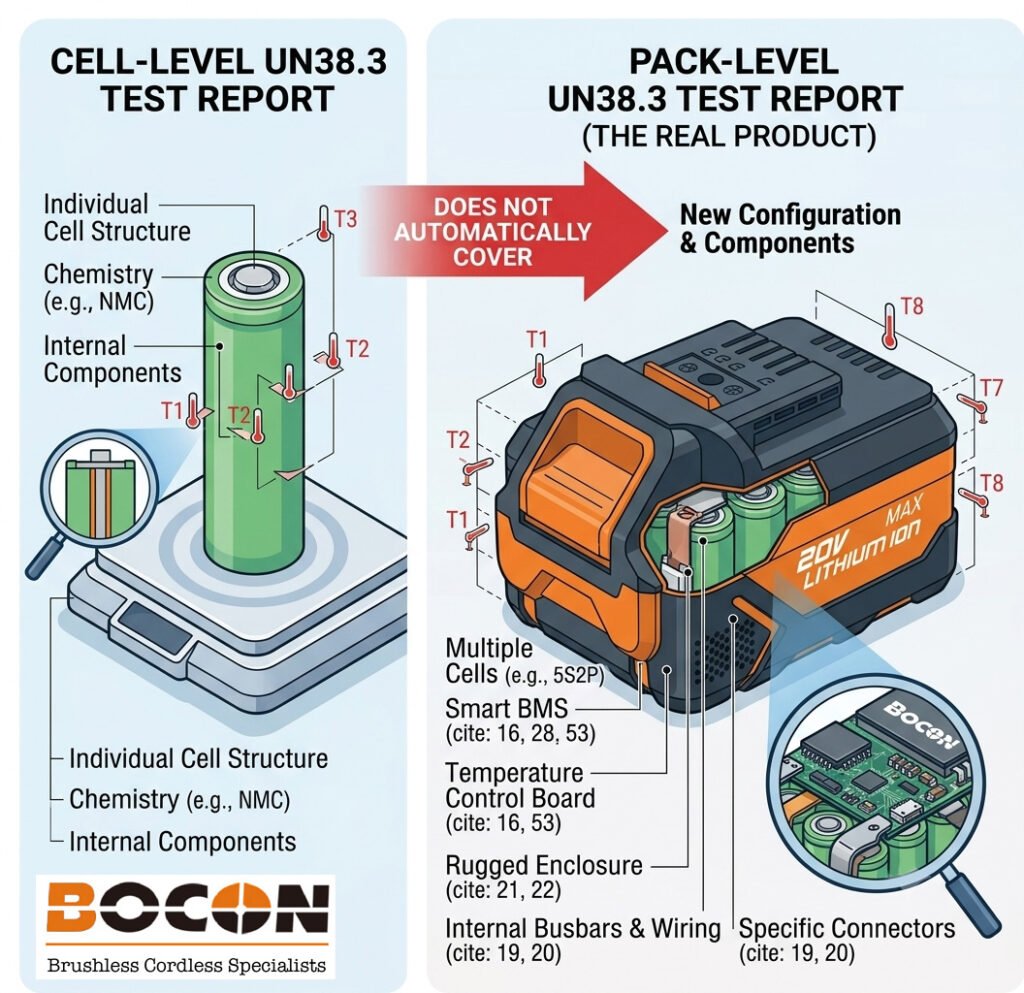
A cell manufacturer may hold valid UN38.3 test reports for their specific battery cells. That’s legitimate. But those cells are not the product you’re buying.
The product you’re buying is a battery pack — a specific arrangement of cells connected in a series/parallel configuration, integrated with a BMS, housed in a mechanical enclosure, with specific connectors, wiring, fuses, and thermal management.
When those cells are built into a new pack configuration, you have changed the product. The cell-level UN38.3 report does not automatically cover the pack.
Common changes that can affect UN38.3 applicability:
- Different number of cells or series/parallel configuration
- New BMS or protection circuit topology
- Different enclosure material or mechanical layout
- New busbar design or wiring structure
- Different connector or fuse arrangement
- Material changes affecting thermal resistance or insulation spacing
I’ve seen battery programs where the cells were tested and certified, but the pack assembly introduced a different internal connector that became a heat concentration point under T5 short-circuit conditions. The cells passed UN38.3. The pack would not have.
What You Should Ask Your Supplier
“Does the UN38.3 report cover the exact battery pack configuration I’m ordering — with the specific cell model, series-parallel arrangement, BMS, and enclosure described in the quote?”
If the answer references the cell model only, that’s a red flag. The pack is a different product from the cell.
For custom battery programs — which is most OEM and ODM programs for 24V to 96V industrial battery packs — treat the finished pack as its own compliance item. Ask your test lab whether the final design requires pack-level testing, a delta evaluation, or a new report. Do this before tooling release, not after the first samples are built.
Insider tip: At Bocon, we conduct pack-level UN38.3 qualification testing as part of our standard development process for any custom battery program. We can share the report scope, test sample count, and timeline before you commit to tooling. We’ve seen too many programs hit the ship date before someone asked about the UN38.3 report.
IATA 2026 Update: The 30% State of Charge Rule Is Now Mandatory
If you ship battery-powered products by air freight, there’s a 2026 regulatory change you need to know about.
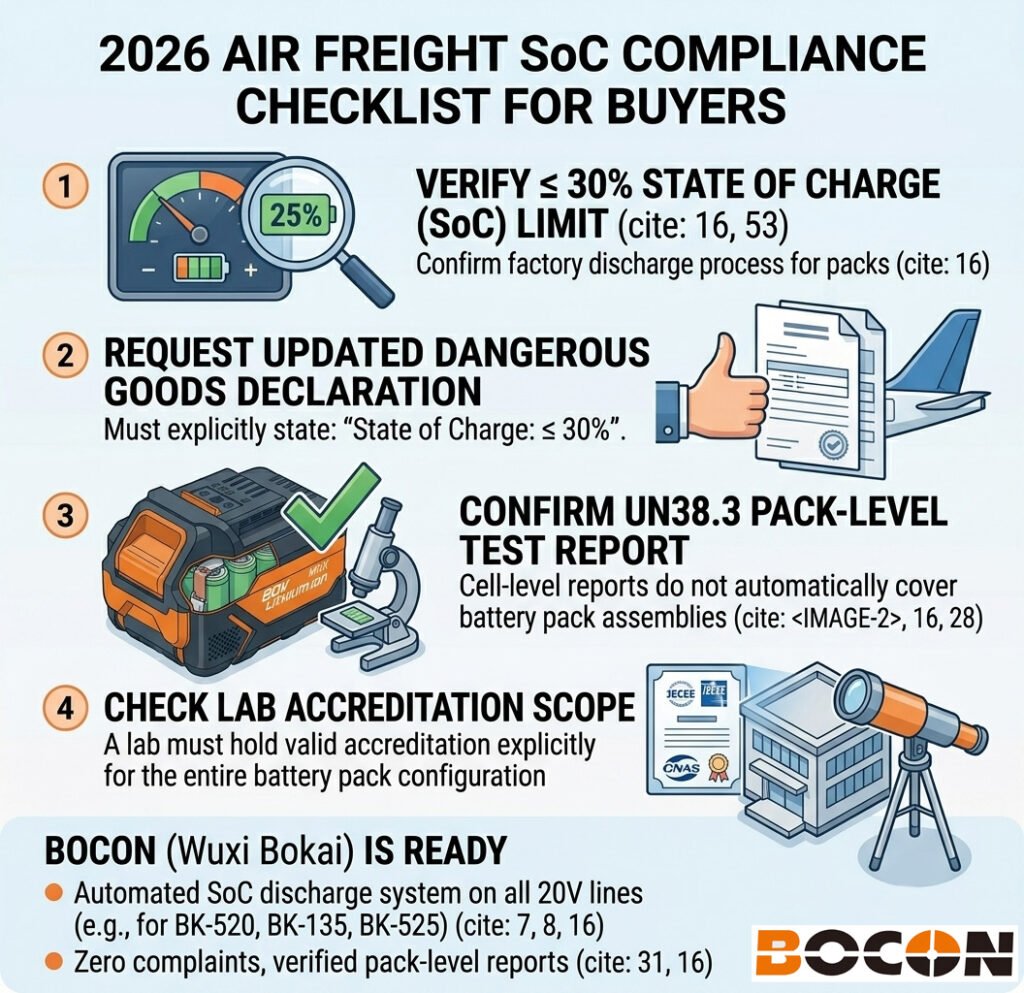
Since January 1, 2026, the IATA Dangerous Goods Regulations (DGR), 67th Edition, has made the 30% State of Charge (SoC) limit mandatory for lithium batteries packed with equipment — not just a recommended guideline.
What This Means in Practice
If your product ships with spare batteries or separately packaged battery packs alongside the main device (the common “batteries packed with equipment” scenario), those batteries must have their state of charge at 30% or below before they leave the factory.
The previous recommendation of ≤30% SoC has been upgraded to a binding requirement. Airlines, ground handlers, and increasingly, e-commerce platforms enforcing FBA inbound requirements, are now enforcing this as a hard gate.
Who Is Affected
This applies when all three conditions are met:
- Packaging configuration: Equipment and battery are in the same outer shipping box, packed separately
- Battery energy: Exceeds 2.7 Wh (this covers most cordless power tool batteries)
- Transport mode: Air freight
Who Is Exempt
- Batteries fully built into the device (smartphones, built-in power tool batteries)
- Batteries transported as standalone commercial goods (UN3480 / UN3090 provisions apply instead)
- Batteries with energy ≤ 2.7 Wh (small cells and small packs)
What You Need to Do
If you’re sourcing battery-powered products for air freight shipment, your supplier must have:
- Factory SoC control process: Discharge to ≤25% before packing (leaving buffer for logistics discharge)
- Random SoC testing in warehouse: Verify outgoing battery state before shipment
- Updated Dangerous Goods Declaration: Clearly stating “State of Charge: ≤30%”
- UN38.3 test report on file: Available for any inspection by carrier or customs
The consequence of non-compliance: the shipment gets rejected at origin, potentially diverted to sea freight, or blocked from e-commerce fulfillment centers — with costs that dwarf whatever was saved by skipping the compliance step.
How to Verify Your Supplier’s UN38.3 Documentation
I’ve seen enough edited PDFs and mismatched test reports to know that “we have UN38.3” means nothing without verification. Here’s the checklist we use internally and share with clients who are doing their own supplier qualification.
Step 1: Confirm the Document Type
Request the specific documents you need, not a vague claim:
- UN38.3 test summary (the standard summary format)
- Battery model identification that matches the product you’re buying — not a similar model, not a previous generation, the exact configuration
- Lab accreditation evidence
Step 2: Match the Exact Model
Compare the UN38.3 report against your quote and the battery datasheet. Check:
- Model number
- Voltage
- Rated capacity
- Cell chemistry
- Cell configuration (series × parallel)
- BMS specification
- Enclosure description
If any of these don’t match, the report doesn’t cover your product.
Step 3: Verify the Lab’s Accreditation
A report from a lab that doesn’t exist or doesn’t hold the relevant accreditation is worthless. Check:
- Does the lab hold CNAS, IECEE CB, or equivalent accreditation?
- Does the accreditation scope explicitly cover UN38.3 testing?
- Is the accreditation current and valid?
A lab can exist and be legitimate for other standards (EMC, electrical safety) but not have UN38.3 in its scope.
Step 4: Watch for These Red Flags
- Model mismatch: The report covers a different cell or battery than the one being quoted
- Cell-to-pack substitution: A supplier shows you cell-level reports as if they cover a custom pack — they don’t
- Edited documents: Company name, model number, or date altered while the lab header remains
- “Certificate only”: A one-page statement with no technical test data behind it — you need traceable evidence
- Expired re-qualification: UN38.3 reports don’t have an expiry date, but re-testing is required after material changes. If the report is from five years ago and the product has been revised since, it’s not current
UN38.3 vs. IEC 62133 vs. IEC 62619: What’s the Difference?
Buyers often conflate these standards, so here’s the quick breakdown:
| Standard | Origin | Purpose | When You Need It |
|---|---|---|---|
| UN38.3 | UN Manual of Tests and Criteria | Transport safety — proves the battery survives shipping conditions | Required for any international transport |
| IEC 62133-2 | IEC | Portable battery safety — cell and battery safety for portable use | Common baseline for handheld devices, medical tools, portable instruments |
| IEC 62619 | IEC | Industrial battery safety — system-level safety in industrial applications | Required for AGVs, forklifts, robotics, energy storage systems |
UN38.3 answers: Can this battery survive being shipped?
IEC 62133-2 / IEC 62619 answer: Is this battery safe to use in its intended application?
You may need all three, depending on your target market and end-product application. None of them replaces another.
What UN38.3 Testing Costs and How Long It Takes
Planning for UN38.3 is part of your development timeline and NRE budget — not an afterthought.
| Item | Typical Range | Notes |
|---|---|---|
| Pack-level UN38.3 testing | US$5,000–10,000 | Varies by sample count, battery size, lab |
| IEC 62619 testing (industrial) | US$8,000–12,000 | Scope depends on application |
| Lead time | 4–8 weeks | Can extend if lab queue is long or redesign is needed |
These numbers are per battery configuration. If you’re building a platform with multiple voltage/capacity variants, each distinct configuration may need its own testing — or a justification memo for why the delta between variants doesn’t require separate testing.
The cost of discovering you need UN38.3 late is always higher than the cost of planning for it upfront. Late discovery means redesign, new samples, requalification, delayed launch windows, and in the worst cases, shipment holds at origin with air freight deadlines missed.
How Bocon Handles UN38.3 Compliance
We’ve shipped lithium-ion battery-powered cordless tools to retailers and distributors in Australia, Europe, and North America. UN38.3 compliance is part of our standard development process — not something we add after the fact.
Here’s how we approach it:
- We test at the pack level for every custom battery configuration we develop. We don’t substitute cell-level reports for pack-level coverage.
- We can share the test report scope before you commit to tooling — so you know exactly what coverage you have and what’s included.
- Our IEC 62133-2 and IEC 62619 capabilities are scoped based on your target market and application. If you’re selling into industrial markets in Australia or Europe, we can map the standards you need to the test plan.
- SoC control for air freight is built into our packing and shipment preparation process. We handle this as standard procedure, not as a special request.
- We can walk through the full compliance documentation package with your procurement or engineering team before you finalize the spec.
If you’re building a battery-powered product and want to understand what compliance testing you actually need — not just what a checklist tells you to tick — we’re available to talk through the specifics.
Key Takeaways
- UN38.3 is mandatory for shipping lithium batteries internationally by air, sea, or land — not optional.
- Cell-level UN38.3 reports do not automatically cover your battery pack. Ask whether the pack configuration was tested.
- Since January 1, 2026, the 30% State of Charge limit for batteries packed with equipment is mandatory for air freight, not just recommended.
- Verify your supplier’s UN38.3 documents: check the model match, lab accreditation, and scope of coverage.
- UN38.3 is a transport safety standard, not a use-case safety standard. You may also need IEC 62133-2 or IEC 62619 depending on your application and market.
- Build UN38.3 qualification into your development timeline and NRE budget — not after tooling is complete.