
Every major power tool brand — whether it’s sold through IKEA, Bunnings, or Total Tools — went through the same qualification process before a single product shipped.
They audited their suppliers. And not just a casual email exchange or a glossy brochure review. Real, structured audits with checklists, site visits, and specific standards that had to be met.
If you’re building a private label brand or sourcing your own cordless power tools, you should be doing the same thing. The problem is: most buyers don’t know what those standards actually are.
Here’s what I’ve learned from 15 years on the factory side — working with brands that came to us with IKEA-style audit frameworks, Home Depot supplier manuals, and their own internal qualification programs.
Spoiler: the criteria are remarkably consistent across brands. And once you know what they look for, you can use the same lens to evaluate your own suppliers.
Why Standardized Audit Standards Exist
You might wonder: why do multiple retailers and brands all converge on similar audit standards?
Because power tools are deceptively complex. A drill that looks fine on the outside can have:
- A motor that burns out under load after 200 hours
- A battery management system that fails in high temperatures
- A gear box that chips teeth within weeks of normal use
- Plastics that crack in cold storage
When a major retailer finds these problems after products are already on shelves, the cost isn’t just a product recall. It’s a damaged relationship with thousands of contractors and homeowners. It’s regulatory scrutiny. It’s liability.
So brands developed standardized audit frameworks — to catch these problems before production starts, not after.
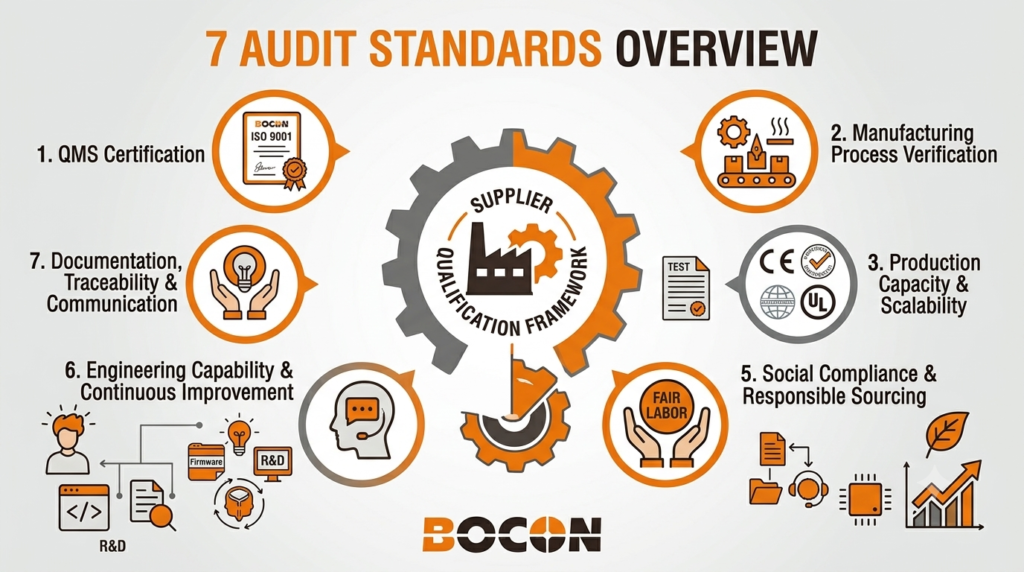
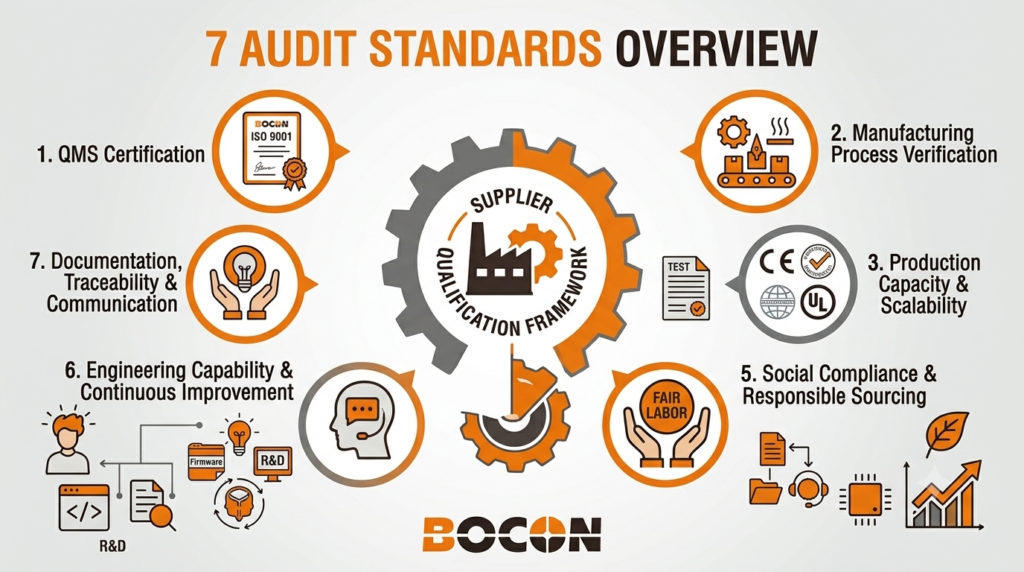
These standards typically cover seven core areas. Any serious brand or retailer will evaluate all seven before committing to a supplier.
The 7 Audit Standards That Apply to Every Brand
Standard 1: Quality Management System (QMS) Certification
This is the foundation. Before a major brand will even consider a power tool supplier, they want to see evidence of a functioning quality management system.
The gold standard is ISO 9001 — the internationally recognized framework for quality management. But here’s what most buyers don’t understand: the certificate itself is just the starting point.
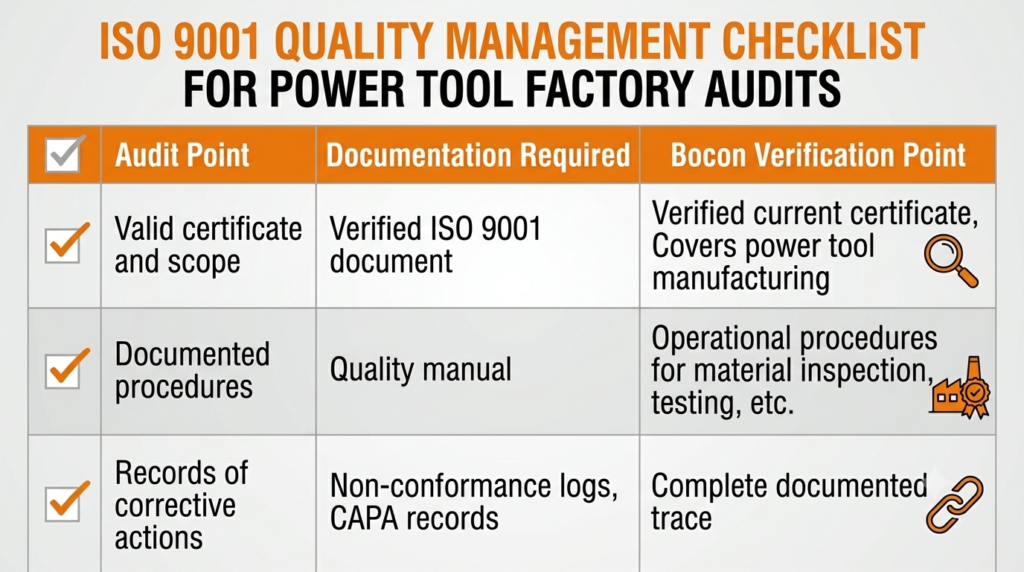
What auditors actually look for:
- Is the ISO 9001 certificate current and verified through a reputable certification body (TÜV, SGS, Bureau Veritas)?
- Does the factory’s ISO scope explicitly cover manufacturing of power tools — not just “trading” or “assembly”?
- Are there documented procedures for:
- Incoming material inspection
- In-process quality checks
- Final product testing
- Non-conformance handling
- Corrective and preventive actions (CAPA)
At Bocon, we’ve maintained ISO 9001 certification since we built the factory in 2017. But more importantly, we’ve operationalized it — not just framed the certificate on the wall. Our quality manual covers every step from raw material acceptance to final packaging, with documented records at each stage.
The insider reality: A factory can have ISO 9001 and still produce garbage. The certificate proves they have a system. Your audit proves they actually use it.
Standard 2: Manufacturing Process Verification
Major brands don’t just want to see that you have a factory. They want to understand how you actually make their products.
This goes beyond square footage and employee counts. It’s about process integrity.
What auditors actually look for:
- Production flow documentation — Is there a documented production process with defined steps, critical control points, and sign-off procedures?
- Equipment (Equipment list) — What machines do you actually use? Are they appropriate for the products being manufactured? Are they maintained on a schedule?
- Special processes — For power tools, the critical special processes typically include:
- Heat treatment (for gears and metal components)
- Motor winding
- Battery pack assembly
- Printed circuit board (PCB) manufacturing for BMS
Here’s where we see a lot of factories fail. They’ll claim they “do” heat treatment — but they’re actually outsourcing it to a third-party shop with no quality control documentation. That creates a blind spot.
At Bocon, we invested in vacuum carburizing capability for our gearboxes — one of the most controlled heat treatment processes available. Why? Because we’ve seen what happens when gear heat treatment is outsourced without proper verification: pitting, spalling, and premature gear failure. It’s a quality nightmare that surfaces months after delivery.
The insider reality: Ask for the actual process flow diagrams. If the factory can’t show you their production process on paper, that’s a red flag — regardless of what they say in a meeting.
Standard 3: Testing and Certification Compliance
This is where many buyers get caught. They see a CE mark or a UL certificate and assume the product is compliant. It’s not that simple.
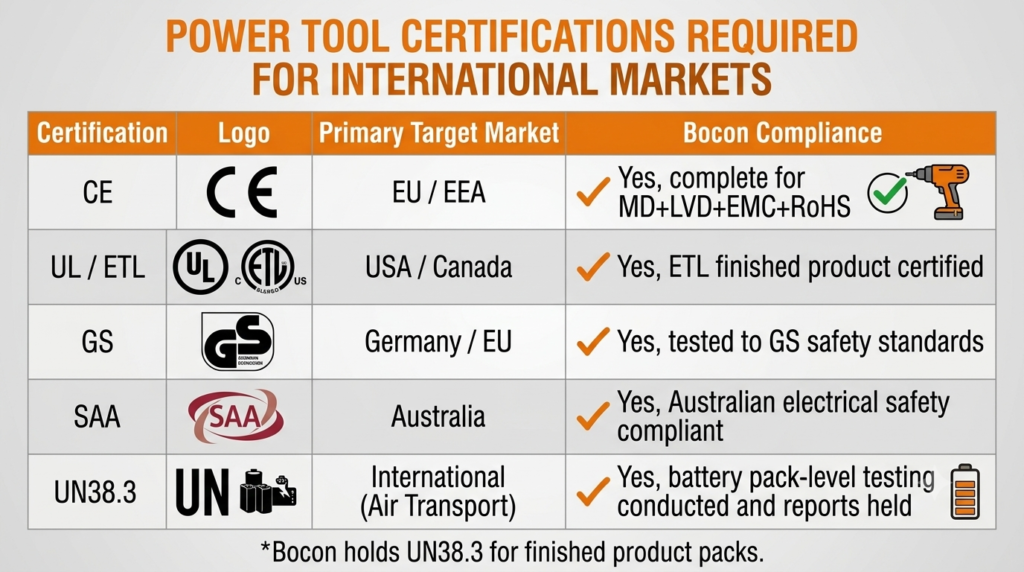
The certification landscape for power tools:
| Certification | Market | What It Covers |
|---|---|---|
| CE | EU/EEA | Safety, EMC, Machinery Directive |
| UL / ETL | USA/Canada | Electrical safety |
| GS | Germany/EU | Safety (German standard) |
| SAA | Australia | Electrical safety |
| UN38.3 | International (air transport) | Lithium battery safety |
But here’s what most suppliers won’t tell you: certifications can be obtained for individual components, not the finished product.
A factory might have UN38.3 certification for their battery cells. But if they’re assembling those cells into a battery pack without proper BMS protection, the pack-level certification might be missing entirely.
What auditors actually look for:
- Is the certification scope the finished product — or just a component?
- Was the testing done on production samples (not golden samples)?
- Is there a test report (not just a certificate)?
- Who performed the testing — an accredited third-party lab, or a self-certification?
At Bocon, we conduct pack-level UN38.3 qualification testing as part of our standard development process. We keep those test reports on file and make them available to customers during the qualification phase. If a customer is shipping by air (which most international orders are), UN38.3 compliance isn’t optional — it’s the difference between your shipment arriving and your shipment being seized by customs.
The insider reality: Always ask to see the actual test report, not just the certificate. A certificate tells you someone made a claim. A test report proves it.
Standard 4: Production Capacity and Scalability Verification
You’ve probably heard horror stories: a brand signs a purchase order, the factory misses every deadline, and suddenly they’re explaining to their retail customers why shelves are empty.
Major brands avoid this by verifying production capacity before committing.
What auditors actually look for:
- Physical production lines — How many dedicated lines exist for the product category?
- Equipment utilization rates — What’s the current capacity utilization? A factory running at 100% capacity is a red flag — they can’t absorb your orders without displacing existing customers.
- Takt time calculations — Can the factory show you the actual cycle time per unit and translate that into monthly capacity?
- Subcontractor disclosure — Does the factory use subcontractors for critical processes? If so, who? Are they disclosed and qualified?
This is where we see buyers make expensive mistakes. They’ll evaluate a factory based on their website photos and sales presentations — not their actual operational data.
At Bocon, we run three dedicated motor winding lines for our cordless tools. Our weekly motor assembly capacity is approximately 30,000 to 37,500 units. We can verify that with production records, equipment specifications, and workforce scheduling. We’re not claiming capacity — we’re demonstrating it.
We also keep six months of component purchase records, production planning documents, and shipping documentation. Why? Because when a customer asks for verification, we don’t want to be digging through files. We want to hand them a folder.
The insider reality: Ask for the factory’s current order book. If they won’t share their utilization rate, that’s your answer.
Standard 5: Social Compliance and Responsible Sourcing
This is where IKEA’s IWAY standards have shaped the entire industry. Major retailers now expect suppliers to meet baseline social compliance — regardless of where they’re sourcing.
What auditors actually look for:
- Labor practices — Are workers paid legally? Are working hours documented? Is child labor present?
- Health and safety — Is the factory safe? Are there proper fire exits, protective equipment, and safety training?
- Environmental practices — Does the factory have proper waste disposal? Are hazardous materials handled correctly?
- Subcontractor standards — Does the factory apply the same standards to their own suppliers?
IKEA’s IWAY framework specifically requires suppliers to demonstrate compliance with 10 principles covering legal compliance, labor rights, health and safety, environmental impact, and business ethics. Home Depot has similar Responsible Sourcing Standards that require pre-disclosure of all manufacturing locations.
The insider reality: Social compliance isn’t just about ethics — it’s about risk management. A factory with labor violations is a supply chain liability. If that factory is exposed, your brand gets dragged into the headlines.
Standard 6: Engineering Capability and Continuous Improvement
This is the audit standard that separates manufacturers from assemblers.
A factory that can only copy existing designs is a limited partner. A factory that can solve problems, optimize designs, and propose improvements is a strategic asset.
What auditors actually look for:
- R&D capability — Does the factory have engineers on staff? What percentage of their workforce is engineering?
- Design ownership — Do they develop their own tooling? Their own firmware? Their own battery management systems?
- Problem-solving track record — Can they walk you through a recent quality problem they identified and solved?
- Documentation control — Do they maintain engineering change control procedures?
At Bocon, we develop and own our BMS firmware in-house. That means when a customer has a battery protection issue, we don’t call a third-party chip manufacturer and wait for a response. Our engineers open the firmware code, diagnose the problem, and push a fix. That’s a completely different capability level than factories that buy generic BMS ICs and use default settings.
We also maintain 72-hour engineering response capability — if you submit a technical question or problem report, you get a substantive response within three business days. Not an auto-reply. An actual engineering assessment.
The insider reality: Ask the factory to describe a recent product improvement they proposed to a customer. If they can’t point to a single design optimization they’ve contributed, you’re working with an assembler, not a manufacturer.
Standard 7: Documentation, Traceability, and Communication
This is the audit standard that buyers consistently underestimate — until something goes wrong.
When a power tool fails in the field, you need to be able to trace that specific unit back through:
- Which production line
- Which shift
- Which batch of components
- Which incoming material lot
Without that traceability, you’re doing root cause analysis blind.
What auditors actually look for:
- Batch traceability — Can the factory trace finished products back to specific component lots and production dates?
- Quality records retention — How long does the factory keep inspection records, test data, and production logs?
- Communication protocols — What’s the escalation path when problems occur? Who’s your direct contact?
- Document control — Are specifications, drawings, and requirements formally controlled and versioned?
Major brands typically require suppliers to retain quality records for 3-5 years minimum — and some require traceability back to raw material suppliers.
At Bocon, we maintain six months of detailed production records (component purchase orders, production planning documents, shipping documentation) and retain quality records for the full product lifecycle plus two years. If a customer calls us with a field failure, we can pull the exact production records for that unit within hours.
The insider reality: Ask the factory to describe their traceability system. Then ask them to show you an actual trace document for a specific past order. If they can’t produce it, you have no traceability — regardless of what their quality manual says.
How to Use These 7 Standards (Even If You’re Not a Fortune 500 Brand)
You don’t need an IKEA-sized procurement team to apply these standards. Here’s a practical approach:
Step 1: Request documentation before the site visit
Send a questionnaire covering:
- ISO 9001 certificate (scope and validity)
- Production process flow diagrams
- Testing and certification documentation (certificates AND reports)
- Current capacity utilization
- Social compliance certifications (if any)
- Engineering team structure
Any legitimate factory should be able to provide these within a few business days. If they can’t — or if they “will send later” repeatedly — move on.
Step 2: Conduct a focused site visit
Don’t try to audit everything in one visit. Pick 2-3 of the 7 standards and go deep. Our recommendation: focus on Manufacturing Process Verification (#2) and Documentation/Traceability (#7) — these two reveal the most about a factory’s actual operational maturity.
Step 3: Request samples and pilot runs
Before committing to full production, order a pilot run of 100-500 units. Inspect them against your specifications. This is your preview of production quality — not the glossy samples the factory sends for approval.
Step 4: Verify, don’t trust
Run your own product testing (or hire a third-party lab). Don’t rely on the factory’s test reports alone. Independent verification is standard practice for major brands — and it should be standard for you too.
What This Means for Your Supplier Evaluation
The good news: you now know exactly what major brands look for. You can use their audit frameworks to evaluate your own suppliers with the same rigor — without needing an IKEA-sized procurement budget.
The key is to approach supplier qualification systematically. Don’t evaluate suppliers on price alone. Evaluate them on:
- Do they have a functioning quality system — or just a certificate?
- Do they control their production processes — or outsource the critical parts?
- Can they verify their certifications — with test reports, not just certificates?
- Can they demonstrate their capacity — with data, not just claims?
- Do they meet baseline social compliance — and expect the same from their suppliers?
- Do they have real engineering capability — or are they assemblers?
- Can they trace their products — and prove it with documentation?
If a supplier scores well on all seven, you’ve found a manufacturer worth building a long-term relationship with.
If they’re weak on several — or if they resist your evaluation process — that’s information. Treat it accordingly.
Ready to See What Supplier Qualification Looks Like from the Factory Side?
We’ve walked hundreds of brands through our facility and answered every question on their audit checklists — from ISO scope verification to BMS firmware documentation to production traceability records.
If you’re evaluating cordless power tool suppliers and want a factory that can meet you where you are — with the documentation, the certifications, and the operational rigor to back it up — we’d welcome the conversation.
Bocon Power Toolswww.oemcordlesstools.com