
In the autumn of 2024, the UK’s Office for Product Safety and Standards issued a recall notice for a generic 18V lithium-ion battery pack sold through a major online marketplace. The hazard: the internal wire could detach during use, bypassing the protection circuit, and causing a short circuit. The outcome: a high fire risk.
The product was a no-name replacement battery. It had no brand protection, no engineering verification, and no quality system behind it. The recall was eventually issued. But the brands that stock similar products on their shelves — even with a reputable label — face the same underlying risk if their supplier cut the same corners.
This is the story that most lithium-ion battery articles don’t tell you: not that fires happen, but why they happen in the first place, and what actually prevents them. Not in theory. In engineering practice.
I’ve spent 15 years inside lithium-ion battery pack manufacturing. I’ve seen what separates a pack that runs for 500 cycles without incident from one that fails in the first 50. The difference is almost never the cells. It’s the Battery Management System — and the engineering decisions that went into it.
This article is for the European retailer, procurement manager, and brand owner who needs to understand the actual fire risk in their battery-powered product line — and what questions to ask a supplier before a recall asks them first.
Why This Matters More for European Retailers
Europe is tightening the regulatory screws on lithium-ion battery safety at a pace we haven’t seen before.
The EU Battery Regulation, which came into force in 2024, now requires CE marking for all battery products placed on the European market — including the battery packs inside cordless power tools. Under this regulation, manufacturers must demonstrate that batteries meet specified safety, performance, and sustainability requirements before they can legally enter the market.
In the UK, the picture is similar. The Fire Safety Order 2005 places responsibility on businesses to maintain fire risk assessments that account for lithium-ion battery risks — and most organizations have not updated those assessments. UK fire services now respond to approximately three lithium-ion battery-related fires every single day. In 2023, lithium-ion batteries contributed to 338 e-bike and e-scooter fires in the UK alone. In waste management facilities, nearly half of all fires — 48% — now involve lithium-ion batteries, costing the UK economy £158 million annually.
For a European retailer or brand manager, these aren’t abstract statistics. They’re the environment in which your product will be sold, stored, and used. A battery fire doesn’t just cause property damage — it triggers regulatory scrutiny, mandatory recalls, retailer delisting, and permanent reputational harm.
Understanding the root causes isn’t about engineering curiosity. It’s about protecting your business.
What Actually Happens When a Lithium-Ion Battery Catches Fire
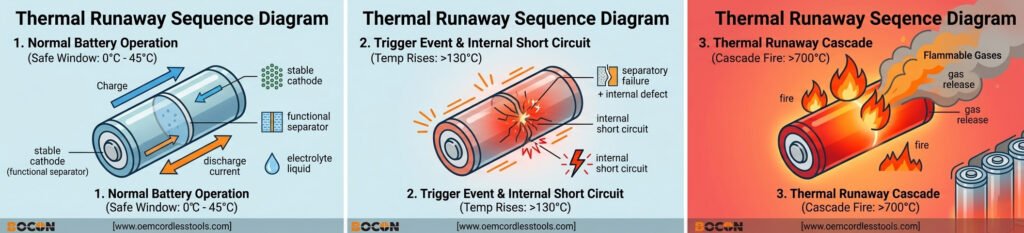
The technical term is thermal runaway, and once it starts, stopping it is extremely difficult.
Thermal runaway is a self-sustaining, self-amplifying chain reaction inside a lithium-ion cell. Here’s how it works:
A trigger event — we’ll get to what those are in a moment — causes the temperature inside a battery cell to rise. As temperature climbs, the cell’s internal chemistry accelerates. The separator between the positive and negative electrodes begins to decompose. The electrolyte — a flammable organic liquid — begins to vaporize. Internal pressure builds.
At a certain temperature threshold (typically between 130°C and 180°C for NMC chemistry, depending on the cell), the reaction becomes self-sustaining. Heat begets more heat. The cell releases flammable gases. And if oxygen is present — which it can be, released from the cathode material itself — the cell can burn without any external oxygen supply.
The burn temperature of a lithium-ion battery fire? 700°C to 1,000°C. That’s hot enough to ignite surrounding materials rapidly. In an enclosed space — a warehouse, a delivery van, a garage — the released gases can also form a flammable vapor cloud explosion.
What makes this particularly dangerous in power tool applications: thermal runaway in one cell can propagate to adjacent cells within the same battery pack. What starts as a single failing cell can cascade into a full pack failure within seconds. A 5-cell (21V) battery pack that goes into thermal runaway is effectively a small incendiary device.
This is why thermal runaway is not a risk to be managed after it occurs. It is a risk to be designed out before it can start.
The Five Root Causes of Lithium-Ion Power Tool Battery Fires
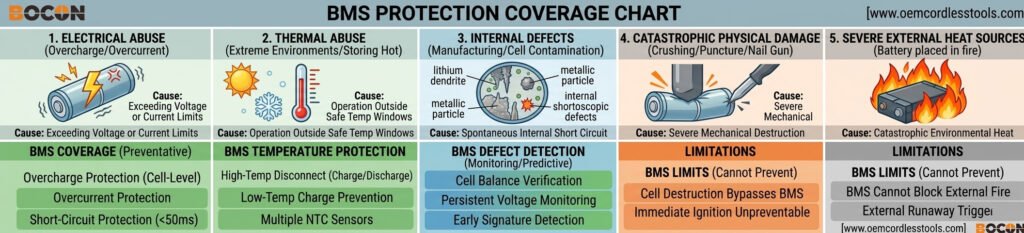
Every lithium-ion battery fire traces back to one of five root causes. Understanding them is the foundation for understanding what prevents them.
1. Electrical Abuse — Overcharge, Overdischarge, and Exceeding Rated Current
This is the most common cause of battery failure in real-world conditions, and it is almost entirely preventable by a properly functioning BMS.
Overcharge occurs when a battery is charged beyond its maximum safe voltage — typically 4.25V per cell for NMC chemistry. At this voltage, lithium metal begins to plate onto the anode surface, creating dendrites (tiny lithium spikes) that can penetrate the separator and create an internal short circuit. The result: rapid heat generation, and the beginning of thermal runaway.
In one scenario documented in battery safety research, a battery with a “separate port” BMS — one that uses different terminals for charging and discharging — could be charged through the discharge port. Because the BMS monitors only the designated charge port, charging through the discharge port bypasses the overcharge protection entirely, allowing cells to reach 4.5V or higher. This is not a theoretical edge case — it is a documented real-world failure mode.
Overdischarge occurs when cells are discharged below approximately 2.5V. Below this voltage, the copper current collector on the anode can dissolve into the electrolyte. When the cell is subsequently charged, this dissolved copper can redeposit as dendrites and create internal short circuits.
Exceeding rated discharge current — common in power tools when a motor stalls against a seized bolt — generates excessive heat inside the cells and can push cell temperature past safe operating limits.
2. Thermal Abuse — Operating or Storing Batteries Outside Safe Temperature Ranges
Lithium-ion batteries are chemistry, not magic. Their performance and safety depend on operating within defined temperature windows.
For charging: the safe range is approximately 0°C to 45°C. For discharging: approximately -20°C to 60°C. Outside these ranges, the electrochemical reactions that govern battery behavior become unpredictable. Charging at sub-zero temperatures causes lithium plating — the same mechanism as overcharge — permanently damaging the cell.
But thermal abuse isn’t only about extreme environments. Storing a fully charged battery pack in a hot van in summer — interior temperatures can exceed 49°C — accelerates the calendar aging of lithium-ion cells, creating latent defects that may not manifest until the battery is placed under load months later.
For European markets, this is particularly relevant: a battery shipped from a warehouse in Shenzhen in winter, stored in an unheated distribution center in Scandinavia, and then used on a job site in summer heat, experiences a thermal profile that requires careful BMS calibration.
3. Internal Defects — Manufacturing Contamination and Process Variation
No manufacturing process is perfect. Internal defects — microscopic metal contamination inside the cell, variations in electrode coating thickness, separator imperfections — are present to varying degrees in all lithium-ion cells.
In high-quality cells from tier-one manufacturers (Samsung SDI, LG Energy Solution, Panasonic, Murata), the defect rate is measured in parts per million. In budget cells from unverified suppliers, defect rates can be orders of magnitude higher.
Internal defects cause internal short circuits — a spontaneous connection between the positive and negative electrodes inside the cell. These defects may not manifest immediately. A cell with a microscopic contamination particle may cycle normally for 50 cycles before the particle migrates enough to bridge the separator.
This is why battery fires from internal defects are often described as “spontaneous” — the user reports doing nothing unusual, and yet the battery failed. The defect was always there. It just needed time.
A quality BMS with temperature monitoring can detect the heat signature of an internal short circuit event and disconnect the pack before thermal runaway propagates. But only if the BMS was designed to look for it.
4. Physical Damage — Impact, Crushing, and Vibration-Induced Failures
Power tools are used in rough environments. They get dropped. They bounce around in tool chests. They are shoved into bags with other equipment.
Physical damage to a battery pack can cause immediate or delayed failure. A sharp impact can puncture a cell directly. A crushing force can misalign internal components. Sustained vibration — a real risk for tools used on construction sites — can loosen solder joints on the BMS board or damage cell-to-cell connections, creating intermittent short circuits that generate heat under load.
The UK recall cited above — the Aorben 18V replacement battery — was caused by exactly this mechanism: an internal wire detaching and bypassing the protection circuit. In that case, the root cause was likely vibration or impact stress on a poorly assembled pack.
For power tool brands: vibration resistance testing should be part of your supplier qualification process. If the BMS board isn’t mechanically secured — potted in epoxy, for instance — sustained job-site vibration can compromise the electrical connections that are supposed to keep the pack safe.
5. Water and Moisture Intrusion
Lithium-ion batteries and water don’t mix well — not because water itself causes fires, but because water intrusion damages the internal components and creates conductive paths that cause short circuits. For power tools used outdoors, in wet conditions, or in humid environments, this is a legitimate risk.
A battery pack with an inadequate IP (Ingress Protection) rating — or no IP rating at all — can allow moisture to reach the BMS board and cell connections. Once moisture bridges the right connections, the outcome is the same as any other short circuit: rapid heat generation, potential thermal runaway.
How a Battery Management System Prevents Each Failure Mode
The BMS is not a single feature. It is a system — a combination of hardware, firmware, and engineering design — that addresses each of the five failure modes described above.
BMS Protection: Electrical Abuse Prevention
A properly designed BMS prevents electrical abuse through four specific mechanisms:
Overcharge protection — The BMS continuously monitors the voltage of each individual cell (not just the pack-level voltage). When any cell reaches 4.25V, the BMS immediately cuts off the charge current via its MOSFET switches. This prevents lithium plating and the internal short circuits it causes.
The critical quality differentiator: a BMS that monitors pack-level voltage only is vulnerable if one cell is significantly weaker than the others. That weak cell can be substantially overcharged while the pack-level voltage is still within spec. Only cell-level monitoring — one voltage channel per cell — provides adequate protection.
Overdischarge protection — The BMS monitors cell voltage during discharge and disconnects the load when any cell reaches approximately 2.5–2.8V. This prevents copper dissolution and the latent defects it creates.
Overcurrent and short-circuit protection — When current exceeds a defined threshold (typically 2–5x the continuous rated current), the BMS disconnects the battery within microseconds. This is the protection against motor stall scenarios — the seized bolt that causes the tool to draw 100A for several seconds.
The response time of the BMS matters enormously here. A protection IC with 20–50ms response time may allow sufficient energy to flow into the fault to melt solder joints or damage cells before disconnection. A well-designed BMS responds in microseconds.
Pre-charge and balanced charging — For packs with separate charge and discharge ports, a quality BMS implements appropriate control logic to prevent charging through the discharge path. This is a firmware decision, not just a hardware one.
BMS Protection: Thermal Abuse Prevention
Temperature protection is implemented through NTC thermistors — temperature sensors placed at critical points inside the battery pack. The BMS reads these sensors continuously and takes protective action based on defined temperature thresholds.
A quality BMS for power tool applications will typically:
- Monitor cell temperatures via sensors placed near the cells
- Monitor PCB and MOSFET temperatures separately
- Disconnect charging when cell temperature exceeds approximately 45–50°C
- Disconnect discharging when cell temperature exceeds approximately 60–70°C
- Prevent charging when cell temperature is below 0°C (to prevent lithium plating)
The number and placement of NTC sensors is a meaningful differentiator. A BMS with one NTC sensor is a cost-reduced design that cannot detect localized hot spots — for instance, one cell in a 10-cell pack heating up while the others remain cool. A well-designed pack places sensors at multiple positions to catch developing problems early.
Insider note: When we audit battery packs returned from the field, the packs that experienced thermal events almost always have one common characteristic: the BMS allowed the battery to continue operating past a safe temperature threshold. Either the temperature protection was not calibrated correctly for the cell chemistry, or there were not enough temperature sensors to detect the problem in time.
BMS Protection: Internal Defect Detection
This is the most technically challenging protection to implement well, and it separates premium BMS designs from budget ones.
Internal defects that cause soft shorts — microscopic connections that don’t immediately cause catastrophic failure — generate localized heat. A BMS with sufficiently precise cell voltage monitoring can detect the voltage signature of a soft short: one cell showing slightly lower voltage than its neighbors under load, diverging over time.
A well-designed BMS firmware monitors cell voltage balance continuously during charge and discharge cycles. When cell-to-cell voltage divergence exceeds a defined threshold, the BMS flags a fault condition — and in a quality implementation, prevents further operation until the pack is inspected.
This is why we run cell balance verification on every production pack at our factory. Not just to maximize pack capacity — though that is also important — but because the balance monitoring process is the mechanism by which the BMS detects early-stage internal defects before they progress to thermal runaway.
BMS Protection: Vibration and Mechanical Stress
The BMS hardware must survive the mechanical environment that power tools operate in. This is an engineering challenge that requires specific design decisions.
Board potting — Encapsulating the BMS PCB in thermally conductive epoxy (thermal potting compound) protects solder joints and component connections from vibration-induced fatigue. A non-potted board may survive initial testing but develop intermittent connections under sustained vibration stress — exactly the failure mode that caused the Aorben recall.
Secure component mounting — Battery pack connectors, balance leads, and the sense wires that connect individual cell voltages to the BMS must be secured with strain relief to prevent vibration-induced disconnection.
When evaluating a supplier, ask specifically about their vibration resistance testing procedure. If they don’t have one, that’s a significant gap.
BMS Protection: Moisture and Contamination
For moisture protection, the BMS itself doesn’t directly prevent water intrusion — that’s a mechanical pack design and IP rating question. But the BMS does play a role: if moisture begins to cause a short circuit, the BMS’s overcurrent protection should disconnect the pack before the short circuit current causes heating and ignition.
For higher IP-rated applications — tools intended for outdoor use or wet conditions — the BMS components and connectors should be rated for the relevant IP level. This requires specific component selection and pack sealing design.
The Cell Balancing Function — Why It Matters More Than Most Buyers Realize
Cell balancing is one of those BMS functions that buyers often treat as optional or don’t fully understand. It is neither.
In a multi-cell battery pack, cells never age identically. Small variations in internal resistance, temperature exposure, and manufacturing tolerances cause cells to drift apart in voltage over charge-discharge cycles. Without balancing, the pack’s usable capacity is ultimately limited by its weakest cell.
But the safety dimension of cell balancing is equally important. When cells are severely unbalanced — one cell at 3.0V while the others are at 3.8V — the low-voltage cell has been deeply discharged into a dangerous zone. If the BMS doesn’t detect and flag this condition, continued operation of the pack can cause copper dissolution and internal short circuits in the weak cell.
Passive balancing — the standard approach in power tool applications — works by discharging the higher-voltage cells through resistors until all cells are equalized during charging. It’s simple, reliable, and effective. The quality of passive balancing depends on whether the BMS firmware correctly identifies the balance threshold, and whether the balancing current is sufficient to equalize cells within a reasonable charging window.
A BMS that claims to have balancing but implements it with an unreasonably low balancing current — a common cost-reduction measure — will not keep cells synchronized under heavy use conditions. Over time, the pack drifts out of balance, capacity degrades, and the safety margin narrows.
The European Retailer’s BMS Checklist — What to Ask Before You Order
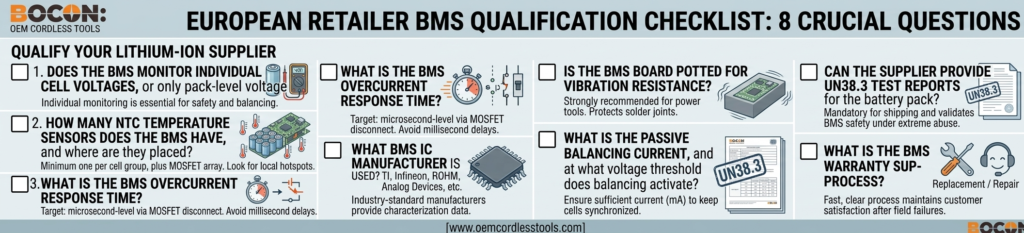
Here’s the practical takeaway from everything above. When you’re qualifying a supplier for cordless power tool battery packs — whether for private label, wholesale, or an existing product line — these are the questions that separate a BMS that was engineered from one that was simply assembled:
1. Does the BMS monitor individual cell voltages, or only pack-level voltage? Individual cell monitoring (one channel per cell) is essential for overcharge protection and cell balance monitoring. Pack-level only is inadequate.
2. How many NTC temperature sensors does the BMS have, and where are they placed? Minimum: one per cell group, plus one at the MOSFET array. For a 10-cell pack, that means at least 4–5 sensors. One sensor is a cost reduction that creates a blind spot.
3. What is the BMS overcurrent response time? Target: microsecond-level response via MOSFET disconnect. If the answer is “milliseconds,” that’s a thermal stress risk during motor stall events.
4. What BMS IC manufacturer is used? Texas Instruments, Infineon, ROHM, Analog Devices, STMicroelectronics are industry-standard. “Proprietary IC” or “manufacturer confidential” without further detail is a yellow flag.
5. Is the BMS board potted for vibration resistance? For power tools, potting is strongly recommended. Ask for vibration test data if the supplier claims adequate mechanical design without potting.
6. What is the passive balancing current, and at what voltage threshold does balancing activate? Balancing current should be sufficient to equalize cells within one standard charging cycle. Ask for the specific mA value.
7. Can the supplier provide UN38.3 test reports for the battery pack? UN38.3 is mandatory for international shipping of lithium-ion batteries and includes thermal abuse testing that validates BMS response under extreme conditions. If a supplier cannot produce this report, do not order.
8. What is the BMS warranty support process? When a BMS fault occurs, what happens? Replacement, repair, or “send it back”? The speed and quality of warranty support directly affects your ability to maintain customer satisfaction after a field failure.
What BMS Cannot Do — The Limits of Protection Technology
Honesty matters in technical content, so here is what BMS does not prevent:
BMS cannot prevent fires from catastrophic physical damage. If a battery pack is crushed by a vehicle, run over by heavy equipment, or punctured with a nail gun, the mechanical destruction of the cells bypasses any electronic protection. The BMS cannot stop a cell that has been physically destroyed.
BMS cannot prevent fires from severe external heat sources. If a battery pack is placed in a fire — not heated, but burned — the BMS cannot prevent thermal runaway induced from the outside.
BMS cannot compensate for inferior cells. A BMS protecting low-quality cells with high defect rates can reduce the probability of fire, but it cannot eliminate the risk inherent in the cells themselves. Cell quality and BMS quality are both required.
BMS cannot prevent aging-related failures indefinitely. Lithium-ion cells age. After 500–1,000 cycles, even a perfectly managed pack will have reduced capacity. Eventually, aged cells may develop internal defects that a BMS cannot fully mitigate. Battery packs have a finite lifespan, and BMS or not, they should be replaced at end of life.
Understanding these limits is not an argument against BMS — it is an argument for sourcing complete battery pack systems from suppliers who control both cell selection and BMS engineering, rather than buying cells and BMS separately and assembling them without system-level integration testing.
The Business Case for BMS Quality
Here’s the financial dimension that procurement managers need to hear clearly:
A single battery fire incident, for a brand operating in Europe, typically triggers the following cascade:
- Product recall — All affected units must be retrieved. For a power tool battery pack with 10,000 units in market, recall costs can reach €500,000–€2,000,000 depending on logistics and the retailer’s market coverage.
- Regulatory investigation — Under the EU Battery Regulation and the General Product Safety Regulation, the incident may trigger a formal investigation. The cost of regulatory compliance response — legal counsel, testing laboratories, documentation — is typically €50,000–€200,000 for a first incident.
- Retailer delisting — Major European retailers (Metro, Bauhaus, Kingfisher, Intergamma) maintain product safety frameworks that typically require delisting pending investigation. A delisting costs more than the recall: it interrupts revenue, creates stock shortages, and may require re-qualification before relisting.
- Reputational damage — Consumer brand trust, once damaged, is slow to rebuild. Online reviews, trade press coverage, and social media amplify even a single incident disproportionately.
Against this backdrop, the marginal cost difference between a quality BMS implementation and a budget BMS — typically €2–8 per unit at the pack level — is one of the highest-return engineering investments a brand can make.
When you see a supplier quote a battery pack price significantly below market for equivalent cell specifications, the cost reduction almost always comes from the BMS: a lower-grade IC, fewer temperature sensors, no board potting, simplified firmware. The cells look the same on the specification sheet. The fire risk doesn’t show up until the pack is in the field.
What a Quality BMS Engineering Process Actually Looks Like
For the buyer who wants to understand what they should expect from a serious manufacturer, here is what BMS engineering looks like when it’s done properly:
Cell selection and characterization — The engineering team selects cells and defines the BMS parameters (voltage limits, current limits, temperature thresholds) based on the specific cell datasheet, not generic settings. For each cell chemistry and supplier, the thresholds are calibrated independently.
BMS firmware development and testing — The protection firmware is developed, tested across the full temperature range, and validated for response time under fault conditions. This is not simply configuring a chip manufacturer’s reference firmware — it’s testing and tuning for the specific application.
System-level integration testing — The BMS and cells are tested together as a system, not in isolation. This includes charge-discharge cycling, vibration testing, thermal imaging under high-current conditions, and short-circuit injection testing.
Production validation — Every production unit is tested at the BMS level: cell balance verification, protection function testing, and quiescent current measurement. Units that fail are rejected, not reworked and shipped.
Field monitoring — Warranty return data is analyzed to identify any systematic BMS issues before they scale into incidents.
This is the process that justifies our engineering overhead. It’s also the process that most traders and assembly operations skip — because it costs money and doesn’t show up in the specification sheet.
Lithium-ion battery fires are not random events. They are the predictable consequence of specific failure modes — electrical abuse, thermal stress, internal defects, physical damage, and moisture intrusion — when adequate protection is absent or inadequate.
The Battery Management System is the component that prevents each of these failure modes from progressing to thermal runaway. But a BMS is only as good as the engineering that went into it: the IC manufacturer, the number of temperature sensors, the firmware calibration, the mechanical design, and the production testing that verifies every unit performs as designed.
For European retailers, distributors, and brand managers: the regulatory environment is tightening. The Fire Safety Order 2005 places responsibility on you. The EU Battery Regulation now requires CE marking. And the consequences of getting this wrong — a recall, a delisting, a regulatory investigation — are severe enough that they justify the extra due diligence upfront.
When you’re evaluating suppliers, make the BMS a line item. Not as an afterthought. As a requirement.
If you’d like to discuss how our battery pack engineering addresses thermal runaway prevention, or what our BMS qualification process looks like for a specific product line, we’re available to walk through the details.