
If you’re stocking cordless power tools in 2026 and you haven’t updated your procurement strategy in the last 18 months, you’re already behind.
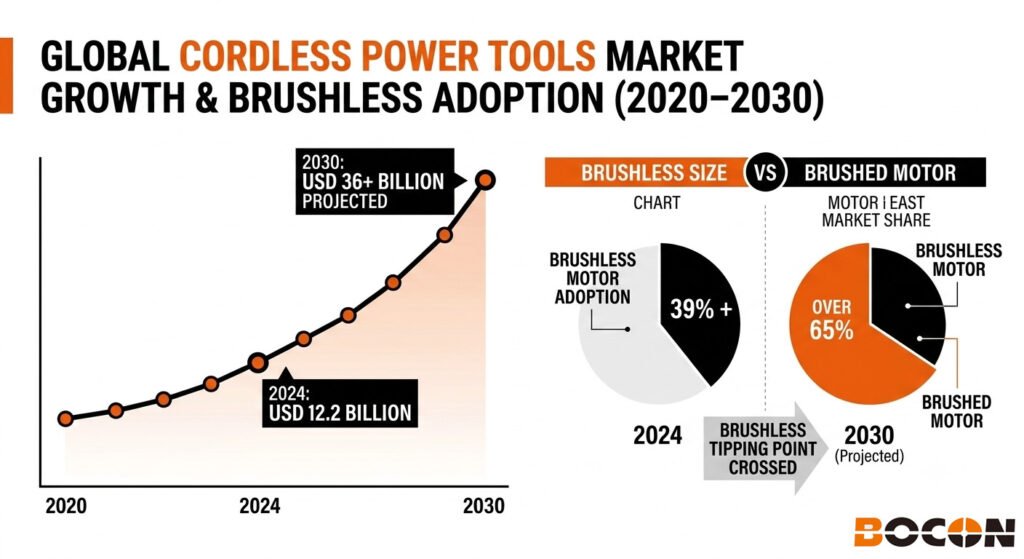
The numbers move fast. The global cordless power tools market crossed USD 12.2 billion in 2024 and is tracking toward USD 36+ billion by the early 2030s — that’s a compound growth story that demands attention from every buyer in this space. But raw market size tells you very little. What matters is where the shifts are happening, which ones are structural versus cyclical, and what they mean for your SKU decisions right now.
I’ve spent the last 15 years on the factory side of this industry — watching brushless motors drop from premium tier to commodity in under a decade, seeing European regulators rewrite the rules for battery products, and helping brands navigate the transition from “corded is fine” to “cordless or nothing.” Here are the five shifts I think European and Australian retailers need to internalize before their next buying season opens.
Shift 1: Brushless Motors Have Crossed the Tipping Point — and Your Margin Structure Needs to Reflect That
Two years ago, brushless was still a differentiator. Today, it’s becoming the floor.
According to GM Insights, the brushless motor segment accounted for over 39% of the global cordless power tools market share in 2024. The brushless power tools segment is now valued at USD 13.40 billion, projected to reach USD 25.05 billion by 2033 at a CAGR of 7.2%. That growth rate outpaces the overall market — which tells you the mix is shifting fast.
What does this mean for retailers in Europe and Australia specifically?
Brushless tools now appear at price points that weren’t viable three years ago. We’ve seen it in our own product development: a brushless 20V cordless drill that carried a USD 45–55 factory gate price in 2022 is now being quoted at USD 28–35 for comparable specs. That’s a structural cost curve, not a one-year adjustment. It reflects (economies of scale) in brushless motor production reaching maturity in Chinese manufacturing.
Here’s the practical problem, though: many retail buyers are still pricing their shelf strategy based on 2022–2023 cost structures. If you’re buying brushless at brushed-equivalent prices from the wrong supplier, you’re leaving margin on the table — or worse, you’re buying brushed inventory that will be harder to move within 18 months as consumer expectations shift.
The other dimension is warranty and return rates. Brushless tools run cooler, wear slower, and have fewer mechanical components that fail. From a gross margin perspective, a lower return rate on brushless tools can be worth more than the unit cost difference.
What to ask your supplier: What percentage of your current cordless drill and driver SKUs are brushless? At what volume does brushless pricing become competitive with brushed at your factory? And can you provide failure rate data from your field returns over the past two years?
Shift 2: Battery Platform Consolidation Is No Longer Optional — It’s a Category Strategy Decision
This is the shift I see the most retailers underestimating — and the one that will define competitive positioning in European and Australian markets through the end of the decade.
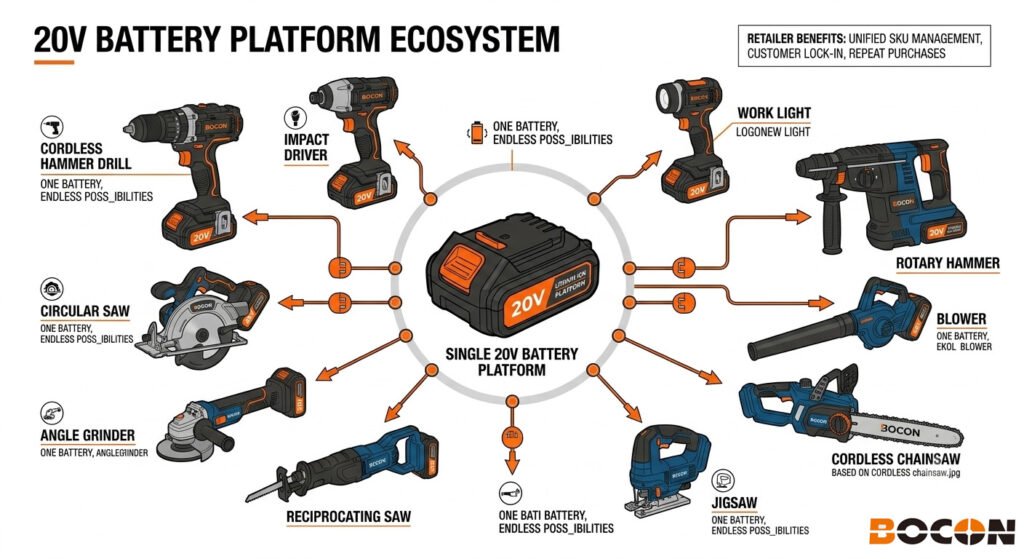
Battery platform strategy refers to how a brand structures its voltage ecosystem: which tools share battery packs, how those packs communicate with the tool’s electronics, and whether the platform is open (cross-brand compatible) or closed (proprietary).
In 2026, three forces are pushing platform consolidation up the decision tree:
1. Consumer loyalty is increasingly tied to ecosystem, not individual tool brand. A tradie who has invested in three 20V packs and four tools from a brand is not switching to a competing platform over a single tool recommendation. For retailers, this means your shelf space choices have compounding effects on repeat purchase behavior.
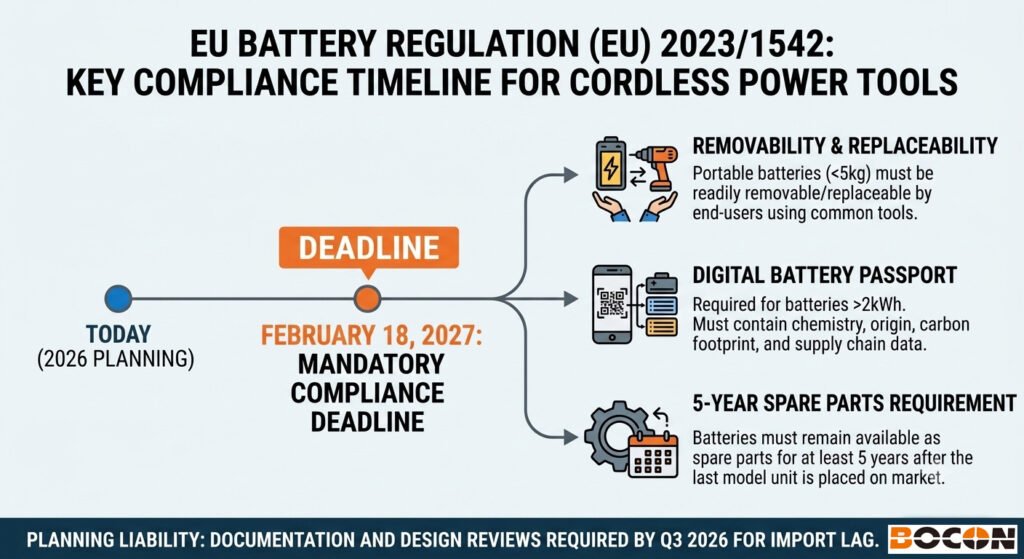
2. EU environmental regulations are reshaping how battery platforms are designed. The EU Battery Regulation (EU) 2023/1542, effective February 18, 2027, introduces mandatory requirements for battery removability, replaceability, and — for packs above 2kWh — Digital Battery Passports. Batteries must remain available as spare parts for at least 5 years after the last unit of a product model is placed on the market. This fundamentally changes the economics of fragmented, single-tool battery packs. Retailers sourcing from suppliers without a clear platform roadmap are inheriting a compliance liability.
3. Cross-platform battery standards are starting to emerge. While no universal standard exists yet, regulatory pressure — combined with market consolidation — is pushing major manufacturers toward greater interoperability at the physical and charger level.
The Australian market adds another layer: Bunnings and Total Tools have both been expanding their proprietary battery platform offerings, creating their own channel lock-in dynamics that affect what private label suppliers can realistically supply.
What this means for your procurement: If you’re stocking multiple brands with incompatible battery platforms, you need a clear rationale for each one. If you’re developing a private label program, battery platform architecture needs to be locked in before you finalize tool specs — retrofitting is expensive and time-consuming.
Shift 3: The EU Battery Regulation Is a 2026 Planning Problem, Not a 2027 Compliance Problem
Here’s what I see too often: European retailers treating the February 18, 2027 EU Battery Regulation deadline as something to address in Q4 2026.
That’s a dangerous miscalculation.
The regulation covers all batteries placed on the EU market, including those integrated into power tools. Key obligations that kick in on February 18, 2027 include:
- Removability and replaceability: Portable batteries (under 5 kg) must be readily removable and replaceable by end users using commercially available tools. For LMT (light means of transport) batteries, professional removability is required throughout the product lifetime.
- Spare parts availability: Batteries must be available to independent professionals and end users for at least 5 years after the last unit of a model is placed on the market.
- Digital Battery Passport: Batteries above 2kWh must carry a digital passport linked to a QR code, containing chemistry, origin, carbon footprint, and supply chain data.
The removability requirement in particular has direct implications for how power tools are designed. A tool with a fully integrated, non-removable battery pack may be non-compliant for the EU market if that battery cannot be replaced without specialized equipment or processes.
For retailers importing cordless power tools from China, the practical risk is supply chain lag: if your supplier’s EU compliance documentation isn’t finalized before your Q3 2026 ordering window, you could face last-minute reformulation of product specs — or worse, shipment delays into key selling seasons.
Australian retailers selling into the EU market (either directly or through third-party platforms) face the same compliance exposure. And for EU-based distributors, failure to source compliant products means returning inventory to suppliers — a costly exercise that damages both supplier relationships and shelf availability.
What to ask your supplier: Do you have EU Battery Regulation compliance documentation for your current battery pack SKUs? Has your battery pack design been reviewed against the removability and replaceability requirements? Can you provide Digital Battery Passport data structures for your packs above 2kWh?
Shift 4: The Private Label Quality Gap Has Closed — and Chinese Factories Are Now Strategic Partners, Not Just Manufacturers
This is the shift that has changed the most in the last five years, and it’s the one most retail buyers are still processing.
The traditional narrative was simple: established brands = quality, Chinese OEM = budget compromise. That story was always somewhat reductive, but it had enough truth in it that buyers could use it as a working heuristic. In 2026, that heuristic is failing.
Why?
Chinese brushless motor manufacturing has reached a quality maturity threshold. The same motor design that powers a Makita or DeWalt tool in 2026 often comes from the same or functionally identical production lines in Shenzhen or Wuxi. The difference between a brushed motor with 30% efficiency loss and a well-engineered brushless motor is now more about design intentionality than manufacturing capability.
At our facility, we’ve been running 100% brushless production on cordless drills, impact drivers, impact wrenches, and angle grinders since 2021. Our return rate across all cordless SKUs over the past eight years sits under 0.3% — a figure that matches or beats what most established brands report for equivalent product categories.
The structural change is in engineering capability. The best Chinese ODM factories now have:
- Full mechanical and electrical design teams capable of original product development
- In-house motor design and testing (not just assembly)
- BMS (Battery Management System) firmware written and maintained internally
- Certification coverage across CE (MD + LVD + EMC), ETL, UN38.3, and RoHS
For European and Australian retailers, this means the private label calculus has fundamentally changed. The risk profile of sourcing a 20V cordless drill from a capable Chinese factory with proper certifications is now materially different from what it was in 2018. What hasn’t changed as fast is the speed of new product development and certification timelines — those still require 8–14 weeks minimum from spec freeze to certified sample, and that’s a lead time most retail buyers underestimate.
The practical implication: if your private label program is still treating Chinese suppliers as interchangeable commodity sources, you’re leaving performance, innovation, and margin on the table.
Shift 5: The Cordless Transition Has Reached a Tipping Point in Core Markets — Emerging Markets Are the Next Growth Frontier
This one is more nuanced than the others, and it’s the shift I find most buyers underweighting in their long-term category planning.
The corded-to-cordless transition in power tools has been underway for over a decade. But “underway” doesn’t mean “complete.” In 2026, the picture looks very different depending on which market you’re examining:
In established European and Australian markets, cordless penetration in the consumer and light-professional segments has crossed 70–80% for core tool categories (drills, drivers, saws). The remaining corded demand is concentrated in heavy industrial applications where sustained high-power output still favors corded or pneumatic alternatives. For retailers in these markets, the growth story is no longer about corded-to-cordless conversion — it’s about platform upsell, battery ecosystem expansion, and tool-to-tool upgrade cycles.
In emerging Southeast Asian, Middle Eastern, and African markets, corded tools still represent 40–60% of the installed base. These are the next conversion markets — and they’re growing faster than mature markets in percentage terms. Retailers with international expansion ambitions should be thinking about how their supply chain positioning in 2026 will affect their competitiveness in those markets in 2028–2030.
Australia’s cordless power tools market is valued at approximately USD 240 million in 2024 and is projected to reach USD 435 million by 2033, growing at a CAGR of 6.90%. For context, that’s a market that will add nearly USD 200 million in size over nine years — driven primarily by residential construction activity, renovation cycles, and increasing professional tool ownership among tradies.
For European retailers specifically, the growth dynamics are more complex: strict environmental regulations are accelerating cordless adoption in some segments, while economic headwinds in key markets (Germany, France) are putting pressure on premium tool spend. The overall trend is positive, but the margin pressure in mid-market cordless SKUs is real.
The procurement implication: Stocking strategies that worked in 2022–2023 in cordless tools are not going to be optimal for 2026–2028. The category is mature enough in Europe and Australia that differentiation is moving to ecosystem, serviceability, and compliance — not just price and power specs.
What This Means for Your Next Buying Season
Five shifts don’t move in isolation. The brushless tipping point affects your margin structure. Platform consolidation affects your compliance exposure. EU regulation affects your supply chain timelines. Private label quality improvements affect who you can source from and at what risk level. Emerging market dynamics affect your long-term category strategy.
The retailers who are winning in cordless power tools right now aren’t the ones chasing the lowest factory price. They’re the ones building battery platform strategies that compound over time, sourcing from suppliers who can demonstrate field quality data, and treating EU Battery Regulation compliance as a 2026 sourcing requirement rather than a 2027 checkbox.
We’re watching these shifts closely from the factory side. If you’re reassessing your cordless tool supply chain for 2026 — whether that’s expanding your private label program, evaluating new battery platform suppliers, or preparing for EU compliance deadlines — we’re available to walk through your specific situation.