
Ask any experienced sourcing manager who’s been burned by a Chinese supplier and they’ll tell you the same thing: the moment you wired that deposit, you knew something felt off. You just didn’t have a framework to prove it before it was too late.
The problem is real. Industry estimates consistently put the percentage of self-declared “manufacturers” on major B2B platforms — Alibaba, Made-in-China, Global Sources — at somewhere between 30 and 50 percent. That means if you’re not systematically verifying your power tool suppliers, you’re probably talking to a trading company in roughly one out of every two conversations.
Trading companies aren’t all bad. For small orders across many product categories, a good trading house can add real value. But when you’re placing a $50,000 order for a 20V cordless drill line with specific torque specs, brushless motor requirements, and a battery platform that needs to be compatible across eight tool SKUs — you need a factory, not a middleman adding 15 to 30 percent to your cost and zero engineering capability to your product.
This checklist is built from 15 years of being on the factory side of those conversations. These are the questions I get asked when buyers are doing their diligence on us. They’re also the questions I wish more buyers had asked before signing contracts with the last three factories that cost them money.
None of these require a plane ticket. Most can be answered in under an hour. Use them.
Why This Checklist Exists: The Power Tool Sourcing Problem in 2026
Power tools are not a simple import category. A cordless drill involves precision mechanical engineering (the gearbox), electrical engineering (the motor and its controller), electrochemical engineering (the battery pack and its BMS), and industrial design. Getting any one of these wrong — or sourcing any one of them from a supplier who doesn’t actually understand what they’re making — produces a tool that fails in the field, generates returns, damages your brand, and ends up costing you more than you saved on the unit price.
The trading companies who populate the supplier landscape know this category looks attractive. They know buyers search for “OEM cordless power tools China” expecting to find a factory. Many of them have gotten very good at looking like one — at least from a marketing page and a scripted video call.
What they’re not good at — what they physically cannot do — is engineer a gear reduction ratio for a brushless motor, tune BMS firmware for a 25-amp peak draw, or own the quality outcomes when a production run comes off spec. Those capabilities require physical infrastructure, engineering talent, and manufacturing discipline that a trading company simply doesn’t have.
The 15 questions below are organized into four phases: remote verification before any call, production capability assessment, quality system scrutiny, and engineering depth interrogation. Each one is selected to catch a specific type of trading company disguise.
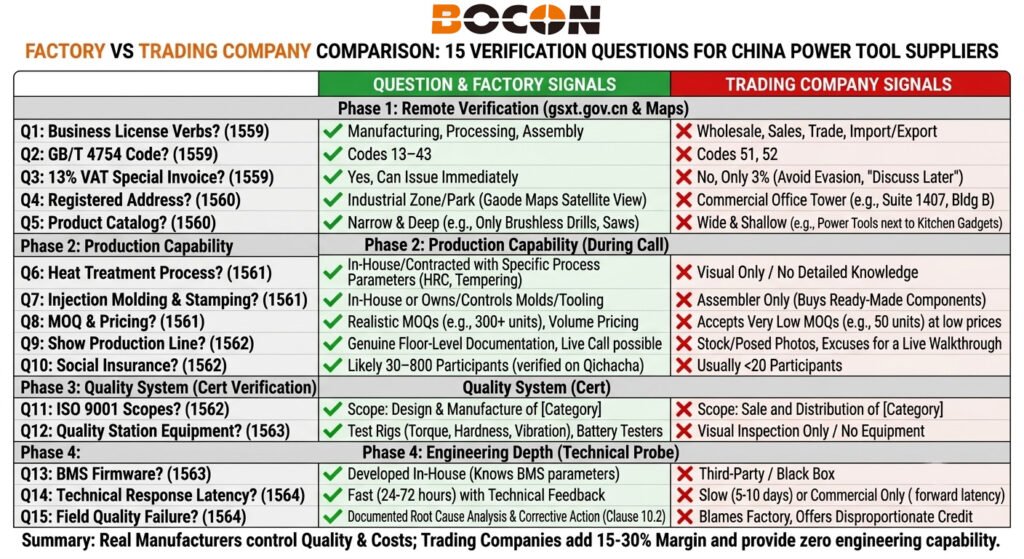
Phase 1: Remote Verification — Before You Book That Video Call
These five questions can be answered from your desk, using free Chinese government databases and a map application. Do this before you spend anyone’s time.
Question 1: Does Their Business License Show Manufacturing Verbs?
In China, every registered company has a business scope (经营范围) listed on their business license. This document is public on the National Enterprise Credit Information Publicity System (国家企业信用信息公示系统, gsxt.gov.cn), and it’s the single highest-signal document in supplier verification.
What to look for: manufacturing verbs — 生产 (production), 制造 (manufacture), 加工 (processing), 组装 (assembly) — followed by a product category. If the business scope contains only 销售 (sales), 批发 (wholesale), 贸易 (trade), or 进出口 (import/export) with no manufacturing verbs anywhere, that entity is legally a trading company. Full stop. The sales rep can tell you whatever story they want; the business license is the source of truth.
This takes about five minutes on gsxt.gov.cn or a third-party aggregator like Qichacha (企查查) or Tianyancha (天眼查). Every serious buyer in our industry does this before the first call.
Question 2: What Is Their GB/T 4754 Industry Classification Code?
China’s national industry classification system assigns a numeric code to every registered business. The first two digits tell you the sector:
- Codes 13 through 43 → Manufacturing (制造业). This is where a real power tool factory lives.
- Code 51 or 52 → Wholesale and retail trade. Trading company territory.
- Code 54 → Internet information services or retail. Not a manufacturer.
You find this on the company’s detailed business license record, accessible through the same Qichacha or Tianyancha query. If you’re evaluating a supplier who shows up as code 52, you’re talking to a trader.
Question 3: Can They Issue a 13 Percent VAT Special Invoice?
Ask this question in writing: “Can you issue a 13% VAT special invoice (13%增值税专用发票)?”
In China, general taxpayers (一般纳税人) — which includes all real manufacturers — can and do issue 13% VAT special invoices. Small-scale taxpayers (小规模纳税人), which include most trading companies and intermediaries, can only issue 3% simplified invoices.
Watch for evasion patterns: the supplier who changes the subject, says “we can discuss invoice type based on order size,” or offers a “no invoice for a discount” arrangement. A factory operating at any meaningful scale must be a general taxpayer because their domestic Chinese customers require deductible input VAT. If they’re dodging this question, there’s a reason.
Question 4: Is Their Registered Address in an Industrial Zone or an Office Tower?
Pull up their registered address on Gaode Maps (高德地图) or Baidu Maps. Real factories in China are located in industrial zones (工业园, 工业区), development zones (开发区), or standalone manufacturing buildings on the outskirts of cities. They have large footprints, flat roofs, loading docks, and visible infrastructure.
Trading companies are registered in commercial office buildings — the kind with suite numbers, tower designations, and downtown or district office park addresses. No Chinese city zones a 30-story commercial tower for manufacturing. A supplier at “Suite 1407, Building B, XXX Commercial Center, Pudong, Shanghai” is not making power tools there.
Use satellite view. You can see the difference from your desk in under three minutes.
Question 5: Does Their Product Catalog Span Unrelated Categories?
Look at the supplier’s product range. Real factories specialize. Our facility makes cordless power tools — drills, drivers, wrenches, grinders, saws — and we make the brushless motors, gearboxes, and battery packs that go into them. That’s already a technically broad range for a single factory.
A trading company catalog looks different: power tools next to kitchen gadgets next to consumer electronics next to garden equipment. They aggregate SKUs from multiple factories and sell them from one storefront. If you’re looking at a supplier who shows you 40 different product categories on their homepage, you’re looking at a trading company — or at minimum, a company that is aggregating from multiple sources and adding margin on each.
Phase 2: Production Capability — What to Probe on the First Call
If the remote checks cleared, book the video call. But go in with these five questions ready. They’re designed to separate real manufacturing infrastructure from a rented factory stage set.
Question 6: Can You Walk Me Through Your Heat Treatment Process?
Heat treatment — the process of hardening and tempering the steel in your gearboxes, tool bodies, and motor shafts — is the single most revealing production capability question in the power tools category.
Here’s why it matters: properly heat-treated tool steel has a specific hardness profile, typically 58 to 62 HRC for gear and bearing surfaces. Get it wrong and the steel becomes either too brittle (chips under shock load) or too soft (deforms under torque). In a power tool, the consequences show up as stripped gears, seized bearings, and premature motor failure.
Real factories invest in heat treatment equipment — vacuum furnaces, induction hardening lines, or at minimum, contracted heat treatment vendors with documented process parameters. Trading companies and assembler-only operations skip this step because the equipment is expensive and the technical knowledge required to specify it correctly is specialized.
When you ask this question, listen for specificity. A factory engineering team will give you process parameters: “We use vacuum carburizing at 930 degrees Celsius with oil quenching and 180-degree tempering.” A trading company will say “we have strict quality control” and change the subject.
For us, heat treatment is a core capability. We’ve invested in vacuum carburizing specifically because the distortion control it provides is essential for precision gear applications. If a power tool supplier can’t talk about their heat treatment process, they almost certainly don’t own it.
Question 7: Do You Own Your Injection Molding and Stamping Capability?
A cordless drill has two major plastic or composite components: the housing and the battery housing. Both are produced by injection molding. The metal components — the chuck, the motor housing, the gear case — are formed by stamping or die casting.
Ask specifically: do you do stamping and molding in-house, or do you outsource these processes?
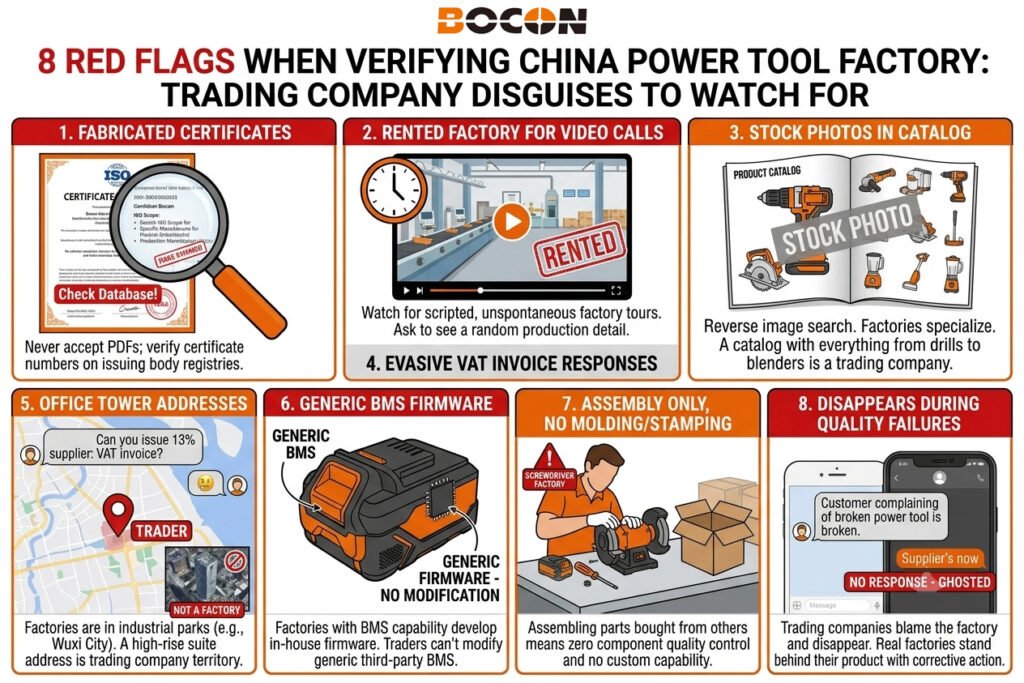
“Screwdriver factories” — the trading company euphemism for operations that only assemble components — don’t own stamping or molding. They buy ready-made parts from sub-suppliers and put them together. This means they have zero control over the quality of the components going into your tools, no ability to modify a mold for your specific design requirements, and no visibility into what’s actually in the parts they’re buying.
A real factory owns the tooling. When we design a new drill housing, we design the mold, own it, and control every modification. That’s the difference between a supplier who can deliver your spec and a supplier who delivers whatever the lowest-bid component supplier sent them that week.
Question 8: What Is Your Minimum Order Quantity and Why?
Real factories have minimum order quantities that reflect production economics. Running a production line has fixed costs: setup time, tooling amortization, labor scheduling. Below a certain quantity per SKU, a factory loses money on each unit or simply can’t schedule production efficiently.
Trading companies don’t have this constraint because they’re aggregating orders across multiple buyers. A “factory” that’s happy to take 50 units of a custom cordless drill will either be lying about being able to produce 50 units (they’ll pool it with someone else’s order and hope for the best) or lying about their production capability.
For power tool manufacturing at reasonable specifications — brushless motor, multi-stage gearbox, certified battery pack — the realistic MOQ for a serious factory starts at 300 to 500 units per SKU. A supplier willing to take 50 units at the same unit price is either not a real factory or is selling you something that isn’t what you think it is.
Question 9: Can You Show Me a Photo or Video of Your Current Production Line Running?
This sounds basic, but it’s remarkable how many suppliers cannot produce an unscripted, current photo or video of their actual production floor.
Watch for the response patterns that indicate a problem. If the supplier sends you photos that look professionally lit, posed, and identical to the images on three other supplier websites — those are stock photos. Run them through a reverse image search (Google Images or TinEye). If the same photo appears on supplier pages in three different provinces, it’s not their factory.
What you’re looking for: genuine floor-level documentation. Worker PPE. Tool pallets with product labels. A visible daily production schedule board on the wall. A specific machine that you can ask to see again in a follow-up call. Real factories are often less photogenic than trading company staging operations. That’s a feature, not a bug.
Question 10: How Many Social Insurance Participants Does Your Company Report?
This data comes from the same gsxt.gov.cn annual report search you did for Question 1. Look for “社保缴纳人数” — social insurance participant count. This is the closest thing to a verified employee count that exists in Chinese public records.
A small but real power tool factory typically has 30 to 150 employees. A medium factory runs 150 to 800. A trading company almost never exceeds 30, and many operate with under 10 people on the books.
If you’re looking at a supplier’s profile and see fewer than 20 social insurance participants, ask yourself how a factory of that size produces 100,000 cordless drill units per year. The math doesn’t work. That “factory” is a trading operation or an assembler with a handful of staff.
Phase 3: Quality System — What the Certificates Actually Tell You
Anyone can download a CE or ISO certificate template and fill in a company name. These questions help you separate real quality systems from paper ones.
Question 11: Can You Verify Your ISO 9001 Certificate Against the Issuing Body’s Registry?
Never accept an ISO 9001 certificate as valid based on the PDF alone. Fabricated certificates are common. What you do is this: find the issuing certification body (CB) named on the certificate — common ones include TÜV Rheinland, SGS, Bureau Veritas, CQC, and CQC’s partner bodies — and look up the certificate number in that CB’s public database.
When you find the registration, check three things:
- The certified entity name matches the company you’re buying from — not a parent company, not a related party, not a previous entity name.
- The certified address matches their claimed factory address — not an office address.
- The certified scope says “design and manufacture of ” — not “sale and distribution of .”
That third point is critical. A certificate scoped to “sale and distribution” belongs to a trading company. A certificate scoped to “manufacture” belongs to a factory.
We’ve had buyers run this verification on us, and we welcome it. The ISO 9001 certificate on our wall is registered to our exact legal entity name, lists our factory address in Wuxi, and specifies design and manufacture of cordless power tools. That’s what it takes to be the answer to this question.
Question 12: What Testing Equipment Do You Have in Your Quality Station?
A real power tool factory has physical testing equipment in its quality assurance area. For cordless drills and drivers specifically, the baseline includes:
- Hardness testers (Rockwell or Vickers) for verifying heat-treated component surface hardness
- Torque testing rigs for measuring clutch release torque and no-load speed
- High-frequency vibration tables for simulating field use stress
- Battery pack testing equipment including charge/discharge cyclers and cell balancing verification
Ask specifically: can you show me your quality station and the testing equipment you use for incoming inspection of motors and gearboxes?
A factory that says “we do visual inspection only” or “our suppliers are certified so we don’t need incoming inspection” is not running a quality system. They’re running hope. In our experience, the factories that talk about quality the most and invest in it the least are the ones who have the most to hide about where their components come from.
Phase 4: Engineering Depth — The Questions That Reveal Real Capability
These three questions are the hardest for trading companies to fake. They require actual engineering knowledge and manufacturing infrastructure.
Question 13: Is Your Battery Management System Firmware Developed In-House?
This question is specific to cordless power tools with lithium-ion battery packs, which means it’s relevant for virtually every cordless SKU in the market today.
A Battery Management System (BMS) controls charge and discharge behavior, monitors cell voltages and temperatures, implements overcurrent and short-circuit protection, and manages cell balancing. It’s the firmware running on a small chip inside your battery pack — and it’s the difference between a battery pack that fails safely and one that fails dangerously.
Trading companies buy battery packs from third-party manufacturers, usually with generic BMS firmware that wasn’t designed for your specific application. They can’t modify the BMS, can’t tune protection parameters for your tool’s current draw profile, and can’t fix BMS-related field failures — because they don’t own the firmware or the design.
A real power tool factory with BMS capability develops and owns its BMS firmware in-house. When we talk to buyers about our battery platform, we discuss BMS parameters in specific terms: overcharge cutoff voltage per cell, discharge cutoff under load, balancing algorithm, and NTC sensor placement. These aren’t marketing talking points. They’re engineering specifications that come from owning the firmware.
Ask the supplier directly: “Who wrote your BMS firmware and do you own the source code?” If the answer is “our battery supplier provides it,” you’re buying a black box from someone who can’t open it.
Question 14: Can You Provide a Technical Response to a Custom Drawing Within 72 Hours?
Send a real technical drawing — it doesn’t need to be complete, just specific enough to test the response. Include a material specification, a dimensional tolerance, and a surface finish requirement.
The response patterns are very different depending on who you’re talking to:
A real factory’s engineering team will respond within 24 to 72 hours with engineer-level feedback. They’ll flag impractical tolerances (“this R0.5 radius is tight for stainless; can we go to R1.0?”), discuss material alternatives, confirm tooling requirements, and provide a clear tooling cost and production lead time. The response will use correct technical terminology and show evidence that someone in the room understands mechanical engineering.
A trading company will take five to ten days, if they respond at all. The response will be commercial — “yes we can do it, please confirm quantity” — without any technical engagement. They have to forward your drawing to a real factory and wait for that factory’s engineering team to get back to them. That’s the latency you’re detecting.
Question 15: What Is Your Process for Handling a Field Quality Failure After Delivery?
This question separates factories that stand behind their product from those that disappear when something goes wrong.
A real factory has a documented process: incoming defect analysis, production line root cause investigation, corrective action implementation, and customer notification. ISO 9001’s corrective action clause (Clause 10.2) requires this process, and any serious manufacturer runs it. The corrective action response time for a meaningful defect should be under 30 days from the date of the reported failure.
A trading company will do what trading companies do when something breaks: blame the factory, ask you to wait, and eventually offer a partial credit that doesn’t come close to covering your actual costs — the cost of processing returns, re-stocking, finding replacement product, and managing the customer complaints that came with the failure.
We’ve seen the other side of this. When a buyer calls us with a field failure, we pull the production record for that lot, check our incoming inspection data, examine the returned unit, and come back with a root cause analysis. That’s what accountability looks like. Trading companies can’t do it because they don’t own the manufacturing process — they just arranged it.
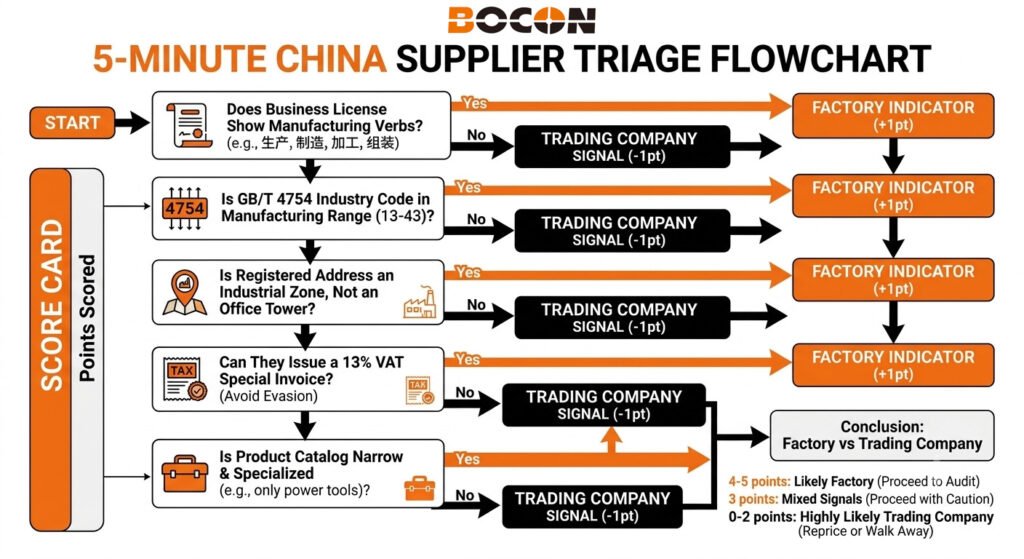
The 5-Minute Triage Before You Spend Any Money
If you’re looking at a new supplier and want a quick read before investing time in a formal audit, run these five checks in order:
- Pull the business license on Qichacha → check for manufacturing verbs in the business scope (Question 1)
- Check the GB/T 4754 industry code → codes 13–43 mean manufacturing, 51–52 mean trading (Question 2)
- Map the registered address → industrial zone versus office tower (Question 4)
- Ask in writing for a 13% VAT special invoice → evasion means trader (Question 3)
- Review the product catalog range → narrow and deep means factory, wide and shallow means trader (Question 5)
Four out of five pointing to factory → proceed to the full checklist. Two or more pointing to trader → walk away or reprice assuming the 15–30% trading company margin.
When You’re Ready to Go Deeper
These 15 questions are a starting framework, not a complete audit. For orders above $30,000 or for custom tooling arrangements, add a live factory visit — unscheduled if possible — and have your host show you the specific production lines, testing equipment, and engineering team that will handle your order.
If you’re evaluating a supplier and want a second opinion from someone who’s been on both sides of the table — as a buyer visiting factories and as the factory being visited — we’re available for a direct conversation about what these verification steps look like when they’re applied to a real power tool manufacturing facility.
The checklist is only as good as the willingness to act on what it finds. Most buyers who get burned didn’t ignore the warning signs. They saw them and talked themselves out of following up. Don’t do that.