
You want to add impact wrenches to your product line. Maybe you’re a retailer building out a power tool category, maybe you’re a brand manager sourcing a private label range. You’ve been looking at specs from different factories, and you’ve run into something frustrating: everyone lists torque numbers, but nobody explains what those numbers actually mean for your end customer.
That’s what this article is for.
I’m writing from 15 years on the factory side of this industry — building cordless power tools for brands across Europe, Australia, and North America. This is what European buyers actually care about when they’re spec’ing an impact wrench for their market. And it’s what you need to understand before you sign a purchase order.
Why the European Market Has Different Expectations
Europe is not a monolith market. A German automotive mechanic, a French construction site foreman, and a Swedish DIY enthusiast are three very different customers with very different demands.
But they share some common threads that shape what retail impact wrenches need to deliver in Europe:
Professional trade culture runs deeper in Europe than in most other markets. The German “Meister” tradition, the Scandinavian respect for skilled trades — these mean that European buyers, even at consumer price points, have more technical literacy than buyers in many other regions. They’ll read the spec sheet. They’ll notice if the no-load speed doesn’t match the competition. They’ll return a tool that overheats on the third lug nut.
Regulation shapes product design. CE marking isn’t just a compliance checkbox in Europe — it influences what features get designed in, what materials get used, and what the battery management system needs to do. The EU’s Battery Regulation (EU) 2023/1542 is already pushing manufacturers toward better cell traceability and documentation. The new EU Machinery Regulation (EU) 2023/1230, replacing the old Machinery Directive 2006/42/EC, adds new requirements around digital instructions and cybersecurity for connected tools. These aren’t distant concerns — they’re active forces shaping what’s available on the market right now.
Sustainability is a purchasing signal, not just a marketing claim. European consumers and trade buyers are increasingly asking about tool lifespan, repairability, and battery platform compatibility. A tool that’s built to last and shares a battery ecosystem with other tools is worth more to European buyers than an equivalent tool with a throwaway battery system.
Understanding Torque: The Spec That Matters Most
Torque is the reason you buy an impact wrench instead of a regular drill. And it’s the spec that causes the most confusion in the buying process.
Here’s what you need to understand before you evaluate any torque number a factory puts in front of you.
Breakaway Torque vs. Fastening Torque
Factories almost always list maximum torque — the highest torque reading the tool produces in controlled test conditions. This is useful, but it’s not the whole story.
Breakaway torque is the force required to loosen a previously tightened fastener. This is typically higher than the torque the tool applies while tightening — impact wrenches are better at loosening than fastening because of how the impact mechanism works.
Fastening torque is what the tool applies while tightening a nut or bolt. This is a more relevant spec for understanding real-world performance in normal use.
The number on the spec sheet is almost always the maximum — a peak reading under ideal lab conditions. In practice, the torque a tool delivers at the socket depends on:
- Battery charge level (lower charge = lower voltage = lower torque)
- Ambient temperature (cold batteries deliver less)
- The specific fastener condition (rusted, painted, or corroded fasteners require more torque than clean ones)
What this means for your product selection: A tool listed at 350Nm maximum torque doesn’t deliver 350Nm in every situation. When you’re comparing tools, compare them on comparable test conditions — ideally IEC 62841-1 test protocols — and ask the factory for fastening torque data, not just the peak number.
Torque Tiers for the European Market
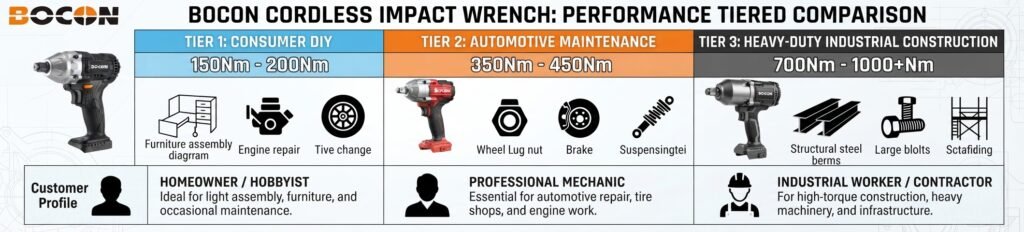
Based on what European trade professionals actually use, here is a practical torque tier framework:
| Torque Range | Primary Application | Customer Profile |
|---|---|---|
| 150–250 Nm | Light mechanical, flat-pack furniture assembly, automotive maintenance | Consumer / enthusiast |
| 250–400 Nm | Automotive service, light construction, HVAC, agricultural equipment | Professional / semi-pro |
| 400–700 Nm | Heavy commercial construction, agricultural machinery, industrial maintenance | Trade professional |
| 700+ Nm | Mining, rail, heavy industrial, infrastructure | Specialist / industrial |
For most European retail impact wrenches — the ones sitting on a shelf at a national tool distributor or a big-box retailer — the sweet spot is 250–400 Nm. This covers the majority of trade use cases from automotive to light construction, without pricing the tool out of the accessible professional market.
Our Bocon BK-525 impact wrench delivers a maximum torque of 350 Nm — which puts it squarely in the professional tier for European trade applications. That spec covers automotive wheel service, construction fastener work, and general mechanical maintenance without the price premium of heavy industrial-grade tools.
RPM and IPM: The Supporting Specs
Torque gets the most attention, but two other performance specs deserve equal weight:
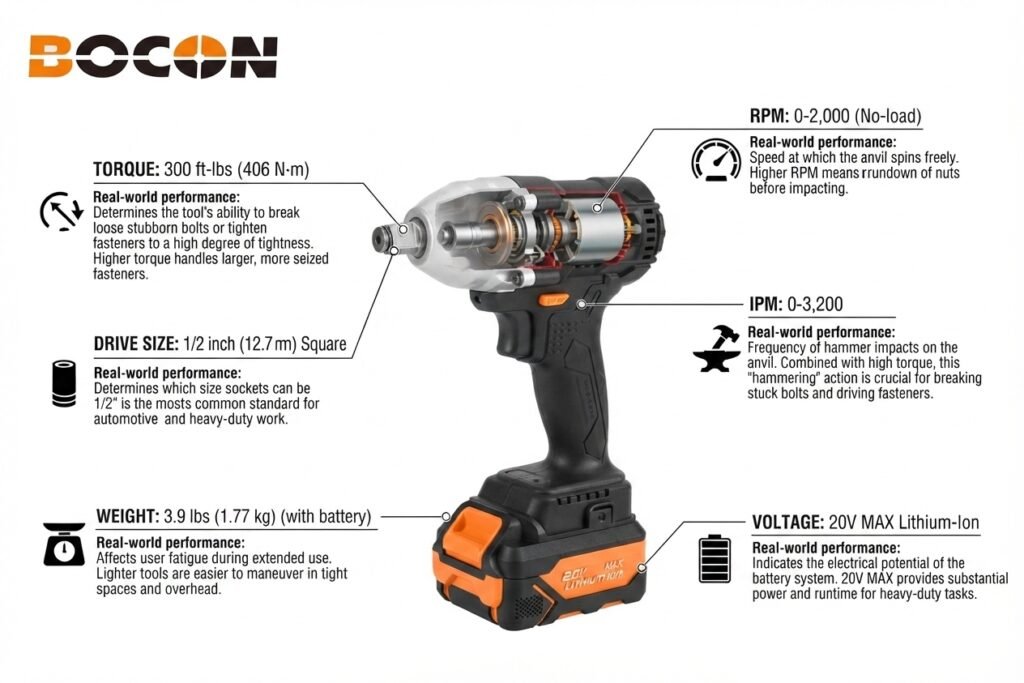
No-load RPM (Revolutions Per Minute) — how fast the tool’s output shaft rotates with no load applied. Higher RPM means faster socket spin, which means faster work in many applications. Three-speed models (low/middle/high) are increasingly standard in European professional tools, giving operators control over speed for different tasks.
IPM (Impacts Per Minute) — how many impact blows the tool delivers per minute. More impacts means more consistent torque delivery, especially on stubborn or corroded fasteners. An IPM that’s too low means the tool hammers inefficiently, overheating the work surface and draining the battery faster.
For European trade tools, look for:
- Three-speed control with meaningful RPM differentiation (e.g., 0–1,200 / 0–2,200 / 0–2,800 RPM)
- IPM of 3,000 or above for the top speed setting
Battery Systems: The Decision That Outlasts the Tool
Here’s the thing about cordless tools that most buyers underestimate: the battery platform decision is longer-term than the tool decision.
A tradesperson who buys into a battery ecosystem — three drills, an impact driver, a grinder, all sharing the same battery — is not going to switch platforms because you have a better impact wrench. They’ve already committed.
This is why battery system compatibility is one of the most important things European buyers look for when evaluating a new impact wrench.
18V vs. 20V: The Nominal Voltage Question
This is one of the most confusing spec sheet issues in the cordless tool market, and it’s especially relevant for European buyers who may be sourcing from multiple markets.
18V and 20V are effectively the same battery platform. The difference is marketing nomenclature:
- 18V is the nominal voltage that major Japanese brands (Makita, etc.) use — based on the actual nominal voltage of a fully charged lithium-ion cell (3.6V per cell × 5 cells = 18V)
- 20V is the fully charged voltage used by brands like DeWalt — based on the peak voltage per cell when fully charged (4.0V × 5 cells = 20V)
Both platforms use the same 18650 or 21700 cell configurations and deliver comparable power. The actual performance difference between a well-designed 18V tool and a well-designed 20V tool is negligible for most applications.
What matters is cell quality, not nominal voltage. A 20V tool with genuine A-grade Samsung or LG cells will outperform a 20V tool with B-grade domestic cells every time — regardless of what the spec sheet says.
Battery Capacity and Runtime
For impact wrenches, which draw high current under load, battery capacity matters more than for lighter tools like drills or drivers.
European trade professionals working on automotive jobs or construction sites don’t want to swap batteries in the middle of a job. Look for battery packs of 4.0Ah or higher for professional use — this translates to roughly 45–60 minutes of continuous use under moderate load for an impact wrench.
At Bocon, our impact wrench line uses 4.0Ah battery packs as standard for the BK-525 professional model. That’s not an accident — it’s a deliberate spec decision based on what European trade customers have told us they need.
BMS and Safety: The Non-Negotiable
Lithium-ion battery safety is not optional in the European market. The EU Battery Regulation (EU) 2023/1542 is raising the bar for cell traceability, safety documentation, and supply chain transparency. More importantly, European trade professionals have seen enough battery failures to know what to ask about.
A proper Battery Management System (BMS) in the battery pack should handle:
- Overcharge protection — prevent charging beyond safe voltage
- Over-discharge protection — prevent discharge below safe cell voltage
- Short circuit protection — interrupt current in microseconds if a short occurs
- Temperature monitoring — prevent operation or charging in unsafe temperature ranges
- Cell balancing — ensure all cells in the pack charge and discharge evenly
Some factories add a secondary temperature protection board specifically for battery safety — an extra layer that prevents thermal runaway in extreme conditions. This is not standard across the industry. Ask about it.
CE Certification: What Actually Needs to Be in Place
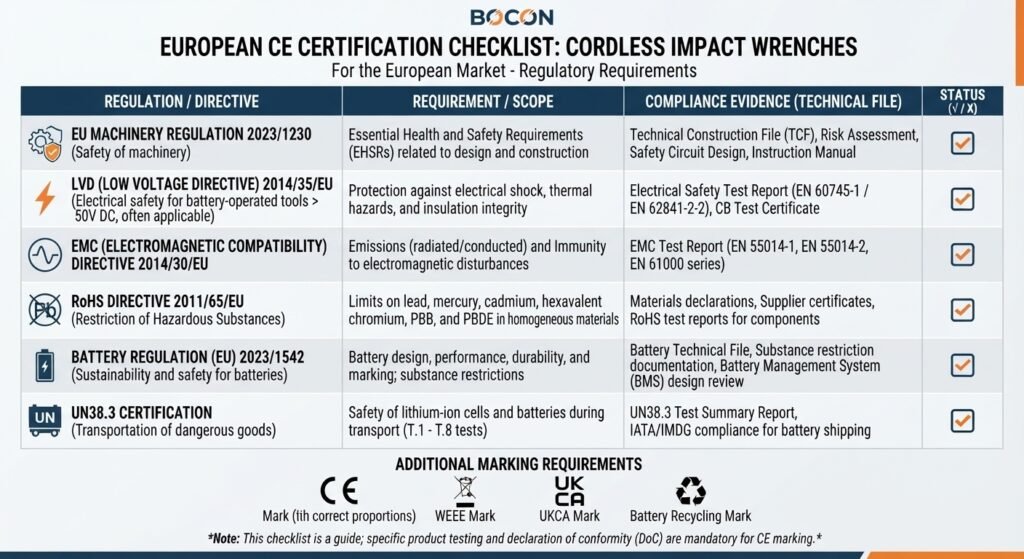
CE marking is mandatory for power tools sold in the EU. But the certification landscape is more layered than a simple “CE certified = good to sell in Europe” equation.
What CE Covers for Impact Wrenches
An impact wrench needs CE marking under multiple EU directives:
Machinery Directive / Regulation — The EU Machinery Regulation (EU) 2023/1230, which replaced Directive 2006/42/EC, sets safety requirements for power tools including mechanical safety, guard design, and operational controls. EN 62841-1 is the harmonized standard that provides the test methodology; it’s been the EU reference standard since 2018.
Low Voltage Directive (LVD) — 2014/35/EU, covering electrical safety for tools operating below 75V DC. Since cordless tools run on battery systems typically below 60V, the LVD applies.
EMC Directive — 2014/30/EU, covering electromagnetic compatibility. Cordless tools with electronic controls (motor controller, BMS) need EMC testing to ensure they don’t interfere with other equipment and aren’t susceptible to interference.
RoHS — Restriction of Hazardous Substances. CE marking also requires RoHS compliance, confirming the tool doesn’t contain restricted levels of lead, cadmium, mercury, or other substances.
Battery-specific requirements — Under the EU Battery Regulation (EU) 2023/1542, batteries must be safe, traceable, and carry appropriate labeling. For lithium-ion battery packs, this includes UN38.3 transport testing, which is required for any international airfreight shipping.
The Certification Depth That Matters
Not all CE certificates are created equal. Here’s what to look for beyond the certificate itself:
Test reports, not just certificates. A certificate is a summary statement. A test report is the detailed evidence — which specific tests were run, on which sample, at which accredited laboratory. If a factory can’t provide the test report, the certificate is just a claim.
Battery pack certification separately from tool certification. The battery pack — with its BMS, cells, and housing — is certified separately from the tool body. Both need to be properly certified for European market entry. Some factories will show you a CE certificate for the tool and not mention that the battery pack hasn’t been independently tested.
Scope of certification matches the product. A CE certificate for a cordless drill doesn’t automatically cover the impact wrench from the same factory, even if they share the same motor and battery platform. Each product type needs its own certification scope.
UN38.3 is required for international shipping, not optional. If your supplier is shipping by air — which is standard for international freight — the lithium-ion battery packs must have UN38.3 test reports. This is an IATA requirement, not just a European one, but it’s often overlooked by buyers who don’t handle the logistics side.
What European Trade Professionals Actually Want
Beyond the spec sheet, here are the things that European professional buyers evaluate when they’re choosing an impact wrench — whether they’re buying for their own workforce or stocking their retail shelves:
Durability Under Real Working Conditions
European trade professionals put tools through conditions that spec sheets don’t capture. Cold winters, dusty construction sites, extended use. They want tools that survive.
What this translates to in spec and construction terms:
- Housing materials: Glass fiber reinforced nylon or PA6/ABS composites with rubber overmolding at key grip areas. These resist impact damage from drops and provide vibration dampening for extended use.
- Dust and moisture protection: IP ratings matter more in European markets than in most other regions, given the variety of working conditions across northern and southern Europe.
- Gearbox durability: Precision machined gears with proper heat treatment (vacuum carburizing produces the best results) survive significantly longer than gears that skip heat treatment. A tool that performs at spec for the first 50 hours and degrades by hour 200 is not what European professionals are looking for.
Ergonomics and Operator Safety
This is one of the areas where European buyers are particularly demanding. The German DGUV regulation, France’s CNAM standards, and broader EU occupational health requirements mean that professional buyers in Europe are increasingly held accountable for the tools they put in workers’ hands.
Key considerations:
- Weight: A professional impact wrench should weigh under 2 kg (tool only, without battery) for extended overhead work. Heavy tools increase operator fatigue and injury risk.
- Vibration levels: EN 62841-1 sets vibration emission limits. High vibration tools can cause hand-arm vibration syndrome (HAVS) with prolonged use. Lower vibration = lower liability for employers.
- Balance and center of gravity: A well-balanced tool with the weight centered in the housing, not the battery, is easier to control in tight spaces.
Socket Drive Size: The Detail That Defines the Product Category
Socket drive size is one of the most fundamental spec decisions for an impact wrench — and one that buyers need to get right for their market segment.
| Drive Size | Typical Applications | Market Segment |
|---|---|---|
| 1/4″ (6.35mm) | Light mechanical, maintenance, electronics | Consumer |
| 3/8″ (9.5mm) | Automotive, light construction, HVAC | Professional compact |
| 1/2″ (12.7mm) | Automotive (main), construction, agricultural | Professional standard |
| 3/4″ (19mm) | Heavy construction, agricultural machinery, industrial | Heavy trade |
| 1″ (25.4mm) | Mining, rail, infrastructure | Specialist industrial |
In the European retail and trade professional market, 1/2″ drive is the dominant standard for general-purpose impact wrenches. This is what the majority of European automotive and construction trade customers will be looking for. Our Bocon BK-525 impact wrench uses a 1/2″ drive specification — the industry standard for the European professional segment.
Hog Ring vs. Pin Detent
This is a detail that trips up first-time impact wrench buyers. The socket retention mechanism determines how the socket attaches to the tool’s anvil:
Friction ring (hog ring): A rubber ring holds the socket on the anvil. Sockets can be swapped quickly with one hand — the socket slides on and off freely. This is the preferred system for professional users because of speed and convenience. It’s the standard on most European professional impact wrenches.
Pin detent (detent pin): A spring-loaded pin clicks into a hole on the socket to lock it in place. More secure but slower to swap. Common on US-market tools; less common in Europe.
For the European professional market, friction ring / hog ring is the standard. Make sure your supplier is quoting you the right system.
Spec’ing the Right Product for Your Market Position
How you position your impact wrench in the market determines what specs matter most. Here’s a practical framework:
Entry Professional (€80–150 retail)
- Torque: 200–300 Nm
- Drive: 1/2″
- Battery: 2.0–4.0 Ah, 18V/20V platform
- Motor: Brushless
- Three-speed control
- Weight: Under 1.8 kg (tool only)
- CE, RoHS certified
This is the volume tier for European trade distributors and national tool retailers. It covers the largest segment of professional buyers who need genuine cordless capability without stepping into heavy industrial pricing.
Mid Professional (€150–280 retail)
- Torque: 300–500 Nm
- Drive: 1/2″ standard, 3/4″ option
- Battery: 4.0–8.0 Ah
- Motor: Brushless, FOC controller
- Electronic torque control (adjustable)
- Weight: Under 2.2 kg
- CE, RoHS, battery regulation compliant
This tier competes with brands like Makita, DeWalt, and Milwaukee at accessible price points. Build quality, battery platform compatibility, and brand-adjacent performance are the key differentiators.
Heavy Trade / Industrial (€280+ retail)
- Torque: 500 Nm+
- Drive: 3/4″ or 1″
- Battery: 8.0+ Ah, high-discharge cells
- Motor: High-performance brushless, thermal management
- Vibration monitoring, electronic protection systems
- IP65 or equivalent dust/water protection
This tier is about capability and durability. Buyers are trade professionals and industrial purchasing managers. They read spec sheets carefully and expect tools to perform consistently over years of heavy use.
The Questions to Ask Your Supplier Before You Order
Before you commit to a purchase order, get answers to these:
1. What is the fastening torque — not just maximum torque — and under what test conditions?
If they can’t explain the difference between breakaway and fastening torque, or provide data under IEC 62841-1 test conditions, dig deeper.
2. Can I see the test report, not just the CE certificate?
Ask for the accredited lab’s report with the lab’s accreditation number. Then verify it.
3. Is the battery pack certified separately from the tool body?
Both need their own documentation. If they share one CE certificate, that’s a red flag.
4. Does the BMS include temperature monitoring and cell balancing?
These are non-negotiable for European market battery safety expectations.
5. What cells are in the battery pack, and can you prove it?
Cell datasheets should be available. If a factory won’t share them, move on.
6. What is the gearbox made from, and how is it heat treated?
Precision gears with proper heat treatment cost more upfront and last significantly longer in the field. Ask specifically about the heat treatment process.
7. What’s the weight, and what’s the vibration emission level under EN 62841-1?
These are spec sheet data points that affect operator safety and should be verifiable.
8. Friction ring or pin detent anvil?
Confirm the socket retention system matches your market expectations.
What Makes One Impact Wrench Worth More Than Another
At the end of the day, European trade buyers are paying for three things:
Performance that holds up over time. A tool that delivers 350Nm of maximum torque in the first month and degrades to 280Nm by month six is not a 350Nm tool. Build quality — motor, gearbox, electronics — determines whether performance specs are promises or durable realities.
Battery platform integrity. A tool with a well-designed battery system and documented cell quality is worth more than a tool with a generic battery pack that looks the same on paper. The difference shows up in field failure rates, which show up in warranty costs, which show up in your brand reputation.
Certification that survives scrutiny. CE marking backed by real test reports, from an accredited lab, covering the correct scope, for both tool and battery. This is the difference between a product that’s legally saleable in Europe and one that might get stopped at customs or recalled six months after launch.
We’re happy to walk through our impact wrench spec sheets — the Bocon BK-525 and BK-526 impact driver — and show you exactly what goes into them. We’ve built these products specifically for European professional and trade channels, with the battery system, the CE documentation, and the motor and gearbox quality that those markets demand.
Talk to us at www.oemcordlesstools.com