
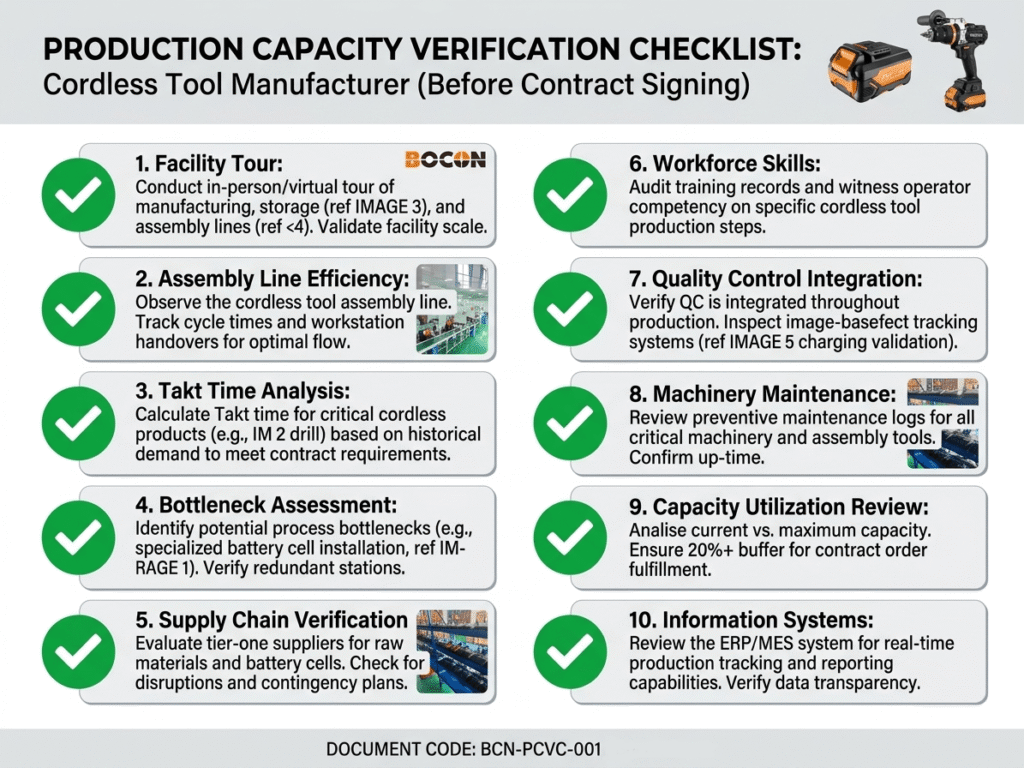
The order looked solid on paper. The factory’s website showed six production lines, the sales manager spoke confidently about handling 100,000 units per month, and the ISO 9001 certificate looked legitimate. You signed the contract, wired 30 percent deposit, and waited for production to begin.
Six weeks later, your order was 40 percent late. The factory blamed a raw material shortage. Twelve weeks later, you were still waiting for half the order. The factory blamed a production scheduling conflict with a larger customer. At week 16, they asked for a timeline extension that blew past your planned shipping date by six weeks and cost you a slot in your key retail account.
This story is not unusual. It’s one of the most common things I see happen to buyers in this industry — and from the factory side, I can tell you exactly why it happens: the buyer verified everything except what actually determined whether the factory could deliver.
They verified the business license. They verified the address. They verified the certificates. What they didn’t verify — what most buyers don’t know how to verify — is whether the production capacity the factory claimed was real.
This guide is about that specific problem. It’s a step-by-step process for verifying a cordless power tool manufacturer’s actual production capacity before you sign anything. Not the numbers on their website. Not the numbers in their sales deck. The real numbers.
Why Standard Factory Audits Miss the Capacity Problem
Most factory audit checklists cover the basics: business license, certifications, floor space, maybe a walk through the production area. These are necessary but insufficient for capacity verification.
Here’s the gap: a factory can have a legitimate business license, a real ISO 9001 certificate, a 3,000-square-meter facility, and still be unable to deliver the volume they promised you. How?
Production lines can be shared, staged, or overstated. A factory might show you six lines on paper but run only three. They might run those three lines for your order category only on certain weeks. Or they might quote your order against lines they currently allocate to higher-margin customers.
Equipment can be decorative. A factory can have modern-looking machines on the floor that are rarely running. The machines that actually produce your product — the ones that matter for your specific tool category — might be older, fewer, or more heavily utilized than the tour suggests.
Monthly output claims are almost never audited. A factory that says it produces 100,000 cordless drills per month rarely has documentation that proves this number. And buyers rarely ask for it in a form that can be verified.
The standard audit checklist is designed to catch fraud — fake business licenses, counterfeit certificates, trading companies pretending to be factories. It’s not designed to catch capacity inflation, which is a subtler problem. A factory may be genuine and still be unable to fulfill your order on time.
What follows is a set of verification methods specifically designed for this problem. Use them before you sign.
Step 1: Map the Factory’s Physical Production Footprint
Before you ask a single question about capacity, you need to establish what the factory actually looks like on the ground. This step requires either a physical visit or a live, unscripted video call that you control.
What to map:
The floor area assigned to cordless power tool production — specifically for the product categories you’re sourcing. A factory that shows you 8,000 square meters of total facility space might allocate only 600 square meters to power tool production, with the rest committed to other product lines. That’s the number that matters for your order.
The number of dedicated production lines for your product category. A line means a complete, self-contained assembly route — from component staging through final assembly, testing, and packaging — that runs independently of other product categories. Shared lines are not full lines.
The location of critical equipment relative to the production area. Specifically: motor winding machines, gear machining equipment, injection molding machines for tool housings, and battery pack assembly stations. These four equipment categories are the backbone of a cordless power tool factory. If the factory doesn’t have dedicated equipment for all four, they are outsourcing one or more production stages — which adds lead time, reduces control, and introduces a capacity bottleneck you won’t see in the sales deck.
On a live video call, ask the host to walk you to each of these areas specifically. Don’t let them show you the showroom and the best-lit corner of the floor and call it a tour. Ask for the power tool production area, the motor line, the gearbox machining section, and the battery pack assembly station.
Step 2: Cross-Reference Equipment Claims Against Floor Evidence
Once you’ve mapped the floor, match what you saw against what the factory told you they have.
The standard claim pattern from factories with capacity problems is to list equipment by category without specifying quantity, age, or utilization. “We have motor winding machines” could mean one machine running one shift, or three machines running two shifts. Those scenarios produce dramatically different output numbers.
Ask for three specific data points on every critical machine category:
How many machines do you have in this category? Not “we have motor winding capability” — how many winders, specifically?
What is the age and model of the machines? Newer equipment from reputable manufacturers (Tamagawa, Nidec, Johnson Electric for motors; Fanuc or Mitsubishi for CNC gear machining) produces at different speeds and tolerances than older or generic equipment. If the factory can’t name the equipment manufacturer, that’s a data point.
What is the current shift schedule for this equipment? One shift, five days per week produces a very different monthly output than two shifts, six days per week. If the factory is running one shift on the machines that produce your order, the capacity claim needs to be adjusted accordingly.
For cordless power tools specifically, the bottleneck is almost never assembly — it’s the upstream stages. Motor production, gearbox machining, and battery pack assembly are where capacity constraints appear. A factory that has plenty of assembly stations but only one motor winder has a motor bottleneck, and that determines the actual monthly output for cordless drills.
We run three dedicated motor winding lines at our facility, each capable of producing approximately 2,000 to 2,500 motor assemblies per shift, running two shifts five days a week. That’s our actual motor production capacity — roughly 30,000 to 37,500 motor assemblies per week, or about 120,000 to 150,000 per month — before we factor in downtime, changeover, and maintenance. We know this number because we built our production planning around it. Any serious factory should be able to give you a similar number, with the same level of specificity.
Step 3: Calculate the Production Line’s Actual Throughput
This is where most buyers get lost. They hear “100,000 units per month” and don’t know how to evaluate whether that number is plausible.
Here’s a practical calculation framework for a cordless power tool assembly line:
Daily output per line = operating hours per shift × units completed per hour
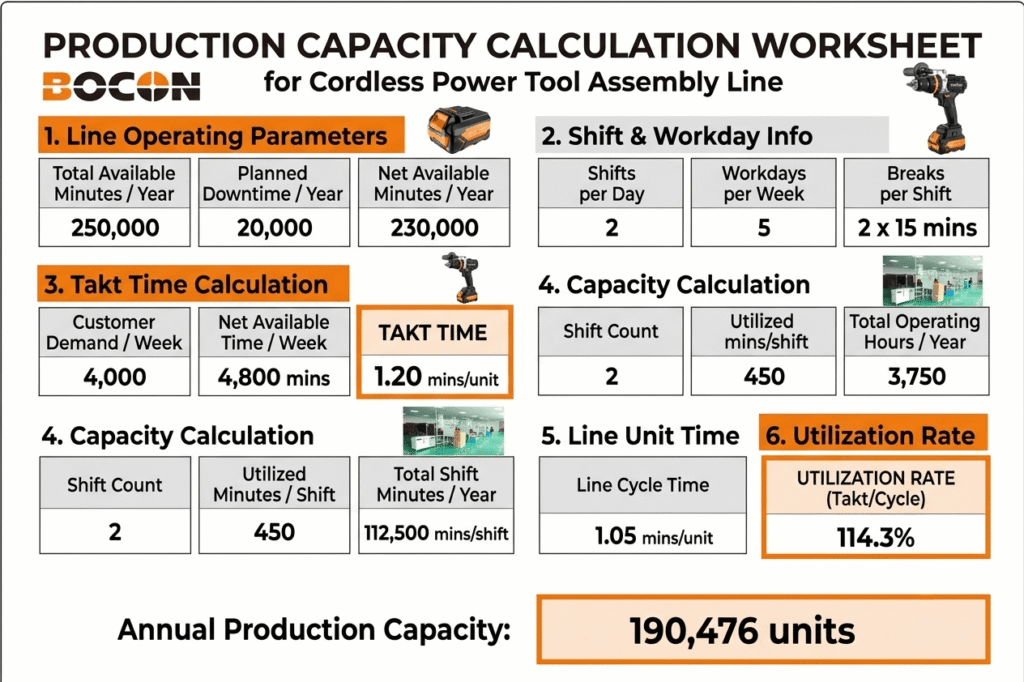
To get units completed per hour, you need the takt time — the rate at which the line produces one finished unit. A modern cordless drill assembly line with reasonable automation and experienced operators typically runs a takt time of 30 to 60 seconds per unit, depending on product complexity and the degree of in-line testing.
At a 45-second takt time, with 10 effective hours per shift (accounting for changeover, breaks, and minor stoppages), a single line produces approximately 800 units per shift. At two shifts, that’s 1,600 units per day. At 22 working days per month, that’s 35,200 units per month from one line.
A factory claiming 100,000 units per month for cordless drills needs at least three fully dedicated production lines running two shifts, five to six days a week — with no significant downtime, no changeover disruptions, and no equipment failures. Each of those conditions needs to be independently verified.
Ask the factory for their production line utilization rate. Utilization rate is the ratio of actual output to theoretical maximum output. A well-run factory targeting 85 to 90 percent utilization is being realistic about downtime and maintenance. A factory claiming 100 percent utilization is either not accounting for changeover time or is overstating their numbers. Most real factories run at 75 to 85 percent utilization for sustained periods.
Cross-check with the BOM lead times. A cordless drill with a brushless motor, precision gearbox, and certified battery pack has a bill of materials that spans multiple component categories — machined metal parts, injection-molded plastics, motors, PCBs, battery cells. Each component category has its own lead time from sub-suppliers or internal production. The factory’s monthly capacity is constrained by whichever component category has the longest cumulative lead time. If the factory is outsourcing gear machining to a third party with a four-week lead time while assembling in one week, the effective production cycle time is five weeks — not one.
Step 4: Check the Supply Chain Dependency Map
This step is where the factory’s capacity story either holds together or falls apart. Most capacity failures in Chinese manufacturing don’t happen in the factory — they happen in the supply chain upstream of the factory floor.
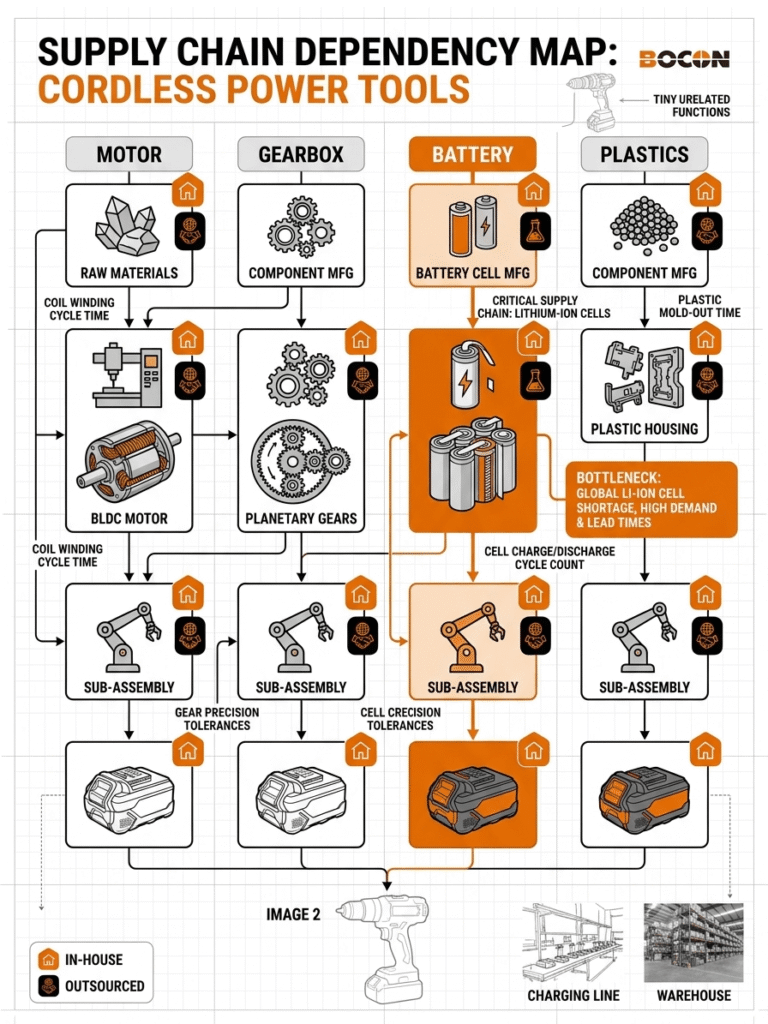
A cordless power tool factory has at least four major component supply chains:
Motor production. Either in-house winding and assembly or outsourced to a motor specialist. If outsourced, who is the supplier, what is their lead time, and what is the capacity reservation?
Gearbox components. Precision gears, shafts, and bearings. These require specialized machining and heat treatment. Outsourcing this stage means the factory is dependent on a supplier’s schedule.
Battery cells and BMS. For factories that don’t produce their own cells (almost all of them), battery pack assembly depends on cell supply. In 2024 and 2025, lithium-ion cell supply tightness affected delivery timelines across the industry. A factory that doesn’t have committed cell supply agreements is exposed to market price fluctuations and delivery delays.
Injection moldings and structural plastics. Tool housings, battery housings, handles. These require mold tooling that is specific to the product design.
For each component category, ask: is this produced in-house or outsourced? If outsourced, who is the supplier, and what is their typical lead time? Can the factory show you purchase orders or supply agreements with these sub-suppliers?
A factory that can answer all four of these questions with specificity — supplier names, lead times, reservation quantities — is managing its supply chain deliberately. A factory that says “we have reliable suppliers” without naming them is running on hope, and hope is not a production capacity.
Step 5: Request Documentary Evidence of Past Output
Numbers on a sales deck are cheap. Documentary evidence of actual production runs is harder to fabricate.
Ask for production records for the most recent completed month. A real production record shows: date, production line, product model, quantity completed, shift, and operator name. It should be granular enough that you can see the daily output variance across the month. If the factory claims 100,000 units in a month and their daily records show consistent output of 3,500 to 4,000 units per day, that’s plausible. If the records show sporadic entries and inconsistent volumes, the number is inflated.
Cross-reference the production record with shipping data. If the factory is truly producing at the claimed volume, there should be corresponding export shipping records — either sea or air freight bookings, customs declarations, or container numbers. You don’t need to see the customer’s names. You just need to see that the volume being claimed is moving through logistics channels consistent with that volume.
Ask for the supplier’s own component purchase records for the past six months. A factory producing at 100,000 units per month for cordless drills is purchasing motor components, plastic resin, battery cells, and packaging materials at volumes consistent with that output. If the supplier’s component purchase records don’t support the production volume they’re claiming, something is wrong — either the volume is overstated or significant production is being outsourced without disclosure.
We keep six months of component purchase records, production planning documents, and shipping documentation for every major SKU. When a buyer asks for this during their verification process, we provide it as a matter of course. If a factory is reluctant to share production documentation, that reluctance itself is a signal.
Step 6: Look at the Workforce Structure
Production capacity is ultimately about people. A factory with the right equipment but insufficient or undertrained workers will consistently underperform its theoretical capacity.
Ask about the production workforce specifically for your product category. How many operators are assigned to each line? How many shifts do they run? What is the operator turnover rate?
High turnover is a significant capacity risk. In the Chinese manufacturing sector, annual turnover rates of 30 to 50 percent are not unusual in some regions and industries. Every time an experienced operator leaves, there’s a productivity dip during training. A factory that can’t retain workers is a factory whose capacity is chronically unstable.
Ask to see the production organization chart. Not a marketing org chart — a real one that shows the production manager, shift supervisors, QC supervisor, and engineering team. The names and positions matter because you want to confirm that these roles exist, not just on paper.
Ask about the maintenance team. Who maintains the equipment? What is the preventive maintenance schedule? Equipment downtime is one of the biggest silent capacity killers, and factories that don’t have dedicated maintenance personnel are managing it reactively — which means unplanned downtime that eats into production capacity without warning.
Step 7: Stress-Test the Delivery Commitment
After you’ve completed Steps 1 through 6 and formed a view of the factory’s real capacity, stress-test the delivery timeline they’re offering.
Ask: what is your current production schedule utilization? A factory running at 85 to 90 percent capacity utilization is probably giving you a realistic lead time. A factory running at 50 to 60 percent utilization that quotes the same lead time as a fully loaded factory is either inefficient or is quoting aggressively to win the order.
Ask: who are your current top three customers by volume? This question is often revealing. If a factory’s largest customers are taking 30 to 40 percent of production capacity, and your order is more than 15 to 20 percent of their stated capacity, you are in direct competition with their biggest accounts for production scheduling priority. When a conflict arises — and in Chinese manufacturing, it always arises eventually — those bigger accounts win.
Ask: what is your production scheduling process for new orders? A factory with a mature production planning system will have a formal scheduling process that incorporates your order into a rolling production plan, with explicit start and completion dates. A factory without one will say “we will start your order after we receive the deposit” — which is not a schedule, it’s a wish.
Red Flags: Capacity Inflation Patterns to Watch
These patterns appear frequently in factories that have capacity problems:
The catalog range problem. A factory that manufactures 15 different product categories — power tools, kitchen appliances, consumer electronics, garden equipment — from a single facility is either dramatically overstating its capacity or is operating as a trading and assembly hub rather than a focused manufacturer. Focused factories specialize. Our facility makes cordless power tools. That’s what we do, and we’ve optimized every production stage around that.
The equipment showroom. A factory with impressive-looking equipment that is covered in dust, has parts off to the side, or is clearly not in active use is showing you what they have, not what they run. Active equipment is running. Ask when each critical machine was last in production.
The vague timeline. “We can start your order soon” or “We will arrange production when we receive your deposit” is not a production schedule. A real schedule has dates.
The too-good price at high volume. If a factory is quoting prices that seem too competitive at the volume you’re ordering, ask yourself where the tradeoff is. Either they have genuine efficiency advantages — which is possible but worth investigating — or they’re quoting to win the order and managing costs later by cutting corners on components, labor, or testing.
The single point of contact. If every question about production goes through one salesperson who has to check with the factory floor before answering, you’re dealing with a communication structure that introduces delay and distortion at every step. A real factory can answer production capacity questions directly from its planning systems.
Putting It Together: The Verification Checklist
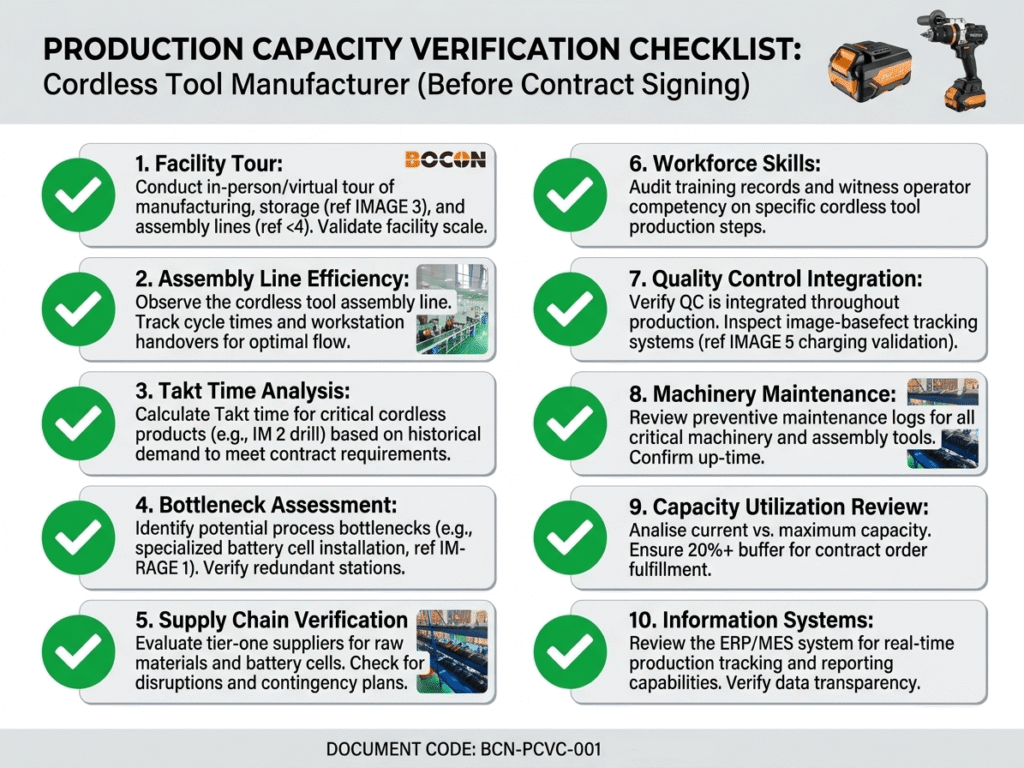
Before you sign a contract, run through these checks:
- [ ] Mapped the physical production footprint: floor area, lines, equipment for power tool production specifically
- [ ] Verified equipment count, age, manufacturer, and shift schedule for motor production, gear machining, injection molding, and battery pack assembly
- [ ] Calculated realistic monthly output from takt time, shift count, and utilization rate
- [ ] Confirmed supply chain dependency map: in-house vs. outsourced for each major component category
- [ ] Reviewed documentary evidence of past production output — daily records, not monthly summaries
- [ ] Cross-referenced production claims with component purchase records or shipping data
- [ ] Assessed workforce stability: staffing levels, shift structure, turnover rate
- [ ] Stress-tested the delivery timeline against current production schedule utilization
- [ ] Identified who the factory’s top customers are and what percentage of capacity they consume
- [ ] Confirmed the factory can provide a formal production schedule with specific dates before the deposit is wired
When the Numbers Don’t Add Up
If you go through this process and the factory’s claimed capacity doesn’t hold up under scrutiny — the equipment count is lower than stated, the supply chain is mostly outsourced, the documentary records are vague, or the delivery timeline feels optimistic — you have two choices.
Walk away, or renegotiate the terms based on what the factory can actually deliver. The second option requires you to have done the verification work, so you know what the realistic capacity is and can price and schedule accordingly.
The worst outcome is to sign a contract for a volume and delivery timeline that the factory cannot meet, wire the deposit, and then spend the next four months managing an overdue order while your own customers wait. That situation is avoidable. It requires doing the verification work before you sign — not after.
We’re available to walk through what our actual production capacity looks like, with the production records to support the numbers. If you’re evaluating factories and want a conversation from the factory side — about what production documentation means, how to read a production schedule, or what realistic timelines look like for cordless power tools — reach out.