
I’ve been on the factory side of power tool procurement for a long time. And the question I get more than any other — from first-time private label buyers and seasoned distributors alike — is some version of this:
“Why are your prices higher than the quote I got from another factory?”
Or its twin: “The other supplier is $4 cheaper per unit. Should I just go with them?”
The honest answer is: it depends entirely on what’s inside the price. And most buyers don’t actually know what’s inside their quote.
This article is my attempt to fix that. I’m going to walk through every line item that goes into a cordless power tool’s unit cost — from the motor and battery cells to tooling, certification, and the things that never show up in the quote but end up costing you money anyway.
By the end, you’ll know exactly what questions to ask and what a legitimate price looks like — versus one that’s low because something important has been left out.
The Short Answer Most Factory People Won’t Give You
A standard 20V brushless cordless drill with a 2.0Ah battery, sold FOB factory with your brand on it, will typically land somewhere between $28 and $65 per unit depending on specifications.
That’s a huge range. The gap between the low end and high end is almost entirely explained by five things:
- Motor quality (brushed vs. brushless, stator grade)
- Battery cell grade (A-grade vs. B-grade lithium-ion)
- Tooling situation (shared mold vs. custom mold)
- Order quantity
- Certification scope
Understanding each of these will completely change how you read a quote.
How a Power Tool’s Cost Is Actually Built
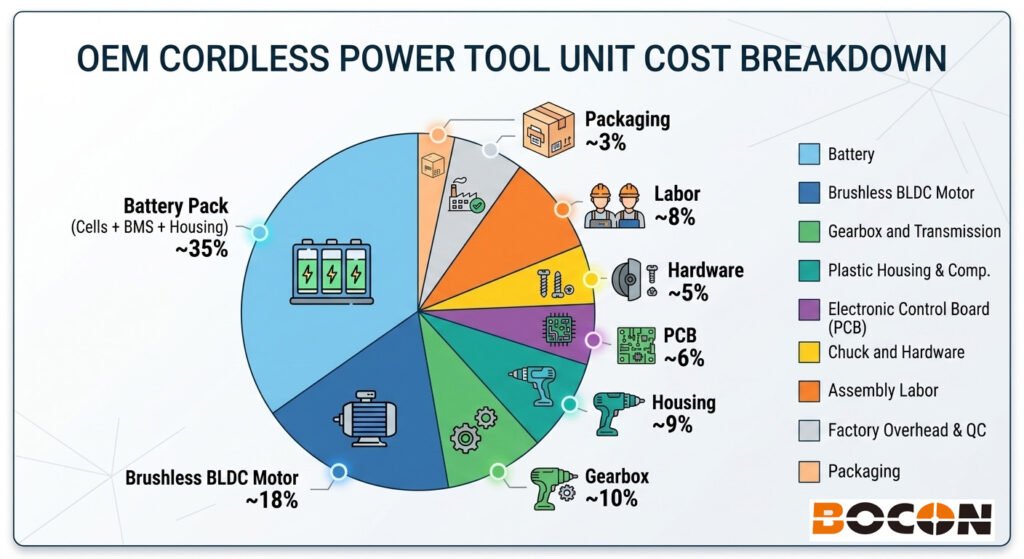
Before we get into each component, here’s the rough structure of what goes into the unit price of a mid-range cordless drill. These aren’t exact numbers — every product is different — but the proportions are representative of what we see at our factory:
| Cost Component | Approximate % of Unit Cost |
|---|---|
| Battery pack (cells + BMS + housing) | 30–40% |
| Motor (brushless BLDC assembly) | 15–20% |
| Gearbox and transmission | 8–12% |
| Plastic housing and components | 8–10% |
| Electronic control board (PCB) | 5–8% |
| Chuck and mechanical hardware | 4–6% |
| Assembly labor | 6–10% |
| Factory overhead and QC | 5–8% |
| Packaging | 2–4% |
These proportions shift depending on your product spec. A high-torque impact wrench with a larger battery will weight battery costs even higher. A basic drill with a brushed motor will look completely different.
The key insight: battery and motor together often represent 45–60% of your unit cost. This is where most of the quality difference lives — and where most factories cut corners when they’re trying to hit a lower price.
Component 1: The Battery Pack
The battery pack is almost always the single largest cost driver in a cordless tool.
What makes two battery packs dramatically different in cost — even at the same voltage and amp-hour rating — comes down to three things:
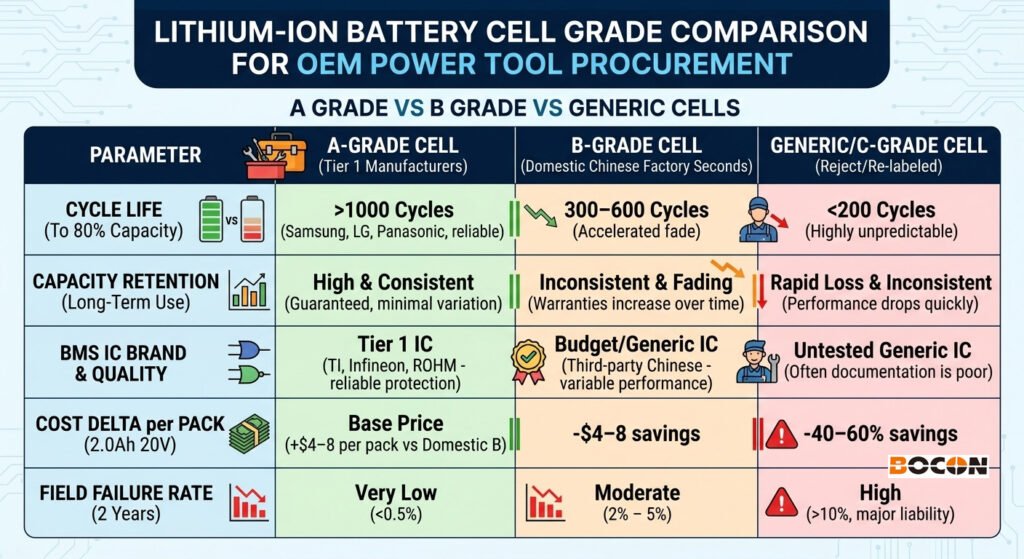
Cell Grade
Lithium-ion cells are graded A, B, and C. A-grade cells from manufacturers like Samsung SDI, LG Energy Solution, or Panasonic are tested, sorted, and guaranteed to meet specified capacity, discharge rate, and cycle life. They cost significantly more than domestic Chinese cells of equivalent nominal specs.
B-grade cells are typically factory seconds — cells that didn’t pass the A-grade inspection but were sold anyway. They’ll work initially. Over time, you’ll see accelerated capacity fade, inconsistent performance across battery packs in the same order, and higher warranty return rates.
C-grade cells are reject cells that have been re-labeled. I’ve seen these. They’re a liability in every sense.
When a factory quotes you a “2.0Ah 20V battery pack,” they haven’t told you anything meaningful about what cells are inside. Ask specifically: which cell manufacturer? What grade? Can I see the cell datasheets?
Real cost difference: A battery pack using genuine A-grade Samsung or LG cells versus equivalent-spec domestic B-grade cells can differ by $4–8 per pack at current market rates. That difference goes straight to the bottom line — or straight to warranty returns.
BMS Quality
The Battery Management System — the circuit board that monitors and protects the cells — is another place costs diverge invisibly.
A factory-grade BMS IC from TI, Infineon, or ROHM behaves reliably across temperature extremes, handles aggressive load spikes from a power tool motor, and protects against overcharge, over-discharge, and short circuit at the microsecond level.
A generic IC from a tier-three Chinese chip house is cheaper. It’s also less predictable, often poorly documented, and sometimes doesn’t perform to its own spec sheet under real-world conditions.
At Bocon, we develop and own our BMS firmware in-house — which means when a customer calls with a battery issue, we diagnose the firmware, not the component supplier. That’s a capability difference that affects your warranty return rate, not something visible on a quote sheet.
Cell Count and Pack Architecture
A 20V 2.0Ah pack uses five 18650 cells in series. A 20V 4.0Ah pack uses ten cells — five series, two parallel. More cells = higher cost. Seems obvious. But some factories will spec a pack using fewer, higher-capacity cells that haven’t been validated for discharge rate. The nominal specs match. The real-world performance under load doesn’t.
Component 2: The Motor
The shift from brushed to brushless motors is probably the most significant quality and cost variable in the cordless power tool market right now.
A brushless motor (BLDC) costs more to manufacture — roughly $8 to $18 more per unit at comparable torque outputs — but it delivers meaningfully better performance: 30–50% more runtime per charge, higher torque density, no carbon brush wear, and longer service life. For any product you’re positioning above entry-level, brushless is now the expectation in European and Australian markets.
Within brushless motors, what differentiates them:
- Stator winding quality — copper fill factor, winding uniformity, insulation grade
- Rotor magnet grade — N42 vs. N35 NdFeB magnets; higher grade = stronger field = more torque
- Bearing quality — Japanese or European bearings vs. generic domestic equivalents
- Controller integration — integrated FOC (Field-Oriented Control) vs. basic trapezoidal commutation
The motor spec you can see on a datasheet is peak torque at no load. The spec that matters is sustained torque under the loads your end users will actually apply. These can be very different numbers, and the difference is entirely in the materials and manufacturing quality of the motor itself.
Component 3: The Gearbox
The gearbox is where many low-price quotes quietly compromise quality.
A planetary gearbox machined from properly heat-treated steel, running in a suitable gear oil or grease, with ISO precision-grade teeth, will survive years of professional use. A gearbox made from untreated mild steel, with loose tolerances and no post-machining treatment, will develop pitting and spalling within months under any real workload.
The cost difference in raw gearbox components between a properly heat-treated set and an untreated equivalent can be as small as $2–4 per unit. The cost difference in warranty returns and replacement parts can be $15–30 per unit over the product’s warranty period.
We’ve invested specifically in vacuum carburizing capability for our gear components. It’s more controlled than conventional gas carburizing, produces less distortion, and consistently delivers case depths and hardness that meet the mechanical demands of professional cordless tools. Most factories don’t do this — they either skip heat treatment entirely for lower-spec products or outsource it without proper quality controls.
Component 4: Tooling — The Line Item That Confuses Everyone
Here’s a cost structure that first-time buyers almost always misunderstand.
When you source an OEM power tool, you have two options:
Option A: Shared (existing) molds. The factory already has tooling for a standard housing design. You use their mold, they apply your branding via decals or label inserts, and there’s no upfront tooling charge. Your unit price is lower. Your product looks like every other product made from that same mold.
Option B: Custom molds. You develop a unique housing design. The factory builds tooling specifically for your product. You pay the tooling cost upfront — typically $8,000 to $30,000 for a standard cordless drill housing, depending on complexity — and then that tooling is yours.
What most buyers don’t realize about custom tooling:
- The mold cost is amortized into the price discussion, not the quote. If a factory quotes you 5,000 units at $45 each, and you’re comparing against shared molds at $38 each, the $7 premium covers some of the tooling amortization. But only if you order enough units. At 5,000 units, a $25,000 mold adds $5 per unit. At 50,000 units, it adds $0.50 per unit.
- Mold steel quality matters. A $6,000 aluminum prototype mold will last maybe 50,000 shots. A $20,000 P20 steel production mold will last 300,000+ shots. If your factory is quoting you a suspiciously low tooling fee, ask what steel grade the tool is built from.
- Mold ownership should be explicit in your contract. You paid for it. Make sure it’s legally yours — documented, with a right to transport the mold to another factory if needed.
Component 5: Certifications and Their Real Cost
Certifications are not free. And they’re not interchangeable.
Here’s what the major certifications actually cost a factory to obtain — and what happens to those costs in your quote:
| Certification | Target Market | Typical Factory Cost | Notes |
|---|---|---|---|
| CE (Machinery + LVD + EMC) | EU/EEA | $3,000–8,000 per product | Requires third-party testing lab |
| GS | Germany/EU | $2,000–5,000 per product | Annual surveillance fees |
| ETL / UL | North America | $5,000–15,000 per product | Product and battery separately |
| SAA | Australia | $2,000–6,000 per product | Often through CB scheme |
| UN38.3 | International (battery transport) | $5,000–10,000 per battery pack | Pack-level testing required |
These costs get distributed across the order quantities they’re meant to support. A factory that obtains CE certification for a product line and runs 100,000 units per year amortizes those costs to almost nothing. A factory that gets certified for a 500-unit order is absorbing significantly more cost per unit.
This is one of the reasons why buying from a factory that already has certifications in place — and runs sufficient volume to have amortized those costs — is materially different from buying from a factory that claims to “be able to get” the certifications you need.
The fake certification problem: This deserves its own mention. Counterfeit CE certificates are common enough in the industry that a CE mark alone is not meaningful verification. You should always request the actual test report from the testing lab — the document with the lab’s accreditation number and the specific product model tested. A certificate is a claim. A test report is evidence.
Component 6: Labor, Overhead, and Margin
The remaining cost components are less variable but worth understanding.
Assembly labor for a mid-range cordless drill at a reasonably efficient factory in Jiangsu or Zhejiang is approximately $2.50–$5.00 per unit, depending on the complexity of the assembly and the local labor cost. This is lower than in coastal Guangdong and higher than in inland provinces.
Factory overhead — the cost of running the facility, amortized across output — typically adds another 15–25% on top of direct material and labor costs.
Factory margin is typically 10–20% on OEM orders, lower for high-volume established relationships and higher for small first orders where the factory is taking on qualification risk.
What this means in practice: if a factory gives you a quote that implies zero margin — or negative margin — either the BOM cost is lower than you think (which means something is cheaper than it should be), or the factory is counting on making money elsewhere (tooling, modifications, reorders at higher prices).
The MOQ Effect: Why Order Quantity Changes Everything
This is the cost relationship most buyers underestimate.
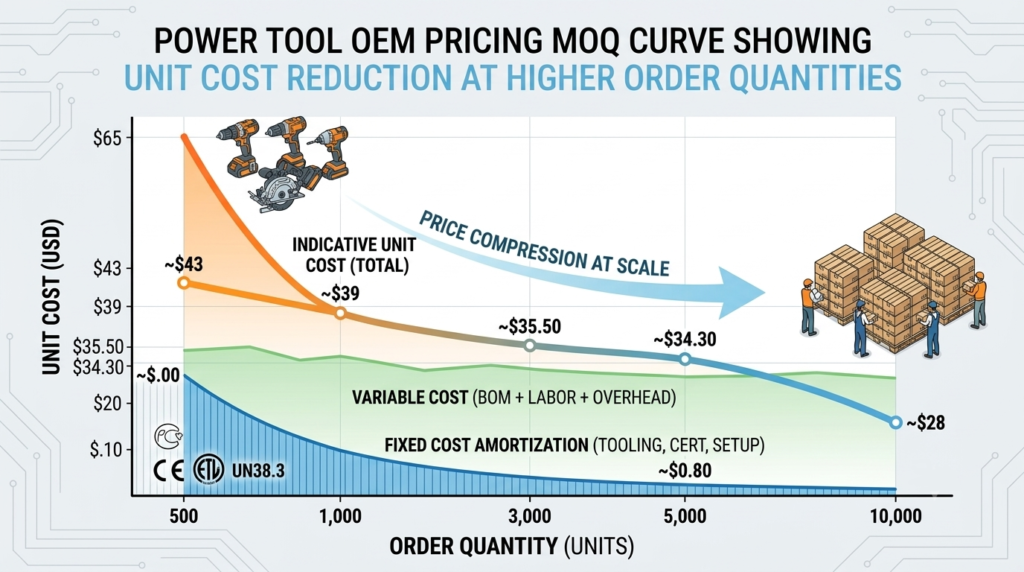
A factory’s fixed costs — tooling amortization, certification, the cost of setting up your order, the engineering work to qualify your product — are all divided across the number of units in your order. The more units you order, the lower the per-unit contribution of fixed costs.
Here’s a simplified illustration for a 20V brushless drill:
| Order Quantity | Fixed Cost Contribution | Variable Cost | Total Indicative Unit Cost |
|---|---|---|---|
| 500 units | ~$8.00 | ~$35.00 | ~$43.00 |
| 1,000 units | ~$4.00 | ~$35.00 | ~$39.00 |
| 3,000 units | ~$1.50 | ~$34.00 | ~$35.50 |
| 5,000 units | ~$0.80 | ~$33.50 | ~$34.30 |
The numbers here are illustrative, not a formal quote. But the shape of the curve is real. Variable costs compress slightly at scale because the factory can negotiate better component pricing, runs longer production batches with less setup waste, and reduces QC cost per unit as the line becomes more familiar with your product.
The practical takeaway: the price difference between your first order and a repeat order at five times the volume is real and significant. Plan for it in your unit economics model from the start.
The Hidden Costs That Never Appear in the Quote
After 15 years of working with buyers across Europe, Australia, and North America, the costs that most often surprise them aren’t in the unit price. They’re in the gaps.
Sample and prototype costs. Reputable factories charge for engineering samples. If someone offers you “free samples,” those costs are embedded in the production price — or the samples are pulled from existing stock that may not represent what your production run will look like.
Engineering change orders. Once tooling is cut, changes cost money. A minor adjustment to a plastic housing could mean re-machining or replacement of a core insert. Define your specifications thoroughly before tooling is approved.
Packaging development. Custom retail packaging — a printed box, a thermoformed insert, a multilingual manual — can easily add $1.50–$4.00 per unit once all elements are costed. Some factories include basic packaging in their quote. Some quote for the bare tool with no packaging. Make sure you’re comparing apples to apples.
Pre-shipment inspection (PSI). A third-party pre-shipment inspection (SGS, Bureau Veritas, Intertek) costs $250–400 per inspection day. It’s not in the factory’s quote. It’s in your sourcing budget. It’s also not optional if you’re selling into regulated markets with returns consequences.
Freight and duties. FOB factory price is not your landed cost. At current container rates and typical import duties (e.g., AU 5% for most power tools, EU 1.7% for most power tools, US up to 25% on Chinese-origin power tools under Section 301), the delta from FOB to landed can easily be 20–35% of the FOB unit price.
How to Read a Quote Like a Factory Person
When you receive an OEM quote, here are the questions to ask before you compare prices:
1. What cells are in the battery pack?
Ask for the cell manufacturer and model number. If they can’t answer immediately, that’s a red flag.
2. Is this brushed or brushless?
If it’s brushless, what controller? FOC or trapezoidal?
3. What heat treatment is applied to the gears?
Acceptable answers: gas carburizing, vacuum carburizing, induction hardening + spec. Unacceptable: “heat treated” with no further detail.
4. What certifications are included, and can you provide the test reports?
Certificates only, no test reports = investigate further.
5. Does this price include tooling, or are you using shared molds?
Neither answer is wrong — you just need to know which one it is.
6. What is the MOQ, and how does the price change at 2x and 5x MOQ?
If the price curve is flat, that tells you the factory doesn’t have much fixed-cost amortization at play — which means the shared-mold, off-the-shelf product you’re probably looking at has limited differentiation.
7. What packaging is included in this price?
Brown box? Retail color box? Labels only? Specify before you sign.
Why Two Quotes for the “Same” Product Can Differ by 40%
This happens constantly. A buyer sends the same brief to three factories and gets quotes ranging from $28 to $45 for what they believe is the same 20V brushless drill.
In every case I’ve seen, the explanation is in the components — specifically, the battery and motor.
The $28 drill is almost certainly using B-grade domestic cells and a budget motor assembly. The $45 drill is probably using A-grade cells, a properly specified brushless motor, and real certification documentation.
Both might have identical voltage and amp-hour ratings on the spec sheet. The difference only shows up in real-world performance, warranty return rates, and what happens when you try to sell into a regulated market with proper compliance documentation.
The cheaper product isn’t a better deal. It’s a different product with a lower price.
What We Actually Charge — and Why
I won’t give you a line-item BOM for our products in this article — that’s not useful without knowing exactly what product you’re building.
What I will tell you is that at Bocon, our pricing reflects the full cost of:
- A-grade battery cells with pack-level BMS firmware we develop in-house
- Vacuum carburized gear components with documented heat treatment records
- ISO 9001-compliant production with four-stage quality inspection
- 100% brushless motor production across our cordless drill, impact driver, impact wrench, and angle grinder lines
- CE, RoHS, ETL, SAA, and UN38.3 certifications with actual test reports available
That’s why our prices aren’t the lowest you’ll find. They’re also not artificially high — we’ve structured our cost base to support high-volume international orders efficiently.
If you want to understand how our pricing compares to alternatives on a spec-for-spec basis, we’re happy to walk through a cost breakdown together. That kind of transparency is how we’d want to be evaluated — and it’s how we evaluate our own suppliers.
Reach out at www.oemcordlesstools.com
One Response
The analysis is particularly relevant when researching market trends.
TraderZO AI